
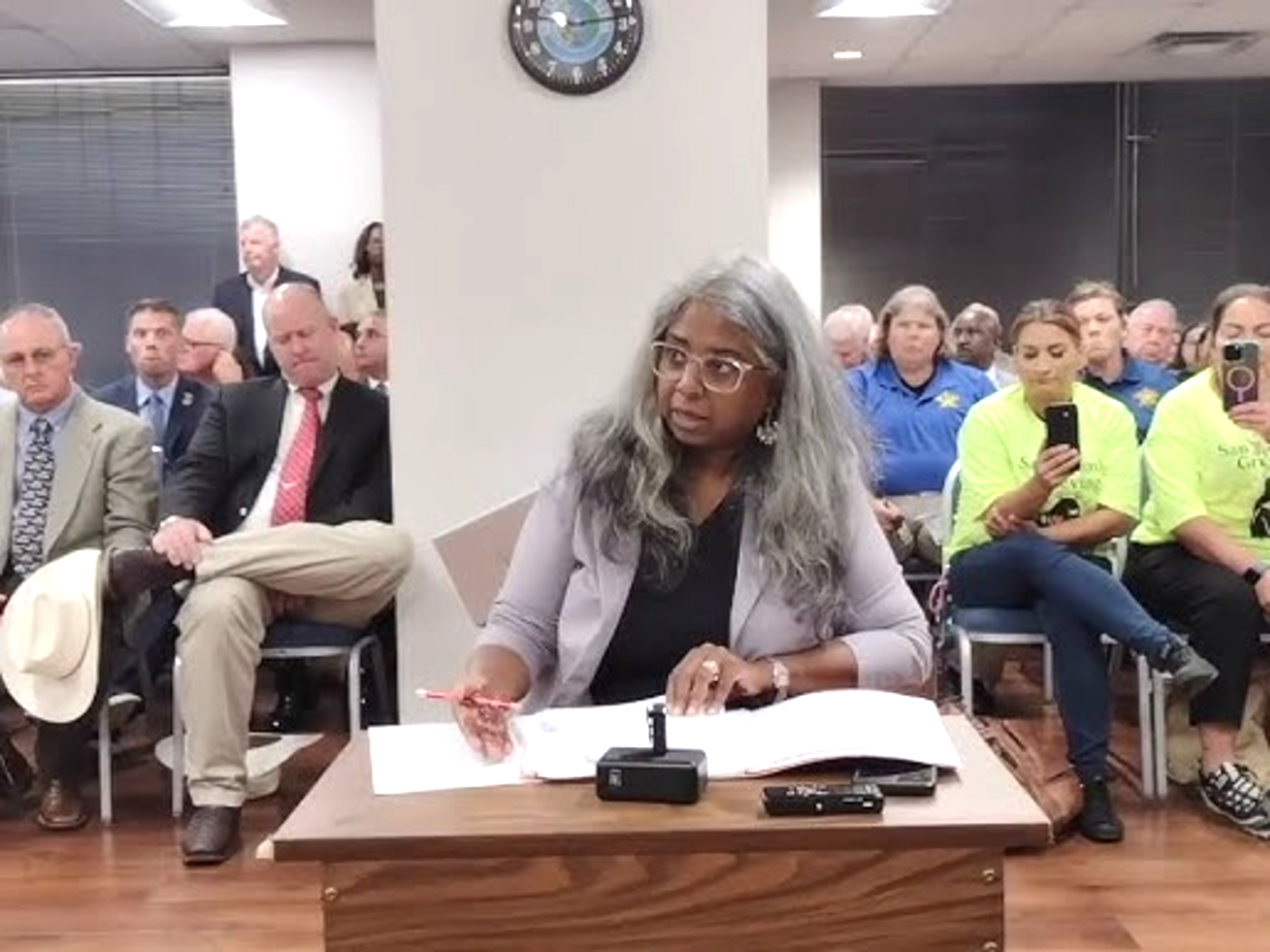
Krish Gundu looks at a March 12 email declaring that — after more than a year of failed inspections from the State Commission on Jail Standards — the Harris County lockup finally got a stamp of approval.
“It means nothing,” says Gundu, executive director of the Texas Jail Project, a Houston-based nonprofit that advocates for the incarcerated and their families. “It means they fixed a fire alarm. There were several issues with timely medical care and getting people to medical appointments. We still get complaints. We’ll have to wait and see how long that compliance lasts. Passing inspection is meaningless to families.”
Gundu has consoled many grieving family members whose loved ones died in Harris County custody because of what she claims were assaults by staff or other inmates, medical neglect and untreated mental health crises.
Twenty in-custody deaths were reported by the jail last year, including one homicide. So far in 2026, two deaths have occurred. The cause of death in both 2026 cases is pending autopsy. Both men, ages 55 and 56, were sent to hospitals with medical emergencies. That could mean anything from a drug overdose to a pre-existing condition to being beaten up by another prisoner.
Wrongful death lawsuits continue to pile up, and taxpayers are footing the bills. Gundu says that, if a smaller facility had so many problems, it would be shuttered, but because Harris County serves an average of more than 8,000 inmates at any given time and already outsources inmates to Louisiana, it’s impossible to close the jail.
And don’t ask Gundu if Harris County should just build another jail. She’s likely to raise her voice when she says a resounding, “Absolutely not.”
A series of failed inspections dates back to 2022, citing staff shortages, missed medical appointments, delayed ER visits and faulty fire alarms. Sheriff’s department personnel say all those issues have been addressed, so does that mean there’s hope for fewer inmate deaths this year?
Not necessarily, Gundu says, because a jail inspection doesn’t account for use of force and inmate-on-inmate assaults.
However, Harris County officials maintain that the jail is “consistently among the safest in Texas and the United States.”
Texas jails have to meet 26 standards that include health services, supervision, commissary, and the admission and release process to be compliant with the state regulatory authority. To come into compliance, Harris County offered pay raises for officers to help with recruiting and retention, dedicated staff to ensure no one misses a medical appointment, and enhanced security screening for everyone entering the jail to prevent drugs and other contraband from coming in.
Harris County District Attorney Sean Teare announced last week that his office has eliminated a felony case backlog that had built up over a period of years since Hurricane Harvey and spiked during the COVID-19 pandemic. Although the county just renewed a $38 million contract with the LaSalle, Louisiana, Corrections Department to outsource prisoners, Teare says a significant reduction in overcrowding means they could terminate the contract within the next year.
Harris County Sheriff’s Office Senior Policy and Communications Officer Jason Spencer told the Houston Press that the facility faces challenges because it’s a large urban jail with a population “that is disproportionately likely to experience homelessness, addiction and mental illness.”
When the jail passed inspection earlier this month, Sheriff Ed Gonzalez said in a press release that maintaining a safe and secure jail environment under challenging circumstances requires constant vigilance.
“The Harris County Sheriff’s Office is committed to operating a jail that reflects our community’s belief that every defendant deserves to feel safe while they await their day in court,” Gonzalez said.
Lawsuits and Indictments
The news of the favorable jail inspection on March 12 couldn’t have come at a better time for Harris County. During the last week of February, three things happened that put a spotlight on what many believe to be unsafe conditions at the jail.
The family of a man who died in custody filed a lawsuit claiming officers caused the prisoner’s death. A teenager’s family was awarded $1.25 million because their loved one was beaten to death by his cellmate. Additionally, three detention officers were indicted for assaulting an inmate in March 2024.
National Police Accountability Project and Houston attorney L. Lee Thweatt filed a federal civil rights lawsuit on February 26 on behalf of the family of Alexis Jovany Cardenas, a 32-year-old husband and father of four who died after being restrained by officers while he was being released from jail. The Harris County medical examiner ruled the death a homicide.
Spencer declined to comment on active litigation but pointed out that the definition of homicide is different from murder. Homicide occurs when death results from an injury or poisoning from “a volitional act committed by another person to cause fear, harm, or death. Intent to cause death is not required for classification as homicide,” according to the definition.
“Homicide is when a person is killed by one or more persons,” Spencer says. “Murder is the unlawful taking of a human life by another, especially with premeditated malice. For example, if a police officer kills someone in the line of duty, it is considered a homicide, but not necessarily a murder. All murders are homicides, but not all homicides are murders.”
Regardless of how it’s classified, Cardenas’ family believes their loved one should have never been in the situation that resulted in his death.
Cardenas was arrested in July 2025 on a decade-old municipal warrant for unpaid traffic tickets. His family claims in the lawsuit that officers attempted to release him after midnight on July 8, but he resisted because he was experiencing a mental health crisis and didn’t have a working cell phone or a plan for getting home safely. Video footage released by the sheriff’s department shows several officers restraining Cardenas, and one attempting to deploy a taser.
Thweatt alleged in a press release that the Harris County Jail has a “long, documented history of beating inmates to death or until they are seriously injured, a culture of violence so pervasive and notorious that it prompted two separate federal investigations — one in 2008 by the U.S. Department of Justice and one in 2023 by the Federal Bureau of Investigation.”
Six officers and one sergeant involved in the Cardenas incident were reassigned to “duties that do not entail contact with inmates,” pending an investigation by the Texas Rangers. Spencer said last week that the results of the investigation have not been presented to the sheriff’s disciplinary committee.
“Typically, our process is to defer to the criminal investigation and for the district attorney’s office to present any criminal evidence to a grand jury to determine whether an indictment is warranted,” he said.
Such investigations can take years. Civil rights attorney Ben Crump sued Harris County in 2024 over the deaths of eight inmates, claiming that the prisoners were deprived of their constitutional rights and mistreated while being detained. “The lawsuit also details Harris County’s persistent culture of maltreatment and lack of concern for the lives of the detainees awaiting pre-trial, which ultimately led to the alleged constitutional violations,” Crump said at the time. Those cases have not yet been settled or gone to trial.
In late February, county officials announced that a family was awarded $1.25 million in the settlement of a civil rights lawsuit over the death of 19-year-old, 98-pound Fred Harris. The teen’s mother alleged that her child, who had special needs, was beaten to death by another inmate, Michael Ownby, who repeatedly slammed Harris’ head against a concrete floor and stabbed him with a makeshift weapon, according to court documents. Ownby pleaded guilty to the murder in 2023 and was sentenced to 50 years in prison.
According to the settlement agreement, Harris’ mother is prohibited from making any future claims or causes of action against the county related to the incident and the county took no responsibility for the death, saying in court filings that Ownby was solely responsible. Harris’ mother claimed her child wore a wristband designating that he was not to be housed with potentially violent inmates and he was supposed to have “escorts and protections by jail staff” because of his disability.
Spencer wouldn’t comment on the settlement agreements. In a separate conversation, he noted that all jails have incidents where inmates assault each other. “The overwhelming majority of the people who are in our jail are charged with a violent crime and they’re in tight quarters. Fights happen.”
Harris County paid $2.5 million in 2019 to the family of Kenneth Lucas, a prisoner who suffocated while in custody after he was hog-tied, sedated and left on a gurney by jail personnel, according to court records. Several other suits have been filed and settled in recent years but the amounts awarded to the plaintiffs are often undisclosed.
Gundu says lawsuits don’t accomplish anything in terms of reforming the jail culture.
“Even though people file lawsuits saying they want change and they don’t want their loved one to die in vain, part of the settlement is that they walk away with the money and the county admits to no wrongdoing,” she says. “Nothing changes.”
Hardly any information was released about the March 2024 incident that led to three detention officers being indicted last month on misdemeanor charges of “use of force.” Spencer would only confirm that Isaac Hernandez, 31, Isaac Serrato, 24, and Kevin Parker Jr., 27, were charged with assault of an inmate and were relieved of duty.
Changes at Harris County Jail
Harris County leaders — including District Attorney Teare — dispute the assertion that nothing has changed in recent years. During a March 17 press conference about the criminal case backlog, Teare acknowledged that Harris County was once among the most dangerous jails in the country.
That can be directly attributed to overcrowding caused by the backlog, he said. “The average length of stay in that jail was so high that people could not get out,” he said. “The victims and the survivors and their families were waiting years and years for justice. It wasn’t just the victims and survivors; it was the accused as well. Having them be able to have their day in court in a meaningful time matters.”
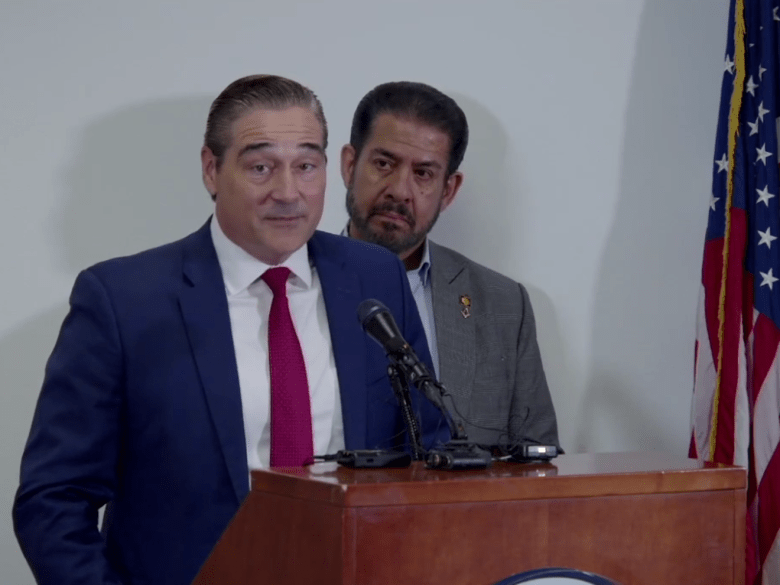 District Attorney Sean Teare and Harris County Commissioner Adrian Garcia talk to reporters at a March 17 press conference. Credit: Screenshot
In 2021, there were 52,000 cases pending in Harris County courts. Today, there are about 21,000, or a reduction of about 70 percent, accounting for more courtrooms added over the years, Teare said. The DA attributes the backlog reduction to a $7.5 million investment from Harris County last year that allowed him to hire more prosecutors and support staff.
Harris County Commissioner Adrian Garcia, a former sheriff, said at Teare’s press conference, “To all those who have been asking us to deal with system breakdowns and slowdowns, we heard you, and we have let our actions speak for themselves.”
Spencer says the county’s need for outsourcing inmates to other jails has primarily been driven by the backlog. “If current trends in the county’s court system continue, it is possible that Harris County could eliminate the need for outsourcing within the next year,” he says.
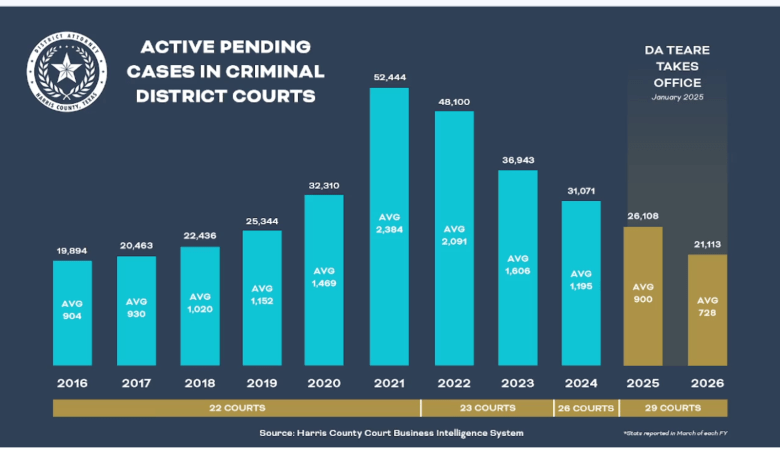 Harris County District Attorney Sean Teare announced last week that the 7 court backlog has decreased by 70 percent since its peak in 2021. Credit: Harris County District Attorney’s Office
Harris County is facing at least three lawsuits from local families whose loved ones died in the LaSalle Correction Center after being outsourced there. The family of 29-year-old Erik Carlson alleges that he died in January 2025 after being transferred from Harris County to Louisiana, where he received no medical treatment for an infection that developed while he had strep throat. Carlson’s family and others showed up at Harris County Commissioners Court last week to oppose the outsourcing contract with LaSalle.
Gundu says the $38 million that the county spent last week on the LaSalle contract could be redirected toward mental health services. “We keep calling for reducing the jail population. That would reduce the jail population,” she says.
Harris County recently approved 131 detention officer positions so it could meet the state-mandated ratio of one officer per 48 inmates. Twelve percent salary increases approved in 2024 have helped with recruiting and retention, Spencer says. A corrections officer makes about $46,550 per year before overtime. About 2,000 detention officers are currently employed in Harris County.
Advocates and family members of the incarcerated often speak about the missed medical appointments that caused failed inspections in the past, but Spencer says the final item that prompted the passed inspection was a fire alarm panel in need of repairs.
“We’ve addressed the issue of getting people to their appointments expeditiously,” Spencer says. “The jail commission agreed that we fixed that problem. Part of that approach was that we’ve created a team of detention officers whose sole responsibility is to escort people to and from medical appointments. That used to be one of many responsibilities that was shared by many detention officers.”
Teare referred to the passed jail inspection as a monumental success. “The Harris County Jail has been a very dangerous place because of overcrowding and because, quite frankly, the sheriff’s department just could not keep up,” he said.
But Gundu says systemic change is needed to prevent deaths. “The jail commission is very limited in its authority,” she says. “They can’t make sure that training is being provided and policies are being followed.”
She references the case of a schizophrenic inmate who starved to death and another who was in restraints in a padded cell and still managed to cause his own death by beating his head against a metal grate in the cement floor.
“Has any policy changed because of that?” Gundu asked. “Has the sheriff said, we should have an ‘unfit for confinement’ policy for someone who has a history of not being able to care for himself? People just fall through the cracks. Well, they’re pushed into the cracks. This is by design, so nobody has to take accountability.”
As of last Friday, 8,296 inmates were housed in the Harris County Jail, with more than 1,000 outsourced to Louisiana, according to a public dashboard. About 77 percent had a mental health indicator, which could mean alcoholism or drug addiction, a history of mental health problems or experiences of serious psychological distress in the 30 days prior to intake.
Gundu says to permanently reduce the jail population, Harris County has to offer a continuum of care for those experiencing mental illness before they get to jail, while they’re incarcerated and after they’re released.
The Sheriff’s Office contracts with Harris Health for primary care and hospital and clinic services. The Harris Center for Mental Health and Intellectual and Developmental Disabilities focuses on behavioral and mental health. Current and former inmates offer varying accounts of the intake process and how medication is dispersed. A Harris Health spokesperson told The Press that people with a history of mental illness, whether by documented charts, self-reporting or custodial observation, are referred to the Harris Center. Harris Center officials did not respond to requests for comment.
Teare has championed mental health and addiction diversion programs to decrease recidivism. He said last week that work is ongoing. “The best way to do this is to get people out of the system entirely,” he said.
Gundu says, regardless of what’s going on behind the scenes, it appears that medical care is unregulated at the Harris County Jail. She plans to testify next month before the Texas Sunset Advisory Commission, a state regulatory authority, on Harris County’s health and human services.
“People keep saying that we need to build a humane jail, and I keep saying, the building is not killing people,” Gundu says.
Related