
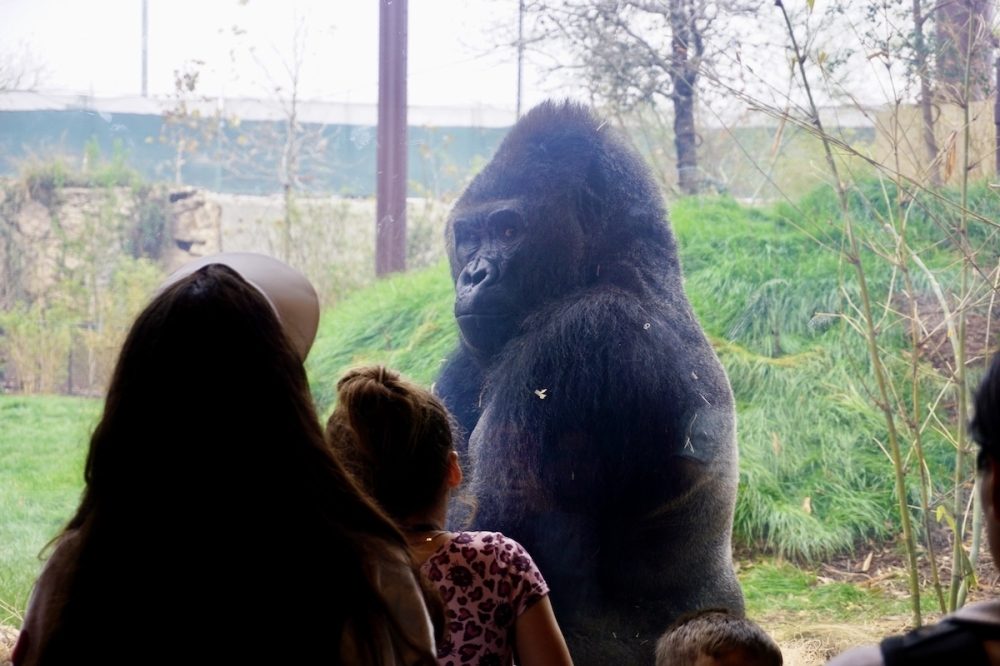
On Dec. 13, the San Antonio Zoo opened Congo Falls, marking the return of gorillas to the city after over 35 years.
Hope Roth, vice president of marketing, sales and communication at the San Antonio Zoo, said the zoo partnered with experts in the field, staff from other zoos, and the Association of Zoos and Aquariums, or AZA, to craft the 2-acre exhibit.
“Congo Falls doesn’t just bring gorillas back to San Antonio—it raises the global standard for how gorillas are cared for, challenged and seen,” Roth said.
Craig Hoover, executive vice president of AZA, said the habitat incorporated the best science available on designing complex environments.
“[Congo Falls] represents the best of what we know about gorilla habitat design, and its innovation will be studied for years to come,” Hoover said.
Home to two troops, with seven western lowland gorillas in total, the exhibit includes three distinct habitats—the lowland basin, the gorilla gorge and the indoor rainforest. Unique features of the exhibit include the 30-foot-tall Will Smith Foundation Infinity Falls and the world’s largest gorilla tower, Silverback Peak, which is 70 feet tall and offers the gorillas a panoramic view of the city.
San Antonio resident Irma Aguilera visited the Congo Falls exhibit with her daughter shortly after it opened and described it as a paradise.
“You feel so good knowing a lot of money went into getting them close to their natural habitat,” Aguilera said.
The conditions
Lauren Inderbitzin, the director of animal well-being at the San Antonio Zoo, said the exhibit has multiple features. These include over 260 plants and trees planted throughout the three habitats, and built-in medical and enrichment spaces that allow the gorillas a truly interactive environment.
“The 2-acre habitat is ginormous for a gorilla habitat,” Inderbitzin said. “And I think really the special attention to the details in it has been groundbreaking in the form of [a] gorilla habitat.”
Congo Falls also incorporates edible plants and browse feeders, which mimic their natural environment, such as a termite mound filled with jellies, honeys and peanut butter. Staff members also regularly scatter food and introduce activities, including fire-hoses stuffed with treats and toys.
“We had a lot more plants in here when we started this, and they ate them. … We’ll replant them because we want the [process] to continuously happen,” Inderbitzin said.
A closer look
Andrea Pearson, gorilla manager at the San Antonio Zoo, said the gorillas are divided into a bachelor troop with three silverback gorillas named B’wenzi, Juba and Shana; and a family troop led by 25-year-old silverback Ajari.
She explained how both troops are modeled after natural behaviors, and that Ajari was scientifically selected for the family troop, using the species survival plan, or SSP, which pairs candidates for mating across AZA member institutions.
“[Ajari] was chosen because genetically and behaviorally he would do well with females,” Pearson said.
Pearson noted that the three bachelors had lived together for approximately nine years at the Dallas Zoo before moving to Congo Falls. She said they will most likely remain together for the rest of their lives.
The local impact
Roth said the new exhibit is already paying dividends for San Antonio by drawing new visitors with its long‑awaited return of gorillas and creating a dramatic new venue, The Ralston, which overlooks Congo Falls and the downtown skyline.
“We couldn’t be happier with the success and the overwhelming feedback from the guests,” Roth said.
Looking ahead
Though Congo Falls is a large habitat, the design has accounted for future expansion, including the addition of new gorillas.
Hoover said the AZA will provide guidance to the zoo through its Gorilla SSP management group and its Gorilla Behavior Advisory Group, which consists of 15 gorilla experts.
“[The AZA will] support gorillas and care staff as they adjust [to the] new space, and will be reviewing outcomes of any introduction and/or reproduction recommendations,” Hoover said.
“>