

As more companies expand or relocate to North Texas, local workers are being asked to keep up with fast-changing job requirements.
Workforce agencies sit at the crossroads of employers, educators and job seekers, and they are rolling out new tools to help residents find child care, training and clearer paths into better-paying, rapidly-growing careers.
Phedra Redifer, executive director of Workforce Solutions for North Central Texas, recently sketched out how her agency plans to use its position to expand opportunities across the region. It was a local answer to the big statewide questions economist Pia Orrenius with the Federal Reserve Bank of Dallas raised about who will share in Texas’ growth.
Related

“Our region stretches from Collin to Denton County, Erath, Somervell and Palo Pinto and so many other urban, suburban and rural communities that do not necessarily share the same challenges, but they do share one economy and one talent market,” Redifer said.
Business Briefing
Workforce Solutions agencies rely on a mix of private and government funding to provide residents with free skills training, career counseling, help with resumes and interview prep, and direct connections to employers. The agencies also guide people to child care and transportation support, adult education, disability services, veteran resources and help buying work-related clothing and tools.
Here are five ways North Texans can benefit from workforce agencies.
Child care assistance
Carla Wright (center) helps her students work through a sticker worksheet at Journeys Child Development Center in Grand Prairie, Texas, on Tuesday, Jan. 28, 2025.
Liz Rymarev / Staff Photographer
Redifer called child care “one of the clearest examples” of her board’s strategy, as she stressed the importance of helping parents work by strengthening child care support.
Across North Texas, she said more than 27,000 early childhood educators are working each day, and many more are needed. Licensed programs often have room to serve more children but cannot find enough qualified staff or pay competitive wages.
For families, that means long waitlists or no nearby options. Workforce Solutions responded by investing in scholarships and wage support for child care workers, professional development, quality coaching and partnerships with higher education to grow the early childhood workforce and raise standards.
Redifer described this as a “two generation strategy” that helps parents stay in the workforce today while giving their children a stronger start.
Career pathways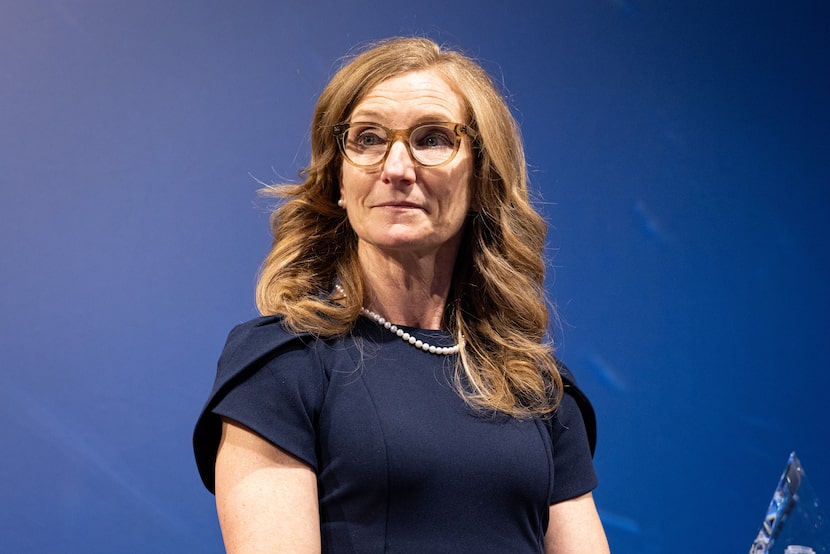
Phedra Redifer, Workforce Solutions for North Central Texas executive director, gives out awards during a Workforce Development Awards luncheon on Wednesday, March 4, 2026, in Hurst.
Angela Piazza / Staff Photographer
For students, job seekers and mid-career workers, Workforce Solutions is trying to make it easier for residents to see what it takes to move up the economic ladder.
Redifer said her agency’s strategic plan calls for deeper and clearer routes into good jobs for adult learners, young and mid-career workers who need to reskill or upskill.
“It shows up in new tools like data dashboards and career lattice resources that give job seekers and students clear visual maps of how careers progress and what education, certification and experience is required at each step,” she said.
Those tools are meant to translate labor market information into actions for people who need it most.
Industry and education partnerships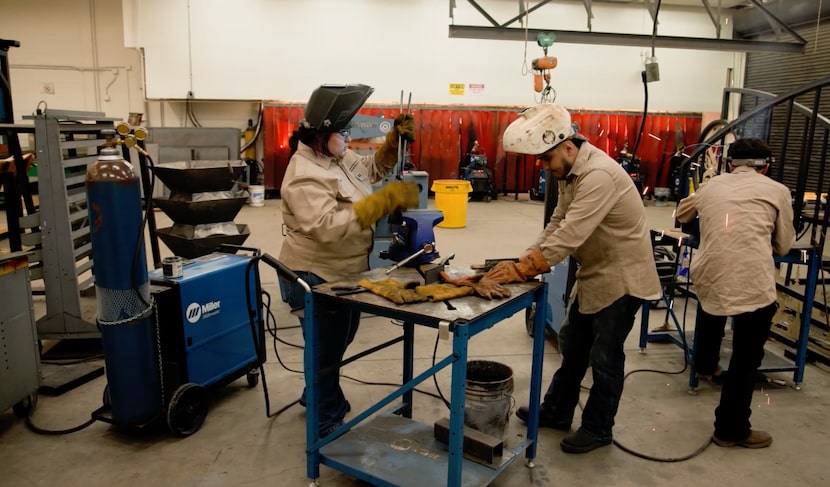
Many Dallas ISD schools offer Career and Technical Education programs in welding and other fields, where students earn industry certifications that can help reduce the cost of higher education.
Courtesy Dallas ISD
Embedding industry and education partnerships into program design can help job seekers better see and access internships, apprenticeships and short-term training options. Workforce Solutions has leaned into partnerships in sectors such as infrastructure and construction and health care, Redifer said.
“We are now sitting at the table with employers, [regional] chambers, economic developers, universities and community colleges to co-design, whether that is an apprenticeship model, an aligned curriculum or a rapid response to an employer’s major expansion or layoff,” she said.
The goal is to make it easier for employers to find skilled workers and for residents to access those opportunities.
Data-driven decision making
Making decisions guided by data and shaped by employers can help ensure the programs job seekers enroll in lead to real openings and long-term careers.
Looking ahead, Redifer said the next chapter for her organization will be defined in part by “data informed, business-driven decision making.”
That means aligning services and investments with real-time labor market information and direct input from employers across North Texas. It also means using data to evaluate which programs are most effective at moving people into sustainable careers.
Regional partnerships
Claris Ngoma, center, and husband Allen Ngoma, center right, check out the Carter BloodCare booth during the 7th Annual ‘You’re Hired Job Fest” hosted by Dallas County Judge Clay Lewis Jenkins, in partnership with Workforce Solutions Greater Dallas, at Gilley’s Dallas in Dallas on Thursday, Sept. 5, 2024. Almost 80 employers signed up for the event with almost 4,000 jobs available.
Juan Figueroa / Staff Photographer
Stronger regional collaboration can give job seekers more options beyond their own ZIP code, so where they live does not limit the schools, training programs or employers they can connect with.
Redifer said Workforce Solutions will keep focusing on populations facing the steepest barriers, including young people, individuals with disabilities, veterans and people balancing work and caregiving.
She also highlighted the need for “deeper regional collaboration” that links education, workforce and economic development across North Texas so companies see “a unified system and a metropolitan area ready to help them grow.”
“The choices we make here in North Central Texas ripple far beyond our 14 counties,” she said, urging employers, economic development organizations and elected officials to include workforce leaders at the table as they plan for the region’s future.
Job seekers and working parents who want to tap those efforts can start by visiting the Workforce Solutions website or neighborhood offices to learn about child care assistance, training programs, career coaching and upcoming hiring events.
This reporting is part of the Future of North Texas, a community-funded journalism initiative supported by the Commit Partnership, Communities Foundation of Texas, The Dallas Foundation, the Dallas Mavericks, the Dallas Regional Chamber, Deedie Rose, Lisa and Charles Siegel, the McCune-Losinger Family Fund, The Meadows Foundation, the Perot Foundation, the United Way of Metropolitan Dallas and the University of Texas at Dallas. The News retains full editorial control of this coverage.
Republicans are remaking Texas’ public universities. Some professors are leaving1 in 5 eligible taxpayers miss a major refund. Here’s how to get your money