
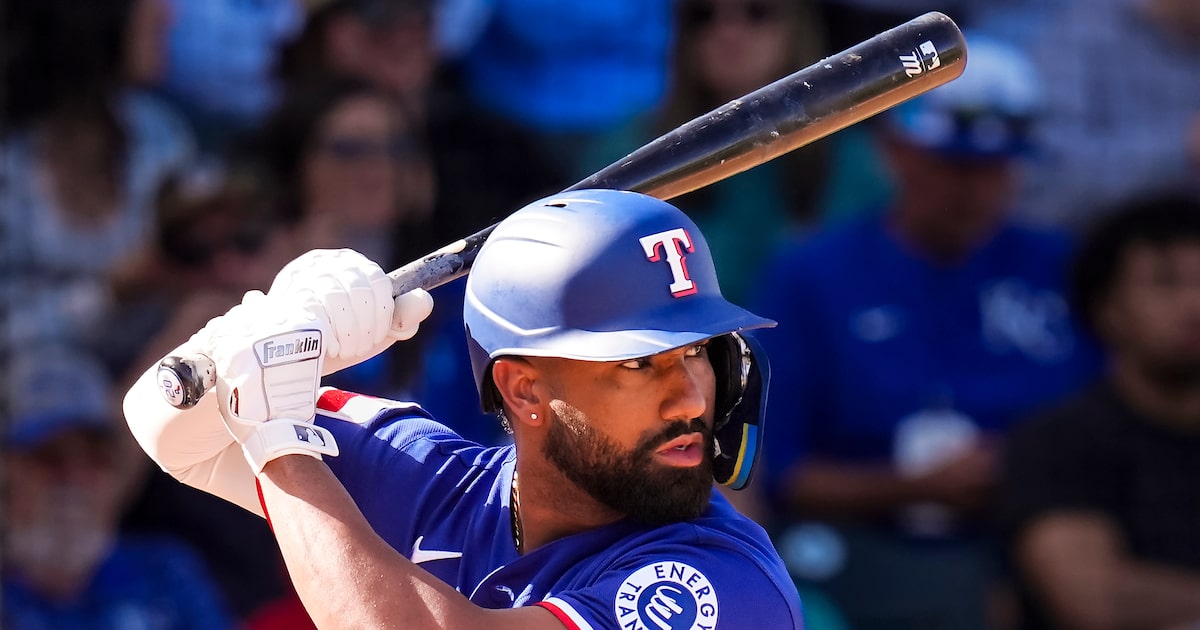
SURPRISE, Ariz. — The Texas Rangers broke camp this weekend relatively healthy. They believe they took positive steps toward a cohesive clubhouse culture. They think the offense is in a better place now than it was a year ago. They have a handful of attractive options for the last few roster spots available to be claimed.
They feel good.
Now all they’ve got to do is carry it into the meaningful games.
Here’s what we learned in the final week of camp.
Rangers
From on the bubble to in the mix: No single hitter might’ve raised their stock more in the second half of camp than utility infielder Ezequiel Duran. Take Skip Schumaker’s praise for proof.
“[There have been] a lot of encouraging signs,” Schumaker said Friday night. “He’s almost forcing himself not only on the team — that’s pretty evident — but as far as, like, how much can you get him in the lineup? It’s really fun to watch.”
Duran slashed .302/.412/.605 in 16 exhibitions thanks to a ferocious finish. He hit three home runs in his last seven Cactus League games — the first of which broke an 18-month drought in which he hadn’t homered in a Rangers uniform — and posted a manageable 7-to-10 walk-to-strikeout ratio. His 93.7 mph average exit velocity was up eight miles per hour from last season and more in line with the quality of contact that he made three years ago when he starred as shortstop Corey Seager’s temporary substitute.
“He is hitting it with authority to the pull side,” Schumaker said. “He’s also taking his walks. It reminds me of a couple of years ago, quite honestly, the way he’s playing. The defense has been excellent lately.”
The 26-year-old might’ve been a tougher squeeze if he didn’t show meaningful offensive improvement with a host of productive veterans also in contention for roster spots, but in a camp that’s prioritized process and growth, he’s epitomized it.
Voracious velocity: Right-hander Kumar Rocker’s first pitch of his last Cactus League start was a 98.5 mph fastball. It was the first of six pitches he threw in four innings that cleared the 98 mph threshold.
Rocker averaged a spring-high 97.1 mph with his fastball. That was a mile-and-a-half per hour faster than his average last season. The six fastballs he threw at 98 mph or greater matched more than half of the total (11) that he threw all of last year. The 26-year-old called it part of the normal spring “progression,” but even last spring, he only touched 98 mph once.
“[Pitching coach Jordan] Tiegs is really good at identifying some things,” Schumaker said. “He’s been working on it the last couple of outings and in side sessions. It’s been showing up. He feels good about where he’s at and, again, the consistency the last two games has been there, and that’s been what’s most attractive to us.”
Rocker, in contention for the fifth starter job, acknowledged that he feels comfortable if his fastball runs “only” in the mid 90s. There may be validity to that. Last season, on fastballs thrown 96 mph or slower, he averaged a 72% strike percentage. On fastballs thrown 96 mph or harder, it dropped to 70%. The difference in velocity may ultimately be moot if he develops a consistent changeup and continues to throw what Schumaker called “as good as there is in the game.”
About the designated hitter: The Rangers believe they made legitimate strides in the establishment of an offensive foundation through camp. The numbers on the whole support that.
At almost every position.
Designated hitter Joc Pederson went 6 for 35 with 12 strikeouts in 15 exhibitions. It followed a debut season with the Rangers in which he posted a career low .181 batting average and a career low .613 OPS in 96 injury-shortened games.
“It’s spring still, but towards the end, you want to see it come together and click so you can also feel good going into the regular season,” Schumaker said when asked about what he’s seen from Pederson in camp. “Early into camp, it doesn’t really mean much. You’re trying to get your at-bats in, trying to get your legs underneath you, and 1774269142 I think you really want to feel good going into the season.”
Then he shifted gears.
“I think the little frustrating part — I know what the results and numbers say — is how good the work has been,” Schumaker said. “It just hasn’t translated yet. That might’ve not been the case last year in spring training even though there was better numbers in spring training. It’s kind of weird how it’s all shaking out, but I still believe in the work right now, and that it’s going to translate.”
There are some metrics — like a 94 mph average exit velocity — that suggest he’s hit the ball a tad better than the statistics suggest. There’s some historical context — like a career incongruency between good spring trainings and good regular seasons — that may need to be considered.
It’ll all just need to translate.
Find more Rangers coverage from The Dallas Morning News here.