
It’s no exaggeration to say the 2016 Oscar-winning movie, Moonlight, is a masterpiece examination of modern male queerness and back culture. But it’s also more than that. Even with such a specific gaze, it’s a movie that manages to tap into universal concerns of identity, secrets and the vulnerability of self we all attempt to navigate.
That Moonlight was based on playwright Tarell Alvin McCraney’s semi-autobiographical drama-school script, In Moonlight Black Boys Look Blue (adapted for the screen by Barry Jenkins), tells you something about McCraney’s ability to make the personal widely moving.
So, it’s natural to think that his play, Choir Boy, now on stage at The Ensemble Theatre, might grab us in the same way. After all, it too concerns a young gay black man trying to find his way in a mostly hostile straight environment -this time a private Black boarding school for boys.
Unfortunately, Choir Boy doesn’t hit the same highs; instead, the play offers little more than a bare character study and a plot that suffers equally from the obvious and the unbelievable.
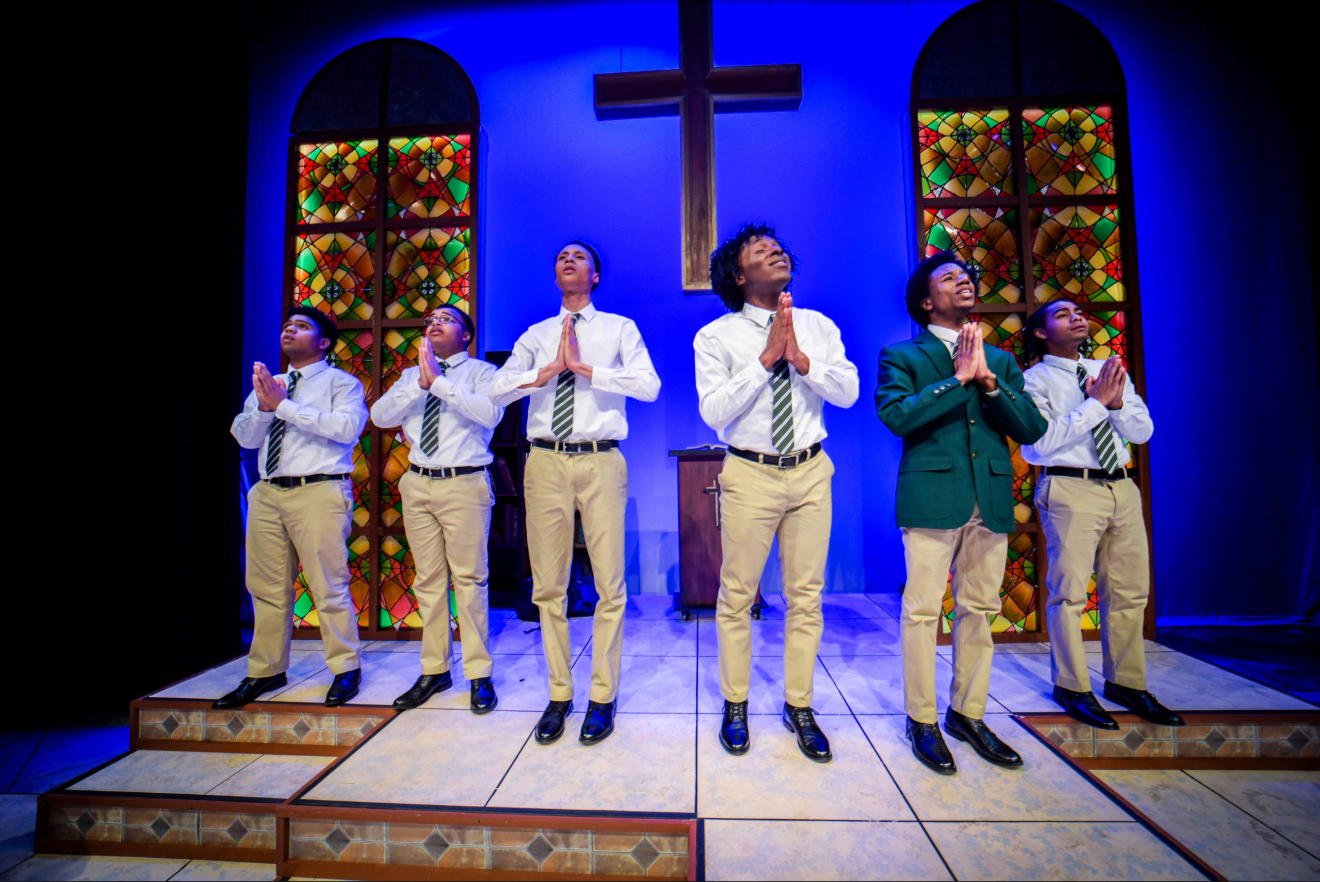
The play tells the story of Pharus Young (Shaq Hester), about to be a senior at Charles R. Drew School for Boys. Full of swagger and the gift of oration, Pharus is also a talented singer for the esteemed chorus – not only the pride of the school, but an important means of academic fundraising. Pharus is also unabashedly effete and flamboyant. A point of contention for the other boys, especially Bobby (Kaleb Womack), who whispers anti-gay slurs at Pharus during his solo at commencement, causing Pharus to wobble his performance, shaming himself and his school.
This sets the play and the year-long feud between the boys in motion. School Headmaster Marrow (Corey Shields) tries to help Pharus fit in by advising him to tone down his personality. Pharus refuses and instead exacts revenge by kicking Bobby out of the choir and assuming the leadership of the group for himself.
The other boys fill cookie-cutter roles. No question, all the show’s young actors are excellent singers as their many short musical numbers (smartly choreographed by Hindolo Bongay) illustrate. But outside of the music, they’re treading shallow waters.
There’s Bobby’s mostly spineless friend Junior (Samuel Jones), David (Jakori Jackson), a quiet boy with dreams of becoming a minister and Anthony (Elia Adams), a star athlete and Pharus’s bunkmate and only friend.
McCraney tries to give each boy an angsty backstory or some sliver of dimension, but the meat falls off the bone. Bobby is just the bully. Junior his weak accomplice. David’s piety covers up a secret we see coming, and Anthony’s unconditional, almost saintly support of Pharus is just too good to be believed.
The adult characters are just as thin. Headmaster Marrow makes announcements but does little else. Worse still is Mr. Pendelton (Brian Broome doing his best with a problematic role), the white, laid back, into communication and feedback teacher who is brought in to prep the boys for college and then tasked with saving them from themselves.
Why McCraney felt the need to throw a white savior into the mix is a head-scratcher. We’re told Pendelton marched with Dr. King and is an ally. Ok? But he also makes racial blunders, which he passes off as jokes. His whiteness feels like a wrong turn at best and a distracting insult at worst.
Then there is Pharus. A character we know should have all our affection and sympathy. It’s a tough life he leads. And that’s probably why he’s such a blowhard. Strike first kind of thing. But as written, he’s a tough character to warm to despite Hester’s commanding performance.
The most satisfying moments of the play are the quieter scenes between Pharus and Anthony, alone in their dorm room with no prying eyes. There, they can be themselves and speak about feelings—at least as much as any adolescent boy can. These are the moments when we feel closest to Pharus and his plight.
And it’s here where Young and Adams (showing why he was included in our Ones to Watch list this season) really exercise their talents. Young does fine work showing a more playful side of Pharus. Even finer work when hiding some of the hurt we know he must feel.
Adams brings bucketloads of charisma to Anthony, far surpassing his character’s limitations. His is an easy kind of actorly twinkle that you either have or don’t. He may not be the lead, but it’s hard to take your eyes off him.
Ironically, the most interesting moment of Choir Boy feels like it doesn’t quite belong in the play. Like something McCraney was musing on and decided to wedge into the script.
Pendelton asks the boys to take a well-known theory and argue against it. Pharus chooses the notion that Negro Spirituals were secretly coded messages designed to steer slaves to freedom and argues it was their holiness, not their earthly instructions, that was the key to escape.
Pharus gives us a fascinating take on the subject, much to the group’s upset, especially Bobby’s. Another notch in their animosity for sure. But this mini lecture in the midst of the play hovers without purpose.
I suppose you could argue that McCraney was trying to make the point that sexuality and identity are holy rather than earthly and that meaning comes from your heart connection to God rather than who you sleep with. Or something like that. But in no way is that apparent in the moment.
As the play lurches to a close, kudos to McCraney for not trying to tie things up neatly in a bow. And kudos to Director Rachel Hemphill Dickson and her cast for a handsome production. With all this potential, it’s a shame we leave feeling barely moved or changed by what we’ve seen.
Choir Boy runs through April 12 at The Ensemble Theatre, 3535 Main. For more information, visit ensemblehouston.com. $45 – $65
Related