
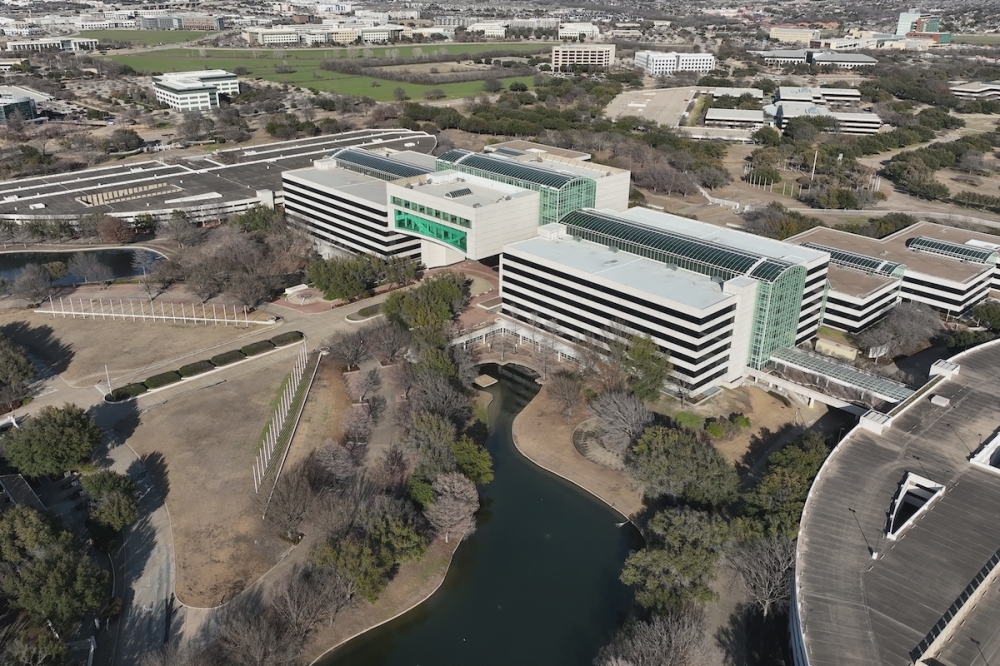
AT&T will soon call Plano home for its global headquarters, taking over a space that is no stranger to big business.
The $1.3 billion, 54-acre AT&T headquarters will replace the former Electronic Data Systems campus, which opened in 1985 and served as a catalyst for corporate growth in the Legacy area but has been vacant for more than seven years.
“This site really is the heart of the Legacy business park,” Assistant City Manager Doug McDonald said.
The gist
The company announced the move in January, and Plano City Council approved $20 million in financial incentives Feb. 23 to facilitate the new headquarters.
The former Electronic Data Systems campus at the site at 5400 Legacy Drive is set for demolition. AT&T’s relocation is the first major corporate headquarters redevelopment project in Plano, McDonald said.
“This location will provide us with the necessary room to cost effectively consolidate all Dallas-Fort Worth Metroplex administrative space, including our three largest locations in Central Dallas, Plano and Irving, and create a corporate campus designed for collaboration, innovation and engagement,” AT&T CEO John Stankey said in a statement.
Diving deeper
The $20 million economic development grant is the largest ever provided by Plano.
The AT&T grant is split into two $10 million incentives, one tied to the campus redevelopment and one tied to job creation.
One agreement details a 65% property tax rebate that would last for 25 years. AT&T could choose to begin the rebate period Jan. 1 of 2029, 2030 or 2031, according to city documents.
The second agreement will give AT&T the first $4 million from the grant after retention of the first 4,000 employees and would be required to reach 10,000 employees by the end of 2039 to receive the full grant.
“We’re connecting them with the right resources to succeed and create these jobs for not only our community’s residents, but our neighboring communities,” Plano Economic Development Director Michael Talley said. “That’s 10,000 people being on campus, going to restaurants, going to happy hour and grabbing coffee. It’s kind of like a snowball effect as far as what the impact could be.”
The backstory
Ross Perot oversaw the original development of the EDS campus in the 1980s. The project helped fuel “long-term economic growth” in the area, city officials said.
McDonald called the EDS building one of three campuses that “really started Legacy business park,” along with the JCPenney and Frito Lay campuses.
The city is set to install a pair of statues honoring Perot near the Shops at Legacy later this year.
EDS was sold to Hewlett-Packard in 2008, and the headquarters has sat vacant since 2018, when it was acquired by current owners NexPoint.
A previous plan approved in 2023 would have seen the site redeveloped as part of a 200-acre life sciences district called the Texas Research Quarter. Council approved a zoning change Feb. 23 reverting the property back to its original zoning from the previous development plan zoning for the Texas Research Quarter.
A NexPoint spokesperson declined to comment on future plans for the Texas Research Quarter.
McDonald said the way the building was built made a demolition the best option for redevelopment.
“Just with the size of this campus, it had some challenges especially in a post-pandemic leasing world,” he said. “We see campuses being built today with all the walkable amenities. … When you have something that customized, that [Perot] put in place in the late ‘80s, it makes it very difficult for other companies to reuse that same facility.”
Zooming out
McDonald said he hopes the AT&T headquarters will economically benefit the city in more ways than one.
On top of job growth, he said the new headquarters will provide the added benefit of increased property tax revenue.
The current 100-acre property generates around $140,000 annually in city property taxes, McDonald said. Once AT&T is fully moved in, he said the city would collect around $6 million per year from the 54-acre site.
Talley added that residents could see the benefit of the increased property tax revenue.
“When commercial is paying in as much possible into the coffers to help offset the cost of the residents, their tax rates can be lower,” he said. “That can really help offset the costs and improve the services at the city level.”
McDonald added that there’s still opportunity for more redevelopment on the site, as AT&T’s campus will only occupy the northern half.
With very little green space left in Plano, redevelopment of old sites is the main way for new developments to enter the city. McDonald noted the former JCPenney campus just down the road from EDS, along with Collin Creek Mall and Assembly Park and east Plano, as other ongoing redevelopment projects.
“A lot of times cities will look at a green field and say, ‘Hey, this is an opportunity,’” Talley said. “Well, we look at the redevelopment projects the same way.
Looking ahead
Demolition of the existing EDS site will begin this year, and AT&T is targeting partial occupancy in the new space “as early as the second half of 2028,” Stankey said.
The company will aim to move employees from multiple North Texas offices into the new building, with a goal to increase that workforce to 10,000 over the next decade.
Plano officials believe AT&T’s move can push the Legacy District forward for years to come.
“AT&T’s relocation represents a powerful reinvestment in the Legacy business district, building on an extraordinary foundation that has driven growth in Plano and our region for decades,” Mayor John Muns said. “With surrounding Legacy developments already advancing innovation, the addition of AT&T brings fresh momentum to this iconic area and helps position Legacy for its next generation of success.”
Jacquelyn Burrer contributed to this report.