
Artificial intelligence is dominating Wall Street, foreign policy and commercial real estate across the country. Texas now has the fastest-growing data center market in the country, with developers drawn to its available power capacity, lax regulations, incentives and open land.
While the Dallas-Fort Worth area is the largest data center market in the state, the Central Texas region between Austin and San Antonio could soon surpass that.
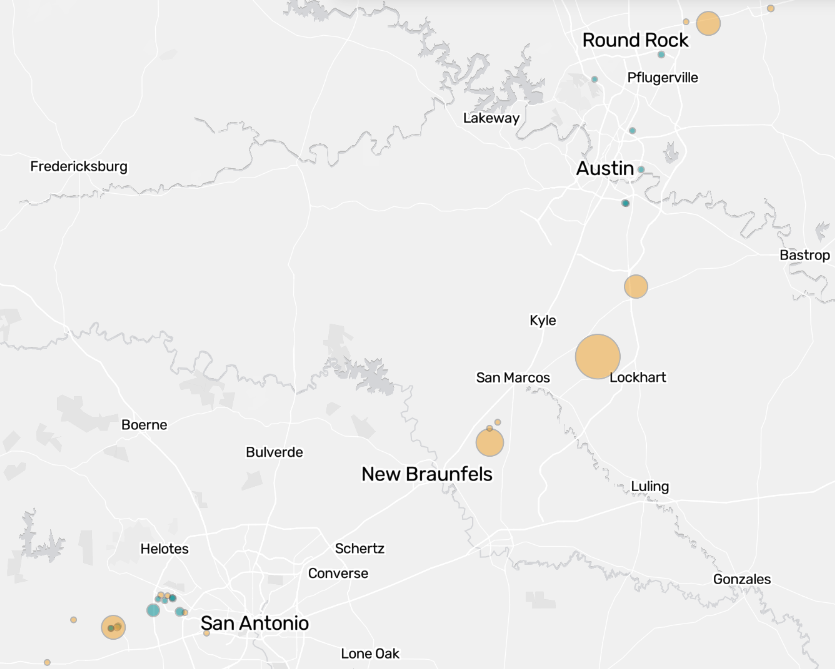
The American-Statesman has tracked more than 70 projects between Temple and San Antonio as of March 2026, with about 5,600 megawatts currently under construction in Austin and San Antonio metro areas.
Data centers, which typically resemble large multistory warehouses, are filled with servers that store and distribute information for everything between Fortune 500 companies, governments, schools and personal electronics.
They provide the infrastructure to power today’s computing world, including the devices in a single home. From phones and smartwatches to household appliances, the average home now has about 21 connected devices, each dependent on data centers.
And many developers are turning to Texas for data centers as Northern Virginia — known as “data center alley” because it’s the industry’s largest U.S. market — and West Coast states are becoming saturated and more heavily regulated.
These massive facilities could bring in jobs, especially indirect construction jobs, helping boost the state’s economy.
But they also come at a significant cost. Data centers are known to drain resources like water and power and could bring light and noise pollution to relatively rural parts of the state. Texas’ power grid manager Electric Reliability Council of Texas projects a 71% surge in energy demand by 2031 because of data center growth. ERCOT estimates their energy demand will exceed 22,000 megawatts by 2030.
An average 100-megawatt data center in the U.S. consumes about 2 million liters of water a day, according to an April report by the International Energy Agency — roughly the same as 6,500 households. The report projects global data center water use could reach 1.2 billion liters a year by 2030.
With increased utility demand also comes the possibility of increased bills. A June analysis by Carnegie Mellon University and North Carolina State University found that U.S. electricity bills could rise an average of 8% by 2030 because of data centers. In large data center markets such as Virginia and Texas, the increase could reach 25%.
Residents in San Marcos and College Station both successfully convinced their city councils to deny proposed data center projects in the past six months. Several counties have also weighed moratoriums on data center development.
But one major draw for developers is Texas’ less restrictive regulatory environment, leading many counties to call for special sessions to grant local governments authority over project approvals — something they do not currently have.