
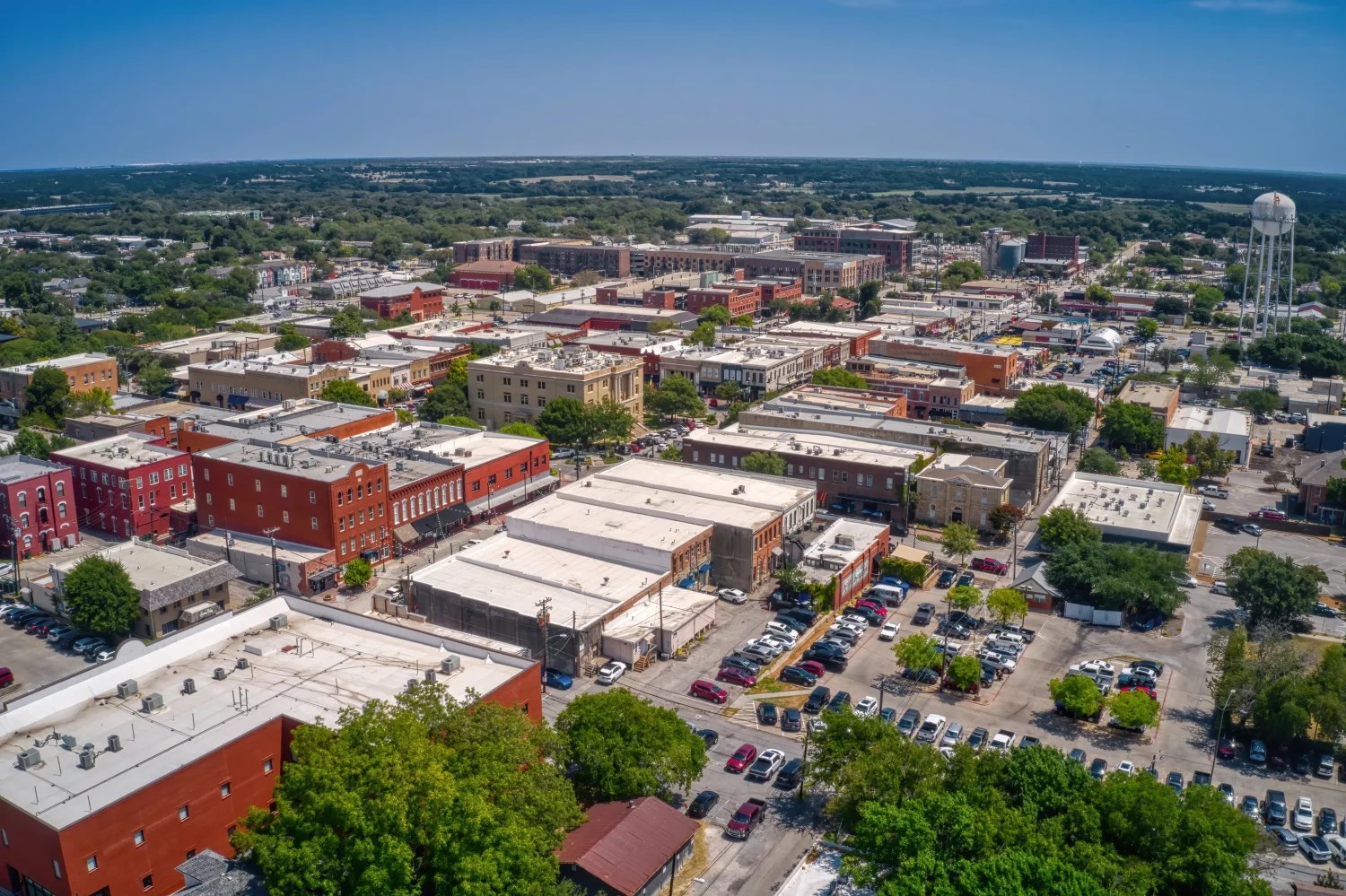
The historic downtown in McKinney, TX
Adobe Stock
Have you driven up the Dallas North Tollway through Plano and past Frisco lately? You’ve surely noticed that many once undeveloped parcels of land have somehow become even more crowded with towers and complexes in just the recent past. The stretch between IKEA, at the nexus of the DNT and the Sam Rayburn Tollway and Toyota Stadium a few miles to the north, once felt like an empty few miles connected the two Frisco landmarks but now is so filled it’s shocking to see there was so much space for development to begin with.
A lot of relocated and newly opened corporate headquarters have helped take up those miles, which is why Frisco is among what a new survey says are the hottest places in the U.S. for career opportunities for so-called “small cities.”
Seems big things come in relatively smaller packages when it comes to prime opportunities outside of major cities including Dallas and Fort Worth.
“Across the U.S., a new wave of cities with a more concentrated urban footprint is quietly turning into career powerhouses, even though we tend to associate that success with the big, bustling cities,” reads the report from Coworking Cafe, an online coworking directory. “Some of the best opportunities are popping up in tight-knit communities where innovation, affordability and a great quality of life all come together.”
Frisco sits at No. 11 on the list, with Flower Mound (No. 15) and McKinney (No. 20) trailing not far behind on the list that The New York Times labeled as “the best small cities for big job opportunities.”
To arrive at their results, Coworking Cafe reviewed 298 cities across the U.S. with less than 250,000 people, taking into account a range of economic, workforce and quality-of-life factors, including some income and affordability metrics, labor market and remote work trends, as well as other factors including healthcare access, education levels and commute times.
One of the report’s listed key findings says that “In Frisco and Pflugerville [Texas], the Sun Belt’s hidden edge shows itself as an engine of growth accelerating faster than almost anywhere else.” Later, when referring to the cities between No. 11 and No. 20, which includes Frisco, Flower Mound and McKinney, the report notes that “the strongest small-city economies tend to cluster in fast-growing Sun Belt metros, high-performing central U.S. hubs and affluent tech-oriented suburbs. These cities share a distinct economic profile: broad, two-digit wage growth over the past five years.”
Frisco
What the report says:
Frisco, TX, shows a median income of $145,444, boosted by 33% wage growth since 2019. The labor force is highly engaged (74.2%) with low unemployment and a strong employer base supported by 3,050 establishments per 100k residents. With 95% fiber access, excellent healthcare and top-tier safety, Frisco backs its economic strength with day-to-day comfort.
Flower Mound
What the report says:
Flower Mound, TX, is one of Texas’s most affluent suburbs, supported by a $166,624 median income and 25% wage growth from 2019 to 2024. The workforce is highly active (70.7% LFPR) and affordability remains favorable relative to income levels.
McKinney
What the report says:
McKinney, TX, closes the top 20 by combining good income levels ($124,177), 34% wage growth over the past 5 years and a very active labor force (72% participation). Its balanced mix of affordability, opportunity and amenities secures its place in the top.
Along with Pflugerville, this trip of North Texas ‘burbs were the only Lone Star State locations in the top 20. Alpharetta, Georgia, about 25 miles north of Atlanta is ranked No. 1 on the list of small cities with big job opportunities. Virginia, California and Indiana, like Texas, had multiple cities named on the list. What is about these spots that make them so attractive to major job providers and those looking for work?
“The strongest drivers aren’t surface-level perks, they’re the public supports that make daily life workable,” said Sarah Mosseri, a sociologist specializing in labor, inequality, and the hidden dynamics of workplace culture. “Workers now prioritize affordable housing, transportation, childcare, and healthcare. Without these, people overwork just to stay afloat. High-skilled workers want sustainability in both work and life, and they’re leaving places where these supports have broken down.”
As has been stated on this site before, it’s of little shock that these local suburbs were named so high on a list such as this. It seems as though one of these cities ends up as a “best” selection on reports ranging from places with the most diverse population to cities with the best quality of living on a dependably annual basis. In January, for example, Plano was near the top of U.S. cities for job seekers in a different report, while Flower Mound was named as the best place to live in the nation not all that long ago.
As if Frisco needed any more praise, a new report says it has the most affordable childcare in the nation, so there you go, job seekers with kids.