
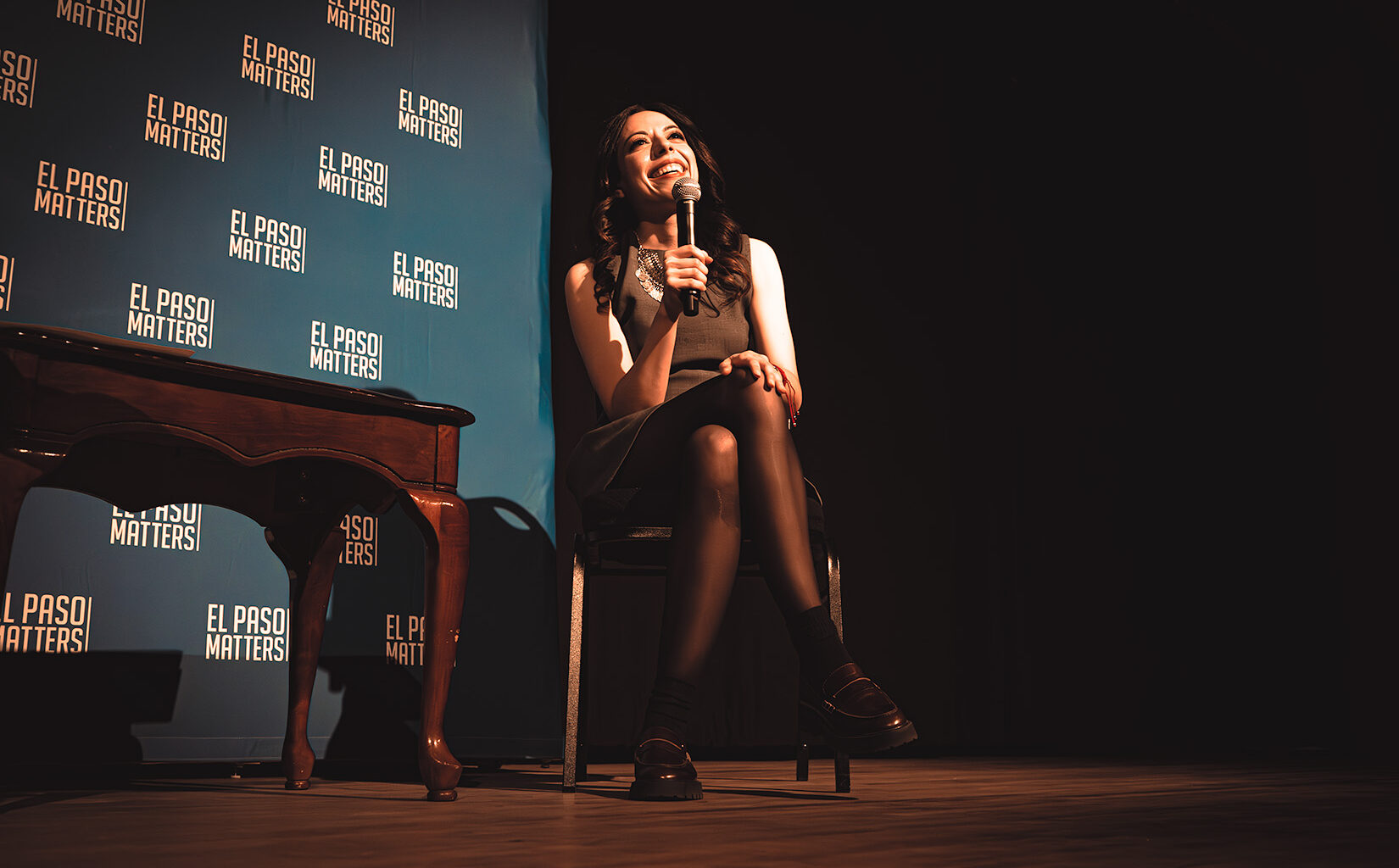
Growing up in the 915, New York Times national reporter Jazmine Ulloa was taught to keep herself out of the story. But on March 9, standing before a crowd of former teachers, childhood friends and the very families she spent a decade interviewing, the Burges High School alumna admitted that this story required her to break the rules.
The event, held at the Philanthropy Theater in partnership with El Paso Matters, served as a homecoming for Ulloa, whose book, “El Paso: Five Families and One Hundred Years of Blood, Migration, Race, and Memory,” was published on March 3.
The discussion served as a deep dive into the story behind the book and why its history is important not only to Ulloa, but to the entire El Paso community.
“I felt like I needed to explore my own history and to serve kind of as a guide for the reader,” Ulloa said. “And I also was asking very personal questions, really hard questions of families, so I realized I’m a hypocrite, you know, because I didn’t know my family history that deeply. I figured if I’m going to be asking these hard questions of the families I’m interviewing, I should be doing the same with my own.”
This personal connection is woven through a narrative that traces a century of border history through five local families including the Chews, Martinezes, Holguins, Rubios and Murals.
A central theme of the discussion was Ulloa’s argument that El Paso deserves the same historical reverence as the nation’s most famous port of entry, Ellis Island.
“We hold Ellis Island at such regard, right, it’s this place that symbolizes our most sacred ideals of welcoming,” Ulloa said. “But it’s really through El Paso where you can see that nativist strain, and how race and racism have shaped immigration policies from the very beginning and how they continue to shape the way that it is.”
Ulloa noted that this project was catalyzed by the Aug. 3, 2019, Walmart mass shooting, recalling it as one of the hardest assignments of her career and the moment that “started it all.”
Through the lens of that event, she addressed broader national conversation.
“I want people to realize that there is no Latino invasion of the United States,” Ulloa said. “Latinos have always been part of who we are as Americans.”
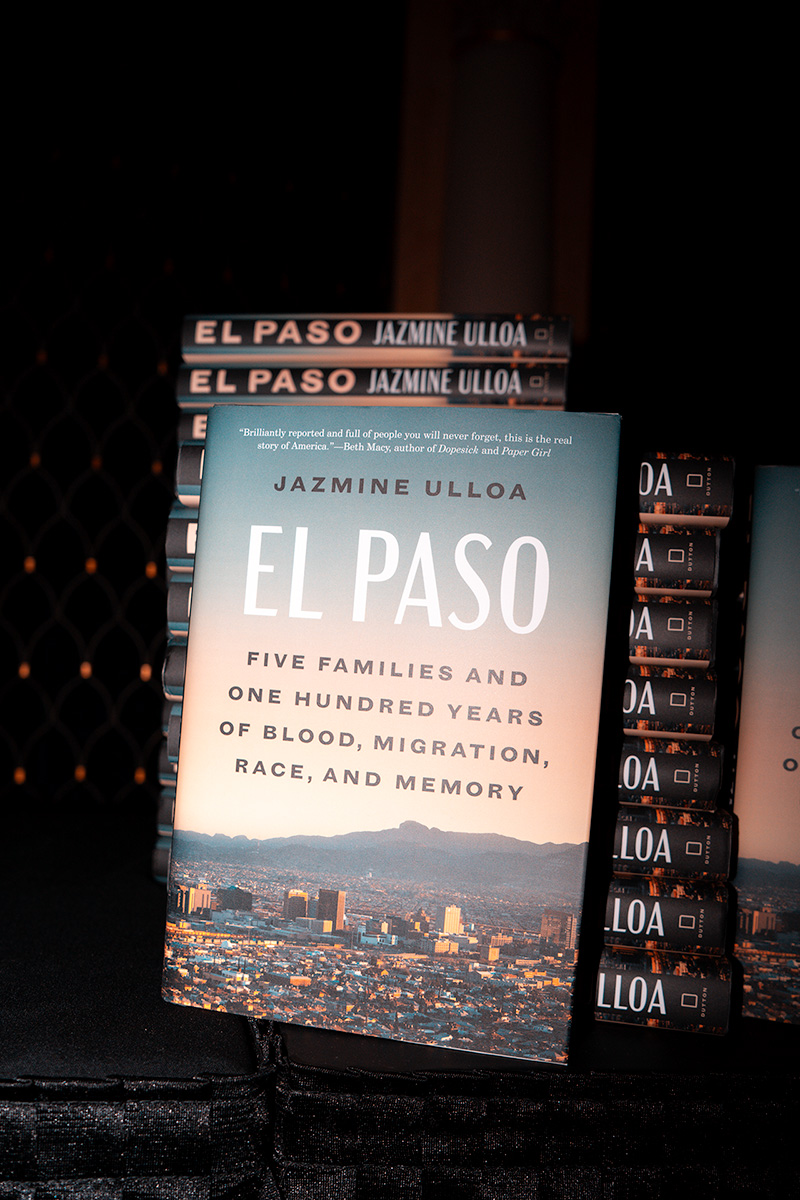
“El Paso: Five Families and One Hundred Years of Blood, Migration, Race, and Memory” by Jazmine Ulloa.
The weight of that history was felt deeply by those in the audience, including her former journalism teacher, Patricia Monroe.
“She always had that intensity as a student journalist,” Monroe said. “And I just knew she was going to be a star. So, in a way, I’m not surprised that she has made it all the way to the New York Times.”
The fmilies featured in the book also attended; some having shared their family heirlooms and fragile audio recordings to help Ulloa piece together the past. Ulloa recalled the emotional weight of handling a tape recorder sent through the mail, which contained the only surviving interview of a relative’s experience being picked up by Pancho Villa’s army.
The emotional core of the evening was further captured by Ulloa’s mother, Laura Martinez, who spoke about the lessons she gave Ulloa when she was just 4 years old.
“I brought her a book about Juárez and we started studying the letters and syllables together because I wanted her to always speak Spanish,” Martinez said. “To never forget her mother tongue, and for me to always speak Spanish, and for her to be Mexican, to feel that she was Mexican.”
Reflecting on the current political climate regarding immigration, Martinez added that while families may face separation, the community remains resilient.
“They can take us down, they can kneel us in the streets, they can separate us from our families, but what they cannot do is break our spirit because we can start from scratch.” Martinez said.
That spirit of resilience and historical importance was echoed by community members like Jack Loveridge, vice president of the El Paso ISD (EPISD) school board, who emphasized that El Paso’s story is not just local, but continental.
“El Paso is the biggest, most important international city that they might not have ever heard of,” Loveridge said. “And that its story is integral to the story of the whole United States and really the Americas broadly.”
For current students and the next generation, the evening was a lesson in visibility and advocacy. Andrea Tellez, a program advisor at the University of Texas at El Paso and high school friend of Ulloa, said she hopes the book instills a sense of pride in a city where middle ground is often hard to find.
“I hope that they’ll see people like Jazmine, who have come from such a long place, you know, to get where she’s at,” Tellez said.
Ulloa concluded the evening by reminding the audience that the border is defined by more than just the violence seen in the headlines.
“There’s more to the border than violence,” Ulloa said. “There’s, like I said, trade, culture, family, and blood. Blood that binds, blood that ties families through generations through time and space and distance.”
Adrian Gonzalez Jr. is a staff reporter for The Prospector. He may be reached at [email protected]
