
From the early 1970s rock opera “Jesus Christ Superstar” to “Monty Python’s Life of Brian” in 1979, controversial takes on biblical stories have generated both cult followings and criticism from Christians.
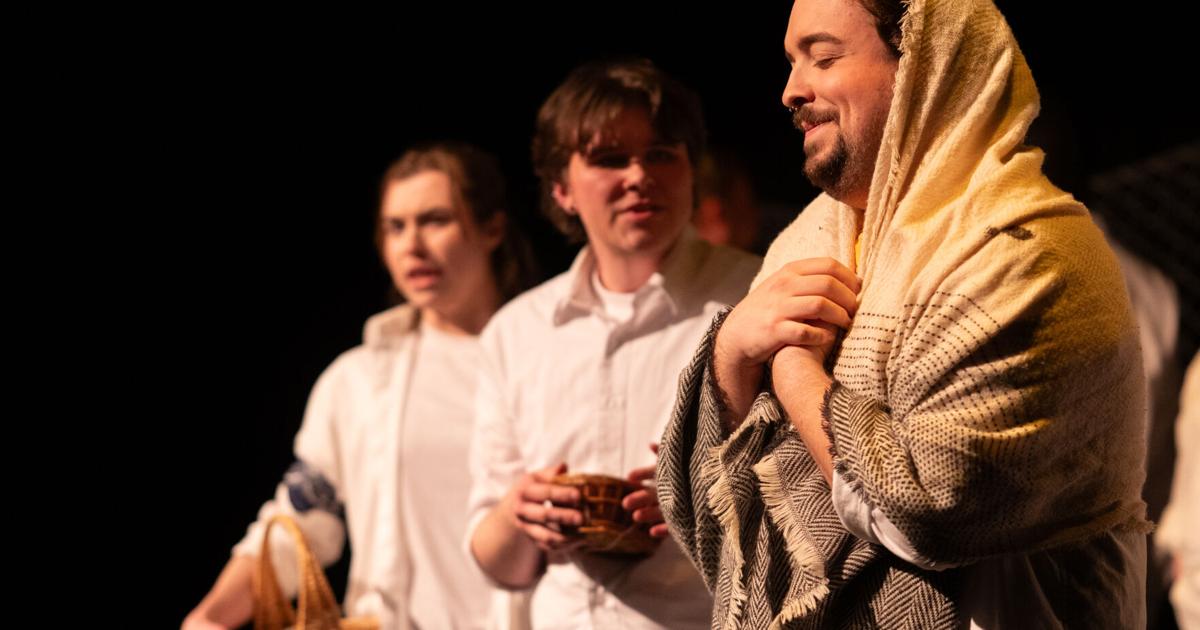
Written 20 years after those, Tony Award-winning playwright Terrance McNally’s “Corpus Christi” retells the story of Jesus living as a gay man in 1950s Texas. Performed by 13 actors playing multiple roles, in “Corpus Christi” Jesus is rechristened “Joshua,” Judas is his first lover, and the play ends in a crucifixion.
“Corpus Christi” opened at Madison’s Bartell Theatre on March 20, directed by Shawn D. Padley. It’s not the first time the Bartell Theatre has hosted “Corpus Christi,” nor is it theater company StageQ’s first time producing it. This time, opening night was quieter.
In 2004, three-year-old StageQ was a relatively new Madison-based LGBTQ community theater troupe (for context, Mel Gibson’s “The Passion of the Christ” was running in local movie theaters). When StageQ programmed McNally’s play, members of the Pennsylvania-based American Society for the Defense of Tradition, Family and Property began a six-month postcard campaign, threatening the Bartell Theatre and then-Mayor Dave Cieslewicz with protests if the production went live.
The Society had pledged to block the play wherever it was being staged. And on opening night, true to its word, the conservative Catholic organization held a protest outside of the Bartell Theatre, according to a Cap Times story at the time.

Protesters outside Bartell Theatre at opening of play “Corpus Christi” in 2004.
MIKE DEVRIES/CAP TIMES ARCHIVE
Steve Noll, one of the original founders of StageQ, produced that original run in 2004 and had a front-row seat to the ensuing drama. He still has some of the postcards, sent by the thousands by protesters.
“It was my idea to do this,” Noll said. “I wanted to show that StageQ was up and going. I really wanted to make a statement … I wanted to kick the hornet’s nest.”
He didn’t expect the backlash to go so far. The protests made front page news.
“We had heard that they had secured a protest permit for Mifflin Street in front of the theater on opening night,” he said. “And sure enough, they drove out here, and they built a giant cross in the street. They had about 20 members with them.”
News reports at the time said there were 50 people protesting against the play (one called it “Christophobia … designed to infuriate people”), and 20 counter-protesters, including some from a local Christian congregation.
Jim Lautenbach looks on as Joshua Paffel embraces John Patrick during a scene from “Corpus Christi” in 2004.
MICHELLE STOCKER/ CAP TIMES ARCHIVE
“It was very theatrical,” Noll said. “I have to admit, as a theater person, I was very impressed.”
The hate directed toward the play worried Noll. The theater received death threats, and Noll said he also received a death threat on his answering machine that included a homophobic slur. But looking back, Noll said he’s pleased he decided to run the play.
Director Shawn D. Padley watches a rehearsal of “Corpus Christi” at the Bartell Theatre. The play, written in 1997 by Terrence McNally, reimagines the story of Jesus in modern-day Texas.
Ilana Bar-av
“I’m pretty proud I did that,” he said. “That was kind of a feather in my cap.”
‘Reminding people what Jesus said’
Padley, who is directing the current production of “Corpus Christi,” said StageQ has already taken steps to keep its actors safe, such as not posting the cast list and keeping an eye on social media.
StageQ actors rehearse a scene from “Corpus Christi” by Terrence McNally at the Bartell Theatre in Madison.
Ilana Bar-av
“I’m also happy to kick the hornet’s nest, but kick the hornet’s nest at me. Not at my actors,” Padley said. “We’ve been very careful.”
“Corpus Christi” first ran off-Broadway in 1998. The same year, 21-year-old University of Wyoming student Matthew Shepard was murdered in a hate crime. AIDS had been taking lives in queer and transgender communities for nearly two decades.
Noll said that for author McNally, “Corpus Christi” came from a personal place. McNally himself was gay, and his status as a respected playwright gave him more leeway in his material.
“He had won multiple Tony Awards, and he pretty much could do whatever he wanted. So he was really getting sick of all this chatter about anything gay-related at all,” Noll said. “So he said, ‘Fine. If you want to complain, I’ll give you something to complain about.’ And that was the origin of this play.”
StageQ actors rehearse a scene from “Corpus Christi” by Terrence McNally at the Bartell Theatre in Madison.
Ilana Bar-av
Padley said in the current moment, with renewed scrutiny on the LGBTQ community and attacks on transgender people, the play remains relevant.
“When I was coming out in the early 2010s there was no place to be queer and Christian,” Padley said. “It’s reminding people what Jesus said: ‘That which you do to the least of these you do to me’ … directly showing that to them and saying, ‘Hey, these are the things that you are doing to the queer community.’ We are showing you that on stage.”
Noll said the events surrounding the 2004 run were, ironically perhaps, good for publicity. The show was very popular for its whole run.
“It’s like the Oscar Wilde quote,” Noll said. “‘The only thing worse than being talked about is not being talked about.’” That applies here for sure.”