
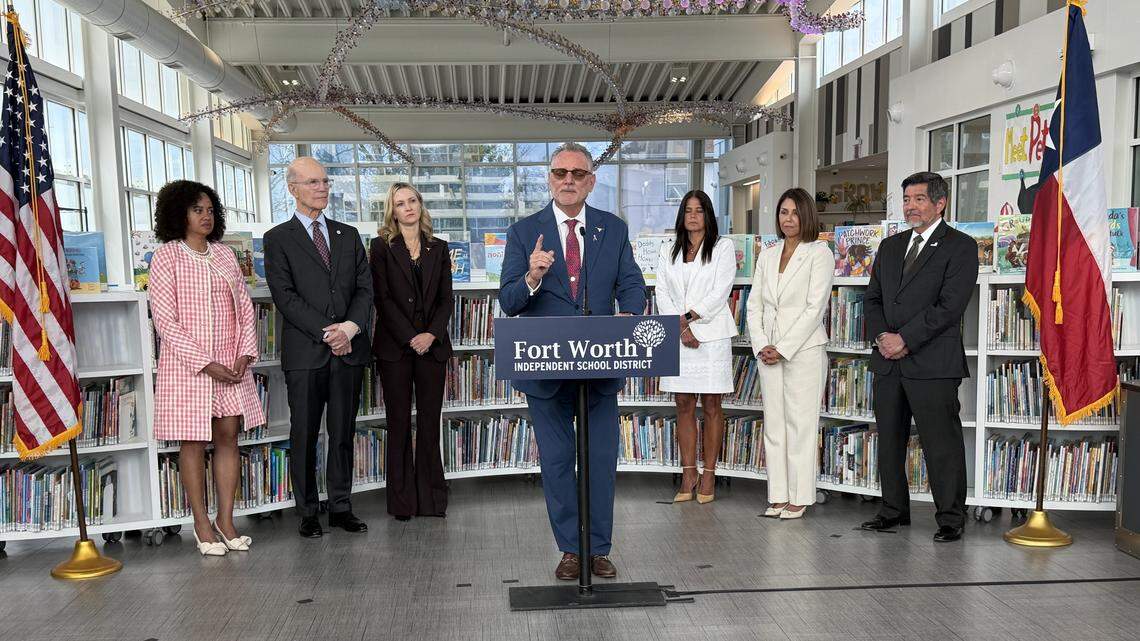
Anyone could quibble with the Fort Worth school district leadership team that the Texas Education Agency unveiled Tuesday. Some might want more educators or stronger business hands on the Board of Managers chosen to execute the state’s oversight. Others might question whether Superintendent Peter Licata is the right fit for a district facing steep learning and socioeconomic challenges.
But after months of speculation and angst, it’s time to get moving with Education Commissioner Mike Morath’s plan to overhaul Fort Worth ISD. There’s no time to waste. All of Fort Worth’s elected officials, business and philanthropic leaders, and families must make fixing decades of inadequate schooling the only priority.
That does not mean blind fealty, silencing tough questions or shying away from accountability. The new board and superintendent need to operate with full transparency and honesty, especially given the sometimes-opaque nature of the transition since Morath announced the takeover in October.
Licata in particular will bear the responsibility for making this work. With public input and the board’s backing, he needs to set a clear vision of where FWISD must go and how it can get there. His demeanor and background in Florida schools are promising, but he’ll face skepticism, in part from the not-insignificant number of people who wanted Karen Molinar retained in the job.
Molinar showed tangible progress, even if it was small, not long after taking the reins. Licata must do the same.
Fort Worth ISD needs more than just a fix for reading crisis
Licata also must generate buy-in for a long-term vision of a district that is the best it can be. Fixing the district’s reading crisis, especially among younger children, is a tall enough order. But if Fort Worth wants to maintain its economic dynamism and improve outcomes across racial, income and language-skill disparities, it needs to strive for more.
Is it too much to ask for a district that is on the cutting edge of developing more children into top-notch critical thinkers who can evolve as the economy does?
Obviously, small steps come first. But Fort Worth should be done settling. If Licata can get teachers, government officials and families dreaming bigger, we’ll all be better off for it.
 A nine-person Board of Managers is replacing Fort Worth ISD’s elected school board members, starting on March 24, 2026. They are, top row from left: Courtney Lewis, Frost Prioleau and Tennessee Walker; middle: Pete Geren, Bobby Ahdieh and Laurie George; bottom: Luis A. Galindo, Rosa Maria Berdeja and Jay Stegall. Fort Worth ISD
The board that Morath chose to oversee the district’s overhaul in place of the elected trustees contains a number of thoughtful heavy-hitters, people who have spent considerable time and effort working on what education can be in Fort Worth. Leaders such as Bobby Ahdieh, who is leading Texas A&M University’s expanded presence in Fort Worth, understand what it would mean to unlock the potential of many more local schoolchildren.
They’ll face tough demands to balance community demands, pressure from vested interests and state mandates. Job No. 1 is to communicate clearly, give Licata room to maneuver and be honest about what’s working and what’s not.
Developing long-term Fort Worth ISD leaders should be a priority
There’s another priority, less urgent but no less real: developing district leadership for the future. One major reason FWISD has languished for so long is dysfunction on the school board, where few serious candidates run and where there was a willingness to let politics and personal priorities obscure the student-achievement crisis that deepened year after year.
It took a crisis for more people to step up. We can’t help but wonder how much damage could have been avoided had those who answered Mayor Mattie Parker’s 2024 alarm bell about the district’s problems been willing to offer their skills earlier.
Education agency officials said that 305 people applied for the nine board positions, and nearly two-thirds went through governance training. So, Fort Worth has a new cohort of people ready and interested in getting the district on a better path and keeping it there.
State oversight won’t last forever. We hope many of these same people are thinking about stepping up for service when the elected board is returned to power.
That’s the only way to ensure that this is a true change of direction for FWISD and not just a detour.
BEHIND THE STORY MORE Hey, who writes these editorials?
Editorials are the positions of the Editorial Board, which serves as the Fort Worth Star-Telegram’s institutional voice. The members of the board are: Cynthia M. Allen, columnist; Steve Coffman, editor and president; Bud Kennedy, columnist; and Ryan J. Rusak, opinion editor. Most editorials are written by Rusak. Editorials are unsigned because they represent the board’s consensus positions, not necessarily the views of individual writers.
Read more by clicking the arrow in the upper right.
How are topics and positions chosen?
The Editorial Board meets regularly to discuss issues in the news and what points should be made in editorials. We strive to build a consensus to produce the strongest editorials possible, but when we differ, we put matters to a vote.
The board aims to be consistent with stances it has taken in the past but usually engages in a fresh discussion based on new developments and different perspectives.
We focus on local and state news, though we will also weigh in on national issues with an eye toward their impact on Texas or the Dallas-Fort Worth area.
How are these different from news articles or signed columns?
News reporters strive to keep their opinions out of what they write. They have no input on the Editorial Board’s stances. The board consults their reporting and expertise but does its own research for editorials.
Signed columns by writers such as Allen, Kennedy and Rusak contain the writer’s personal opinions.
How can I respond to an editorial, suggest a topic or ask a question? Do you have an opinion on this topic? Tell us!
We love to hear from Texans with opinions on the news — and to publish those views in the Opinion section.
• Letters should be no more than 150 words.
• Writers should submit letters only once every 30 days.
• Include your name, address (including city of residence), phone number and email address, so we can contact you if we have questions.
You can submit a letter to the editor two ways:
• Email letters@star-telegram.com (preferred).
• Fill out this online form.
Please note: Letters will be edited for style and clarity. Publication is not guaranteed. The best letters are focused on one topic.
Related Stories from Fort Worth Star-Telegram