
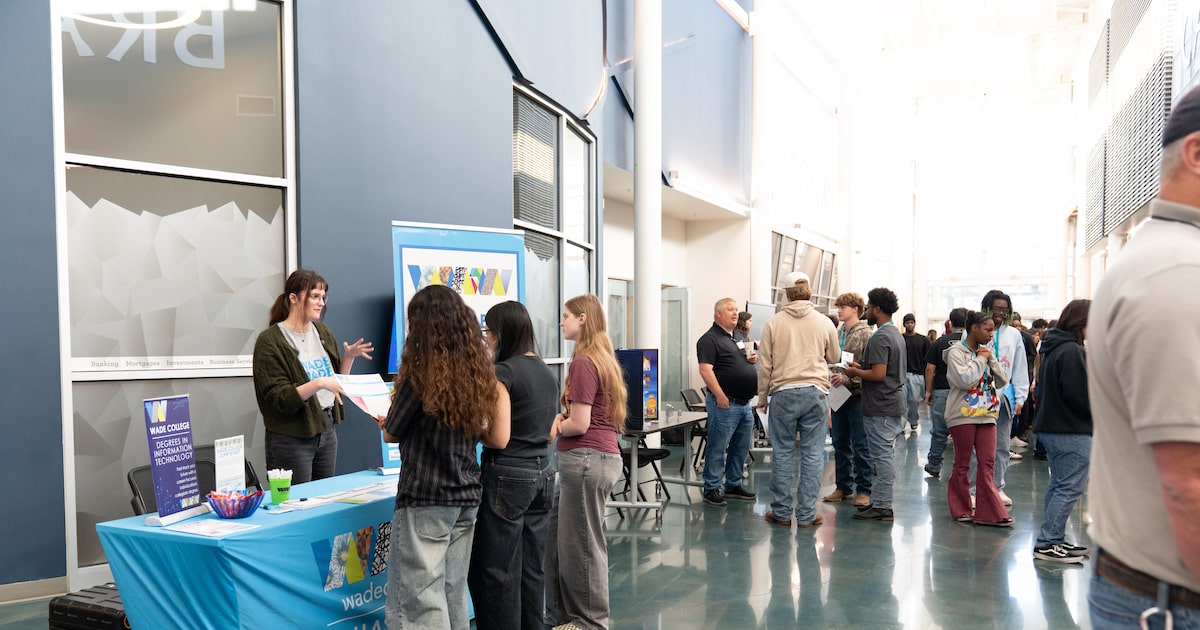
Maxine Escanlar went all out to prepare for her first job fair at Garland ISD’s Gilbreath-Reed Career and Technical Center. The Naaman Forest High School senior’s teacher helped her complete a résumé, while friends walked her through interview questions and made sure her outfit looked appropriate for employers.
She’s also practicing for a bigger transition. This fall, Escanlar plans to attend the University of Texas at Arlington to study aerospace engineering, where she expects to cover most of the costs herself. She said she feels confident about working with new people and believes students like her can succeed if adults give them a chance to learn.
“Give us a chance and we’ll run with it,” she said.
Related

Although Texas’ high school graduation rate surpasses the national average, 63% of jobs statewide will require education beyond high school by 2031, according to a Georgetown University report. Workforce advocates say that’s why career and technical training, apprenticeships and military service are becoming more important paths to living-wage jobs without the heavy student debt often tied to a four-year degree.
At Garland ISD’s recent career fair, employers, colleges and nonprofits laid out skills they hope North Texas teens will bring to those opportunities.
Business Briefing
Attitude matters
Garland ISD students speak with employers at the school district’s Gilbreath-Reed Career and Technical Center. Employers at the job fair emphasized that they notice a student’s attitude before résumés, certifications or grades.
Cesia Murillo, Garland ISD Communications / Cesia Murillo, Garland ISD Communications
Employers emphasized that they notice a student’s attitude before résumés, certifications or grades.
Garland ISD roofing supervisor Bryan Petty said the teens who stand out show energy and are ready to work. They approach employers engaged, ask questions and express a willingness to put in “sweat equity” instead of looking for instant results. He also warned students against only dwelling on a paycheck.
“Money cannot replace experience,” he said, urging teens to be willing to take starter jobs they may not love so they can build a work history.
Soft skills
Sofía Núñez, Empower the Voice founder, focused on soft skills not often taught in classrooms. The nonprofit helps Hispanic families understand college and career pathways and offers a student marketing internship.
Núñez said she wants students who can communicate clearly, tell their own stories and motivate others. She described the difference between a teen who gives up at the first barrier and one who learns to push back respectfully. The goal is to help students hear a rejection and think about how to turn “this no into a yes” by asking for resources, support or another chance.
She spends just as much time with parents. As an immigrant mother of a young adult, she said it is hard to move from directing every detail to becoming “a supporter and a provider of resources.” Families, she said, have to learn how to guide without sitting in the driver’s seat.
Come prepared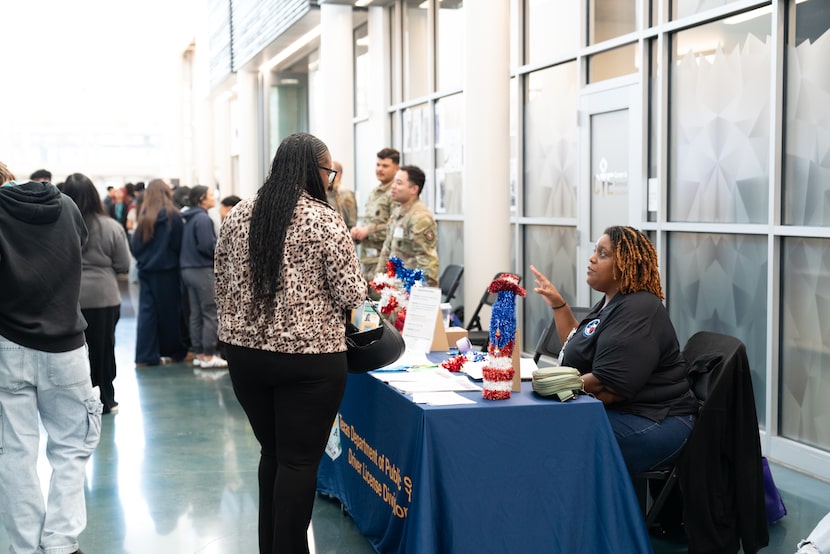
Educators at the Gilbreath-Reed Career and Technical Center opened computer labs so students could polish résumés, get feedback and print copies before the job fair. They also hosted an etiquette luncheon where hospitality students walked classmates through place settings, handshakes and professional dress.
Cesia Murillo, Garland ISD Communications / Cesia Murillo, Garland ISD Communications
CeAira Flores, a license and permit specialist II at the Texas Department of Public Safety, said one of the biggest problems they see is students arriving without the documents needed to apply for the IDs or driver’s licenses required for work.
She advised teens to read every email and confirmation carefully, bring all requested paperwork and schedule DPS appointments months in advance.
Sharonda Green, CEO of Linson Eye Investigation, a private investigation and security services firm, said many teenagers come to fairs curious but not ready, often forgetting about paperwork until it is too late. Students should bring real résumés, not just a file on their phone, because some employers may want to hire them at the fair, and missing something as basic as a printed résumé can cost them a job on the spot.
Brandy Schneider, the principal of Garland ISD’s Gilbreath-Reed Career and Technical Center, said her educators opened computer labs so students could polish résumés, get feedback and print copies before the fair. They also hosted an etiquette luncheon where hospitality students walked classmates through place settings, handshakes and professional dress, while a photographer took free headshots for students who wanted a more professional photo.
Be willing to learn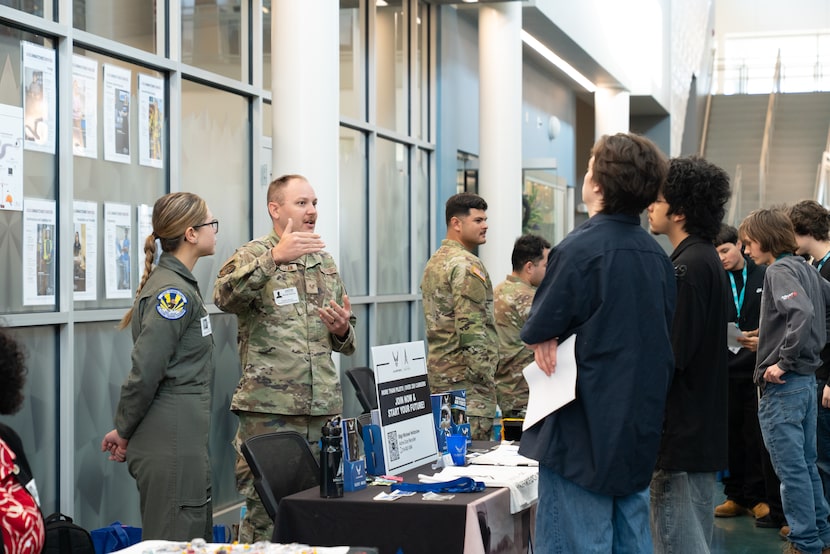
Garland ISD students speak with employers at the school district’s Gilbreath-Reed Career and Technical Center. Photo by Cesia Murillo, Garland ISD Communications.
Cesia Murillo, Garland ISD Communications / Cesia Murillo, Garland ISD Communications
Most employers said they do not expect high school students to arrive as experts. What matters is if they are teachable.
Military recruiters stressed a similar point. Air Force Staff Sgt. Michael Holtzclaw said he did not know how to repair HVAC systems before he enlisted. The military sent him to a six month HVAC school, paid for it and helped him earn industry certifications. He tells students if they can name a civilian job they are considering, “we probably have the equivalent of it in the Air Force,” plus education, medical care, food and housing while they serve.
Carlos Quintana, a shop manager for Backyard Dieselz, said his company works on everything from light duty trucks to heavy equipment and lawnmower engines. They can teach technical skills if students are willing to train and keep up with changing technology. But what he cannot teach as easily is effort.
“If you wake up to do something, do it to the best of your ability,” he said.
Learn practical skills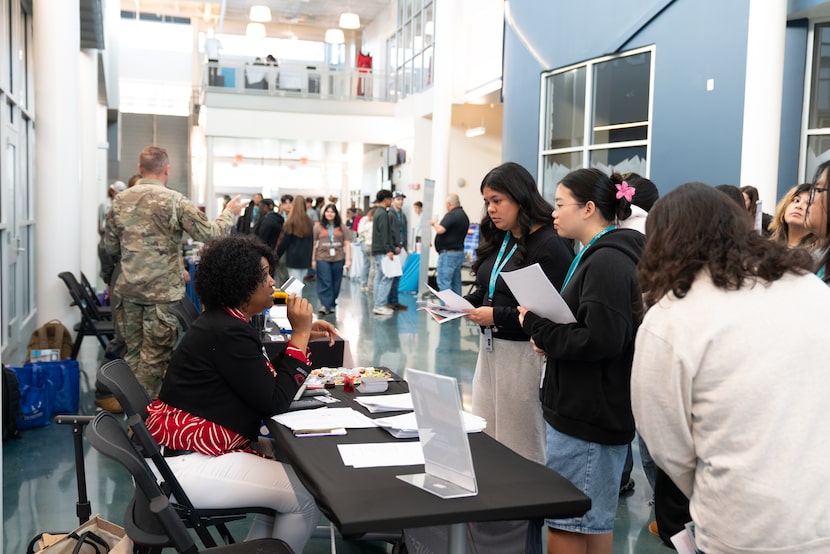
Some employers, trade schools and training centers talked about life skills, such as financial literacy, attention to detail and hands-on abilities students can use in any job.
Cesia Murillo, Garland ISD Communications / Cesia Murillo, Garland ISD Communications
Some of the most specific advice was about practical skills that rarely make it into glossy brochures.
Lynette Wilson, community affairs director for the Dallas-Fort Worth Alliance of Black Accountants, said students aspiring for business jobs need a strong grasp of spreadsheets. Teens should start learning spreadsheet software now, using free tutorials if needed.
“Excel is the name of the game,” she said. “It is not something they can skirt by, AI cannot mitigate it for them.”
Other employers, trade schools and training centers talked about life skills, such as financial literacy, attention to detail and hands-on abilities students can use in any job.
Have a plan but be flexible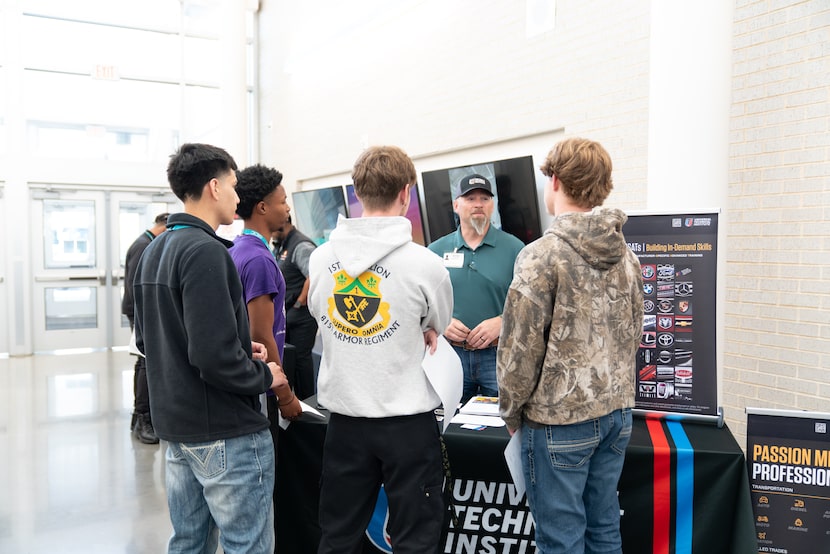
Employers also shared feedback on the long-term importance of money. One recuiter said passion matters, but students also need to understand their cost of living and how their chosen field will support them.
Cesia Murillo, Garland ISD Communications / Cesia Murillo, Garland ISD Communications
Employers don’t expect every teenager to have life mapped out. What they do want to see is intention.
Army Staff Sgt. Xavier Laboy said the students who concern him most are the ones who have no plan and never thought about what kind of work or training they might want after graduation. Teens should at least set a short-term goal and ask employers how to get there, he said.
Employers also shared feedback on the long-term importance of money. Wilson said passion matters, but students also need to understand their cost of living and how their chosen field will support them. Quintana said students should find work they can love on hard days, and to let the money follow their skills.
That kind of intentional thinking has already forced Harmeet Gill, a Lakeview Centennial High School senior, to change course. He started high school in computer science, then shifted into engineering after watching how AI is reshaping the job market. After taking engineering and robotics classes, he is now looking at civil engineering.
“I do not think AI can take over that job as well,” he said.
This reporting is part of the Future of North Texas, a community-funded journalism initiative supported by the Commit Partnership, Communities Foundation of Texas, The Dallas Foundation, the Dallas Mavericks, the Dallas Regional Chamber, Deedie Rose, Lisa and Charles Siegel, the McCune-Losinger Family Fund, The Meadows Foundation, the Perot Foundation, the United Way of Metropolitan Dallas and the University of Texas at Dallas. The News retains full editorial control of this coverage.
Five ways North Texans can benefit from local workforce programsRepublicans are remaking Texas’ public universities. Some professors are leaving