
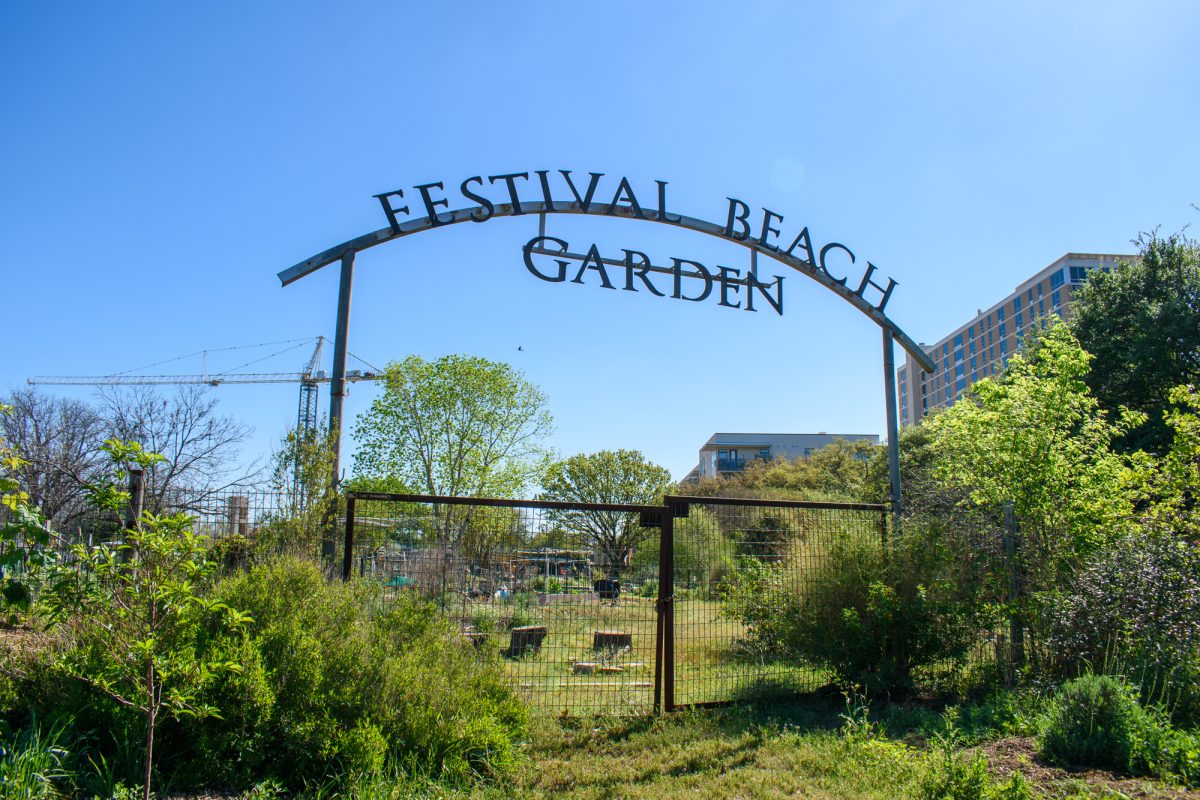
What took years of community effort to grow in East Austin was altered in a matter of days. The Festival Beach Food Forest, a three-acre, volunteer-led space offering free food and medicinal plants, has been partially cleared for a wastewater pipeline connected to the Interstate 35 expansion.
The site is designed using permaculture principles that mimics a natural ecosystem, featuring trees, shrubs and plants that grow back year after year while supporting soil health, water retention and local wildlife.
But parts of the food forest were recently cleared to make way for a wastewater pipeline relocation tied to the I-35 expansion project, raising concerns among organizers about communication failures and the loss of a carefully cultivated ecosystem.
“We’re not just planting a garden — we’re rebuilding an ecosystem,” said Angelina Alanis, communications and partnerships coordinator for the Festival Beach Food Forest. “When it’s ripped out of the ground, it’s gone forever. You can’t just replace that overnight.”
The food forest sits on land that once housed a power plant and fish hatchery, industrial sites that community members successfully pushed to shut down in 2012 due to environmental concerns. In the years since, residents and volunteers have worked to transform the space into a sustainable, accessible resource for the surrounding neighborhood.
The first trees were planted in 2015 as part of a community project. In 2021, the City of Austin approved an expansion, growing the site from two-thirds of an acre to more than three acres. Since then, volunteers have contributed thousands of hours to planting, watering and maintaining the space, with organizers estimating the total investment — both financial and services — at around $500,000.
Despite ongoing coordination with the Texas Department of Transportation regarding nearby I-35 construction, Alanis said the organization was not informed about plans to trench through part of the site until Jan. 6. Just weeks before construction was scheduled to begin.
“We had been meeting regularly and were told to expect things like noise and dust,” Alanis said. “But trenching on the site was never mentioned.”
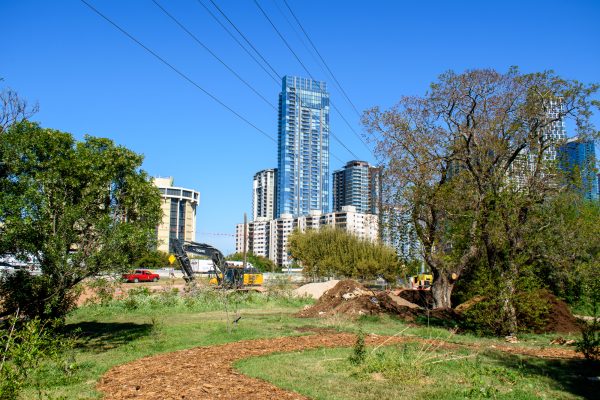 Construction equipment operates along the edge of the Festival Beach Food Forest as a water pipeline project encroaches on the community green space, with downtown Austin’s skyline visible in the background.
The late notice also appears to conflict with a 2021 agreement between the City of Austin and the nonprofit, which requires at least a 60 days notice before any non-emergency construction or modification. Instead, Alanis said they were given just a two-day pause by TxDOT to respond.
In that time, volunteers mobilized quickly, removing more than 90 plants and trees from the construction path in an effort to save them. Including relocating a 40-year-old mountain laurel. Those plants are now being cared for by partner organizations while the organization awaits guidance on whether replanting will be allowed.
Still, the damage to the site has been significant.
“What used to be a thriving section of the food forest is now just a flat, empty stretch of dirt,” Alanis said.
Austin Water has since verbally promised to restore the land to its previous conditions, but Alanis said there is uncertainty about how that will be achieved, particularly given the specialized nature of permaculture design.
“We haven’t met anyone at the city who specializes in this kind of work,” she said. “So we’re asking, how are you going to restore something you don’t fully understand?”
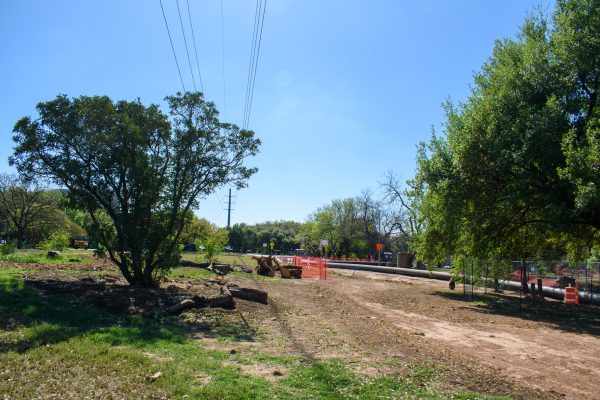 Construction for the water pipeline surrounds the Festival Beach Food Forest. Native plants and trees were relocated and one tree (left) was transplanted on-site to preserve existing growth during construction for the new water pipeline. (Mia Aguirre)
Beyond the physical damage, the situation has highlighted broader concerns about coordination between city departments. According to Alanis, different parts of the city approved overlapping projects — the food forest expansion and the wastewater pipeline — without clear communication between them. Even staff within the Parks and Recreation Department were unaware of the planned construction until notified by the food forest team.
For organizers, rebuilding trust is just as important as restoring the land.
“We spent years working with the city to create this plan,” Alanis said. “Now we’re trying to figure out how to move forward together in a way that actually honors that partnership.”
The organization is asking the City of Austin to reinvest in the project, not only by restoring the damaged area but also by supporting future phases of development that had already been approved.
As the future of the impacted area remains uncertain, the food forest remains open to the public, and organizers are encouraging community members to get involved. Weekly volunteer workdays continue, offering opportunities for residents to help maintain the space and contribute to its recovery.
“This project has always been about community,” Alanis said. “And even in this moment, we’re seeing people show up and support it in really powerful ways.”