
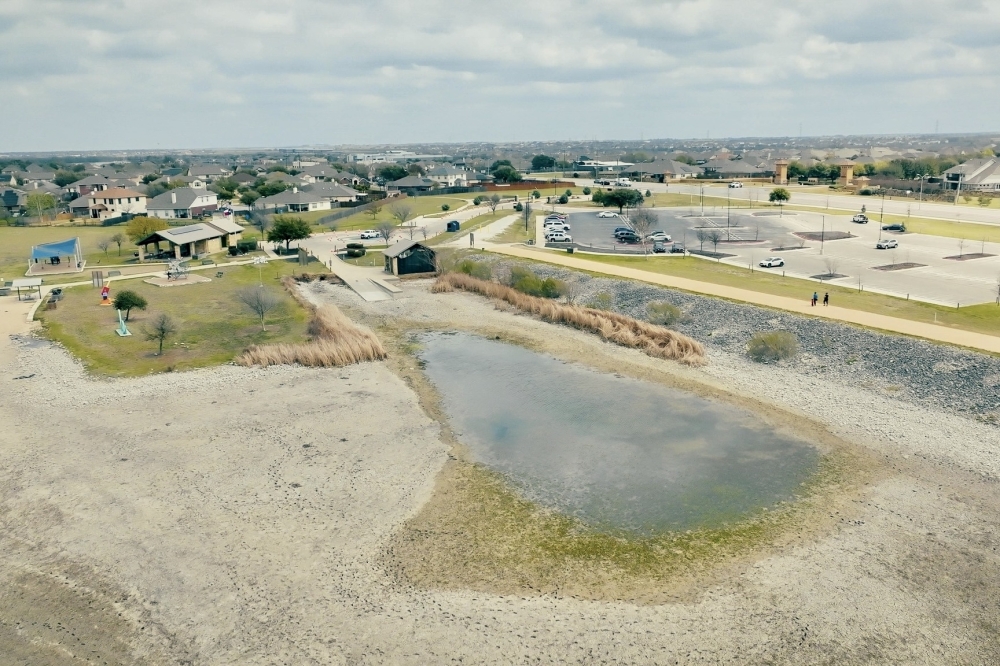
City officials said Pflugerville’s water system is stabilizing, but remains under strain as crews work toward permanent repairs following multiple pipeline breaks that disrupted the city’s raw water supply.
During a recent City Council update, staff detailed a coordinated repair plan, ongoing conservation efforts and the timeline needed to restore more normal operations.
The big picture
The city’s water issues stem from a series of breaks along its 30-inch raw water pipeline, which delivers water from the Colorado River to Lake Pflugerville. While a temporary bypass has restored partial flow, officials said full repairs are still weeks away.
“We’re almost there,” Public Utilities Director Matt Rector said. “The light is at the end of the tunnel. We just have to get through a few more issues.”
Crews are preparing for a major repair phase expected later this spring.
City officials said materials to replace roughly 400-500 feet of damaged pipeline are expected to arrive by mid-to-late April. Once on site, contractors will plan a coordinated shutdown in late May to complete repairs and reconnect the system.
Rather than stagger multiple outages, the city is aligning work across contractors into a single shutdown expected to last about two weeks.
The repairs will replace all sections of pipe where failures occurred, though officials said replacing the entire 15-mile pipeline is not being considered due to cost and feasibility.
Diving deeper
A key turning point came in early March, when city officials discovered Lake Pflugerville held significantly less water than previously believed, prompting an immediate escalation in restrictions.
During the council discussion, officials were asked to explain the discrepancy after a March 3 report showed “significantly less water” than expected, and whether the city knew how large the gap was or what caused it.
Rector said the city had been relying on SCADA system readings—electronic sensors that estimate lake depth—which indicated the lake was around 28 feet deep.
However, a diver inspection told a different story.
“When they came back, they told us the depth we were seeing on the SCADA report was off by close to 11 feet,” Rector said. “SCADA was telling me 28 feet, and the divers’ report said I had 17 feet.”
Council members noted the difference was even more severe in terms of total water volume, since the lake widens closer to the surface.
“That’s a catastrophic difference,” City Council member David Rogers said.
Officials said the discrepancy was uncovered after divers were sent into the lake to verify sensor data as a precaution. The inspection required time due to difficult underwater conditions and post-survey analysis.
City staff said they have not identified a clear cause for the inaccurate readings, but the system has since been recalibrated.
“I can’t tell you what caused the difference,” Rector said. “All I can tell you is we’ve since gone out and recalibrated to make sure that doesn’t happen again.”
The discovery triggered Stage 3 emergency water restrictions on March 4, as officials realized the city had far less water available than anticipated.
What’s next
As of the latest update, Lake Pflugerville remains below its desired level, and officials are working toward a target elevation of 633 feet—the threshold for easing Stage 3 restrictions.
Rather than moving incrementally through restriction stages, officials said the goal is to reach Stage 1 conditions directly to provide more meaningful relief to residents.
“The citizens do not really see a benefit by going from Stage 3 to Stage 2,” Rector said. “That’s why we’re focused on getting to Stage 1.”
Higher lake levels are also needed to create a buffer ahead of the planned system shutdown in May.
To conserve water, the city has restricted construction-related water use from its system. Contractors are now required to use alternative sources, including water from other providers or designated non-potable supplies.
The city has also shut off irrigation at public facilities, paused street sweeping and stopped municipal vehicle washing, while limiting pool use to essential maintenance.
City staff have made additional operational adjustments to maintain water quality and system reliability, including resuming required hydrant flushing while attempting to capture and reuse that water for non-potable purposes.
Officials said some residents may notice temporary changes in water taste due to delayed maintenance.
“This is a community effort,” Rector said. “We can pump water all day, but if everyone is using that much, we’re not getting anywhere.”
City leaders said continued conservation will determine how quickly Pflugerville can return to normal operations.
“>