
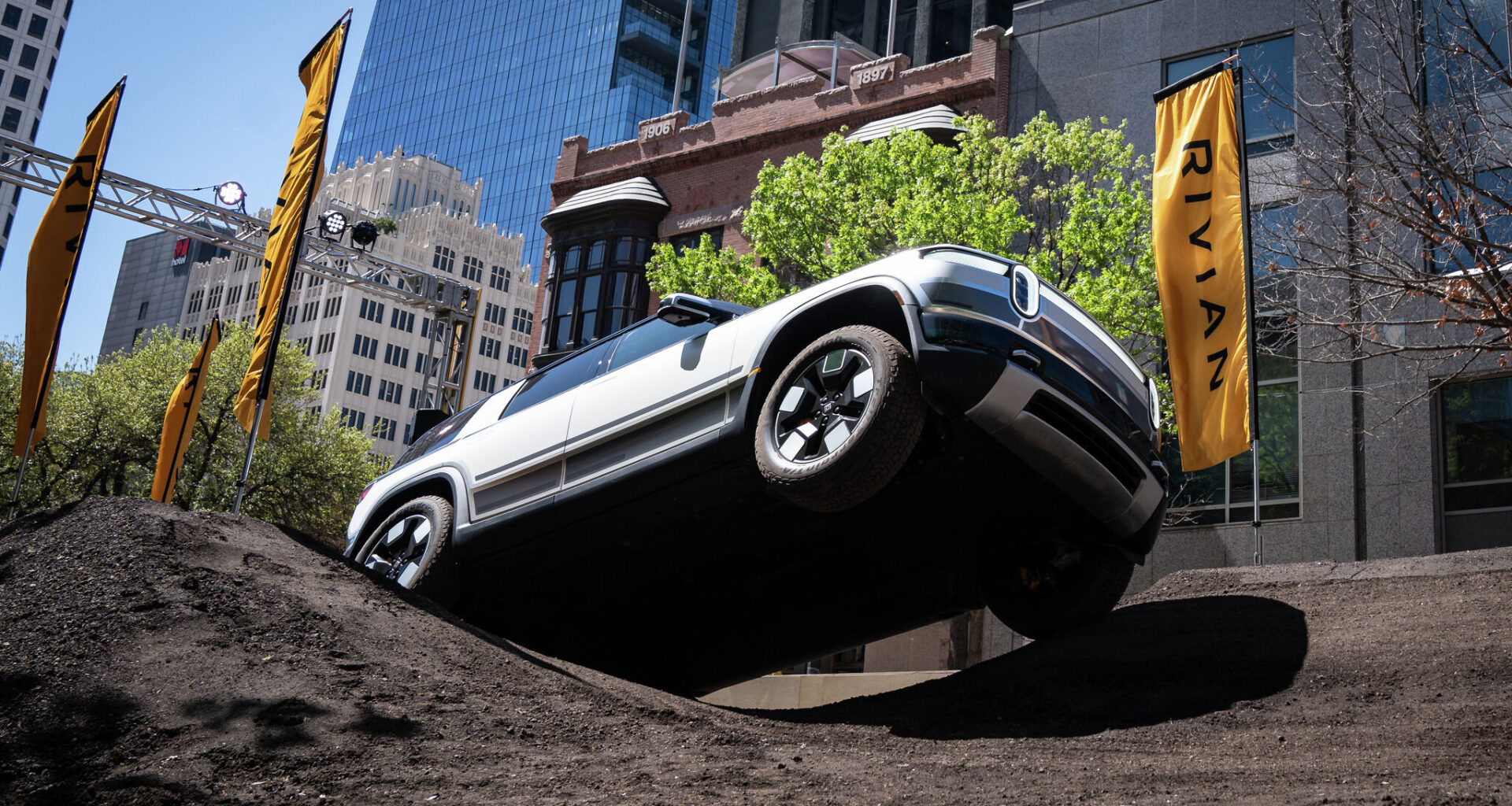
Rivian brought an off-road course to the middle of downtown Austin for SXSW. The EV maker built a 270-foot dirt track on Congress Avenue — using 2,500 tons of recycled asphalt — to showcase its upcoming R2 SUV. bit.ly/40pluer
Austin American-Statesman
Rivian Automotive Inc. is gearing up to launch its new R2 electric SUV in the coming weeks — and is betting Austin will be a major market for it.

The R2 is a five-seat, midsize electric SUV that Rivian is positioning as a mass market vehicle.
Article continues below this ad
The California-based electric vehicle maker served as the headline sponsor of the South by Southwest Conference and Festival earlier this month, where it also showcased the vehicle, underscoring a major push to expand its customer base as deliveries approach.
Company executives say Austin is key to that strategy. Denise Cherry, Rivian’s vice president of marketing, called the city a “priority market” as the automaker looks to deepen its footprint in Texas.
“We anticipate Austin being a really large market for us, and we want as much coverage here in this market as possible, so we continue to explore coverage across the larger Austin metro,” Cherry said.
A state filing earlier this year shows Rivian is also investing in that growth, with plans for a $9.5 million service and sales center in Round Rock.
Article continues below this ad
Rivian’s push into Austin also brings it into closer competition with Tesla Inc., which operates its massive Gigafactory Texas in Travis County and is expanding its autonomous vehicle efforts.
While Rivian is betting on a more accessible SUV to expand its customer base, Tesla has leaned into more futuristic designs, including its autonomous Cybercab concept. The purpose-built robotaxi lacks a steering wheel and pedals and was also showcased during SXSW.
Rivian has said the R2 will start at $57,990 for a performance model, with lower-cost versions expected to reach about $48,490, positioning it below the company’s earlier vehicles, though still above Tesla’s planned Cybercab, which is expected to start at around $30,000.
Rivian R2 trucks drive on an off-road course at the SXSW Rivian Electric Joyride on Congress Avenue the first day of South by Southwest in Austin, Thursday, March 12, 2026.
Sara Diggins/Austin American-Statesman
“More broadly, we’re investing a great deal in both the sales and service experience across the United States,” said Greg Revelle, Rivian’s chief customer officer. “So we started, for the most part, on the coast. And then as we fill out our network — expanding here, Dallas, Houston — there’s a lot of stores across the state, and there’ll be more coming.”
Article continues below this ad
Revelle said the company has about 100 service centers nationwide and plans to add more as it puts additional vehicles on the road.
Entering the robotaxi race
At the same time, Rivian is investing heavily in autonomous technology. Last week, the company announced a deal with Uber to supply 10,000 fully autonomous R2 SUVs for use as robotaxis in cities including San Francisco and Miami starting in 2028.
The companies plan to expand to 25 additional cities across the United States, Canada and Europe through 2031, with Uber holding an option to purchase up to 40,000 additional vehicles beginning in 2030.
Article continues below this ad
Rivian and Uber have not said whether any Texas cities will be included, though Austin has become a hub for autonomous vehicle testing.
Industry leader Waymo, owned by Google parent company Alphabet Inc., has offered driverless rides in Austin for the past year through a partnership with Uber. The company operates a fully driverless fleet of about 200 vehicles and reported four new crashes in its latest disclosure, bringing its total to 60 since June.
Tesla launched its own robotaxi service in Austin in June and has since seen a total of 15 crashes. Tesla, which operates a fleet of fewer than 40 vehicles that still often have human safety monitors, reported one crash in its latest filing to federal regulators.
Zoox Inc., owned by Amazon.com Inc., is also preparing to test its autonomous robotaxi in the city, initially offering rides to employees and their family and friends before opening rides to a limited audience by the end of this year.
Article continues below this ad
For Rivian, its bet on autonomous tech is expected to affect profitability goals. In a SEC filing last week, Rivian said it no longer expects EBITDA, a key measure of profitability, to turn positive by 2027 due to increased spending on its autonomy roadmap.
That follows a challenging year for EVs. In 2025, Rivian reported a 15% drop in automotive revenue, though its software and services revenue grew.
AI and autonomy
The R2 will include lidar sensors and feature an AI-powered Rivian Assistant that can handle tasks such as adjusting the temperature or rescheduling a meeting while owners drive their vehicle.
Article continues below this ad
A Rivian R2 electric vehicle drives over a dirt obstacle course set up on Congress Avenue during the South by Southwest Conference and Festivals in Austin on Thursday, March 12, 2026. Festivalgoers could ride in the vehicles as part of Rivian’s “Electric Joyride” demonstration.
Jay Janner/Austin American-Statesman
“We didn’t seek to build the best electric car. We sought to build the best car, period,” Revelle said. “What we have really pushed on this vehicle is intelligence; that’s the word I would use much more than I would electric. Electric is a component of it, but the whole package is really different from anything you’re going to find on the market today.”
The vehicle will also include a “universal hands-free” assisted driving feature that allows drivers to take their hands off the wheel on 3.5 million miles of roads in the U.S. and Canada if lanes are clearly marked. Using 10 HDR cameras and five radars, Rivian says its vehicles can perceive objects up to 1,000 feet away and offer some personalization. Drivers interested in the feature can set a drive style from the options of mild, medium or spicy.
Revelle, like others in the autonomous driving business, positioned Rivian’s autonomous tech as a plus for road safety.
Article continues below this ad
“One of the reasons we’re investing in all this autonomy technology is because it takes the human out of the loop and will ultimately lead to a much safer environment, not just for the driver and their passengers, but for everybody on the road,” Revelle said. “So that’s actually one of the core reasons why we’re investing so much in autonomy. Because we do believe that at the end of the day there should not be auto related deaths in the United States or anywhere in the world.”
While Rivian rides high for now on the recently announced features, safety regulators are keeping a close watch on driver-assistance and autonomous systems.
Federal safety officials last week intensified a probe into Tesla’s Full Self-Driving system after crashes raised concerns about its performance in low-visibility conditions.
Article continues below this ad
The National Transportation Safety Board is also investigating Waymo after its driverless vehicles reportedly passed stationary Austin school buses more than 24 times since the start of the school year, including at least one incident in which a human operator directed the vehicle to move.