
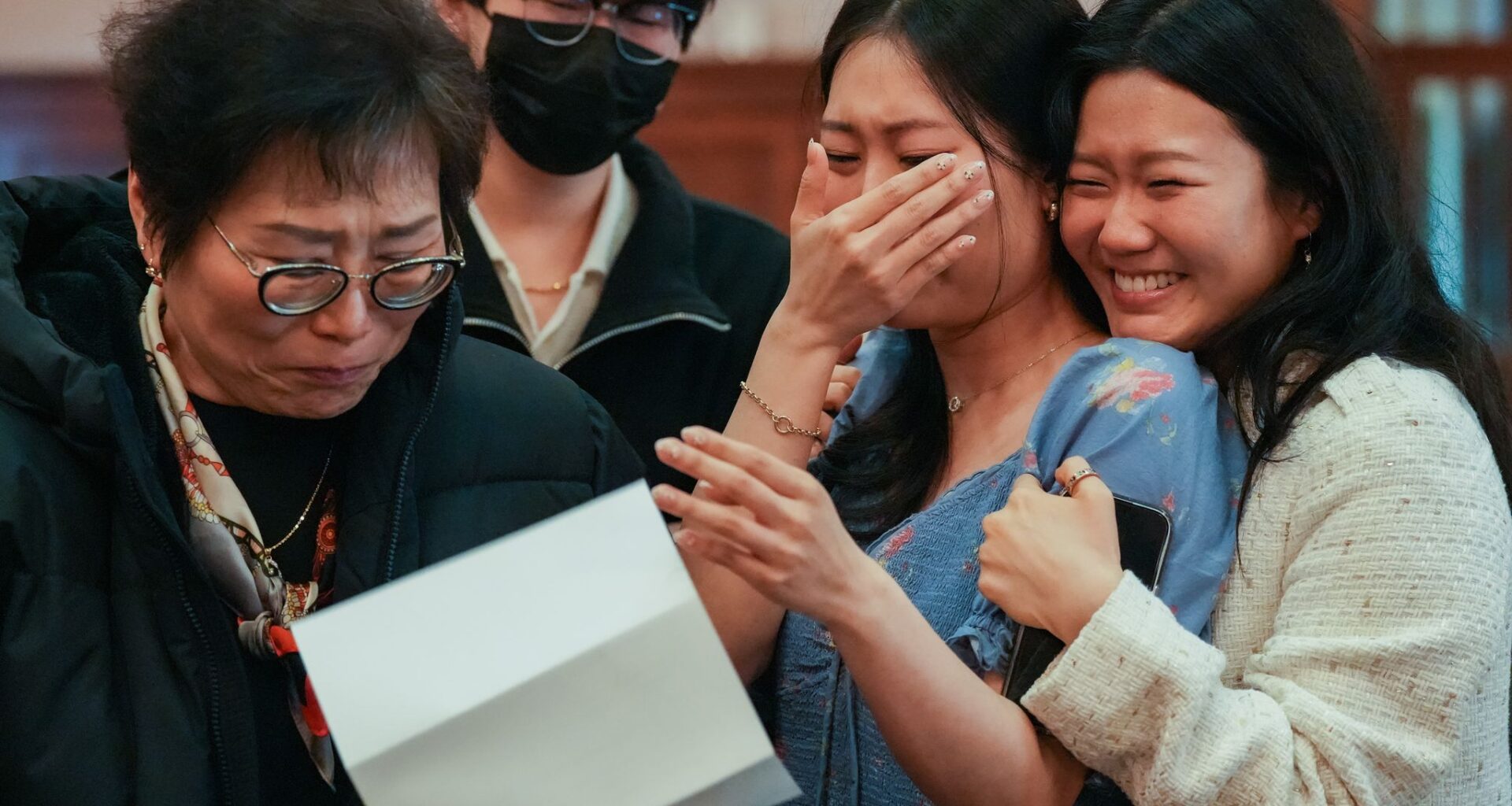
Xena Nam, middle, reacts with her family and friends to her residency match as the graduating class of the University of Texas’ Dell Medical School celebrates Match Day at the Texas Union on March 20. Nam was one of five students selected to do a residency in anesthesiology, which is one of the most competitive residencies. She will be at the University of Texas Health Science Center in Houston.
Mikala Compton/Austin American-Statesman
Mamadou Balde embraces his family as the graduating class of the University of Texas’ Dell Medical School celebrate Match Day at The Texas Union in Austin, Friday, March 20, 2026.
Mikala Compton/Austin American-Statesman
Students pose for photos with friends and family as the graduating class of the University of Texas’ Dell Medical School celebrate Match Day at The Texas Union in Austin, Friday, March 20, 2026.
Mikala Compton/Austin American-Statesman
Alia Pederson hugs a fellow student as the graduating class of the University of Texas’ Dell Medical School celebrate Match Day at The Texas Union in Austin, Friday, March 20, 2026.
Mikala Compton/Austin American-Statesman
Students gleefully pick up their Match Day envelopes as the graduating class of the University of Texas’ Dell Medical School celebrate Match Day at The Texas Union in Austin, Friday, March 20, 2026.
Mikala Compton/Austin American-Statesman
Xena Nam holds her envelope to her face as her friends and family count down to 11 a.m. — the time they students are permitted to open their envelopes, as the graduating class of the University of Texas’ Dell Medical School celebrate Match Day at The Texas Union in Austin, Friday, March 20, 2026.
Mikala Compton/Austin American-Statesman
Dr. Erin Gottlieb hugs student Xena Nam as the graduating class of the University of Texas’ Dell Medical School celebrate Match Day at The Texas Union in Austin, Friday, March 20, 2026.
Mikala Compton/Austin American-Statesman
KC Koepp smiles as she is congratulated as the graduating class of the University of Texas’ Dell Medical School celebrate Match Day at The Texas Union in Austin, Friday, March 20, 2026.
Mikala Compton/Austin American-Statesman
Uma Jacobs celebrates with a friend as the graduating class of the University of Texas’ Dell Medical School celebrate Match Day at The Texas Union in Austin, Friday, March 20, 2026.
Mikala Compton/Austin American-Statesman
Attilie Carrig and her family are applauded as the graduating class of the University of Texas’ Dell Medical School celebrate Match Day at The Texas Union in Austin, Friday, March 20, 2026.
Mikala Compton/Austin American-Statesman
Classmates applaud each other as the graduating class of the University of Texas’ Dell Medical School celebrate Match Day at The Texas Union in Austin, Friday, March 20, 2026.
Mikala Compton/Austin American-Statesman
The graduating class of the University of Texas’ Dell Medical School celebrate Match Day at The Texas Union in Austin, Friday, March 20, 2026.
Mikala Compton/Austin American-Statesman
One of Attilie Carrig’s five children sits on her lap and opens the magic envelope for her at precisely 11 a.m. on March 20.

Inside a University of Texas ballroom, fourth-year medical students are opening their envelopes with cries of joy, high-fives and, for some, a big lump in their throats. Their futures and their families’ futures are revealed in these envelopes.
Article continues below this ad
Medical students across the country open similar envelopes at exactly the same time each year to learn where they will spend their residency after graduating medical school. This event is known as Match Day.
Ten years ago, Dell Medical School welcomed its first class with the promise of bringing more doctors to Austin to teach at the school as well as training more doctors in Austin in the hopes that they might stay in Central Texas — where there is a shortage of primary care physicians — after residency.
Surrounded by her five children, Attilie Carrig opens her Match Day envelope on Match Day.
Mikala Compton/Austin American-Statesman
For Carrig, the envelope brought relief and excitement. She matched with Dell Medical School in internal medicine. She’ll be able to stay in Austin and work at Dell Seton Medical Center and Ascension Seton Medical Center, as well as clinics throughout the city. She chose Dell Medical School for its culture, and she would not have to uproot her family.
Article continues below this ad
“It was either this or I wouldn’t be a doctor,” she said.
Internal medicine appeals to her because of the ability to be more involved in whole patient care and “how everything fits together.”
“I really like the intellectual challenge and complexity of patient care,” she said.
Article continues below this ad
Students pick up their envelopes with their residency program match as the graduating class of the University of Texas’ Dell Medical School celebrates Match Day at The Texas Union in Austin, Friday, March 20, 2026. All 40 students who put in to match received a match, with 20 staying in Texas and 10 in Austin.
Mikala Compton/Austin American-Statesman
Inside the class of 2026
This is the school’s sixth graduating class. In the class of 50, 40 are going directly to residency programs. Ten have deferred graduation for research, dual education programs such as a doctorate, or to do an internship year.
In this class, 50% of the matches were to programs in Texas and half of those at Dell Medical School. Other years have had similar results.
Article continues below this ad
Eleven of the 40 students with a match are going into a primary care residency. The rest are doing a specialty care residency.
This summer, 119 residents from 78 medical schools will start at Dell Medical School residency programs along with 49 fellows, bringing the total to 494. Half of the incoming residents have selected primary care.
Vice Dean James Korndorffer Jr. said those numbers — with half staying in-state, including 25% staying locally and the rest going elsewhere — is what medical schools should strive for.
Having half the residents coming from elsewhere is also a goal.
Article continues below this ad
“It’s essential we pull in great people, but also to send great people out to be our ambassadors,” he said.
Those ambassadors going to prestigious places like the Mayo Clinic, the University of Washington, Georgetown University and the University of Pittsburgh help build the reputation of Dell Medical School, he said.
Matthew Taing reacts as he finds out where he’ll spend his residency. Taing is doing a transitional year to get more experience in a variety of medical fields before heading to the Mayo Clinic to study radiology.
Mikala Compton/Austin American-Statesman
Before the medical school opened, Austin had 259 trainees in 15 residencies and fellowships through UT Southwestern in Dallas. When Dell Medical School opened, it built up what was already here. It now has 17 residency programs and 32 fellowships, with 494 trainees.
Article continues below this ad
Since 2015, 651 doctors completed a residency or a fellowship here and began practicing medicine: 43% stayed in Central Texas, another 21% went elsewhere in Texas, and 36% went out of state.
Coming to Austin and staying
Texas has a shortage of doctors, ranking 41st in the country in the number per 100,000 people, a 2022 Texas Health and Human Services report noted.
This report projected how primary care doctor shortages would increase by 2032:
Article continues below this ad
2,495 more family medicine doctors needed
2,607 more internal medicine doctors
427 more obstetricians and gynecologists
1,913 more pediatricians
1,143 more psychiatrists
The report estimated that to increase the number of doctors in these medical areas, Texas would need to add more medical residencies each year.
88 more family medicine residencies
149 more internal medicine
33 more obstetrics and gynecology
109 more pediatrics
125 more psychiatry
Daniel Ramirez’s parents lead a prayer for him before he opens his envelope showing where he’ll spend his residency. He will train in neurology at Dell Medical School this summer.
Mikala Compton/Austin American-Statesman
Cameron Shew, 31, was a special education teacher in Baltimore before starting medical school in Austin. That teaching experience got him interested in psychiatry. He’ll be staying at Dell Medical School working in psychiatry, which will put him in emergency rooms at Dell Seton and Ascension Seton, as well as in inpatient care at Cross Creek Hospital and Austin State Hospital.
Article continues below this ad
Lia Varghese, 26, also will be doing internal medicine here. She calls internal medicine “bread and butter medicine” and is perfect for people like herself who love all aspects of medicine, not just one particular organ.
Dell Medical School residency programs also work within clinical settings, not just hospitals, and many of those clinics such as CommUnityCare, Central Health, People’s Community Clinic, Integral Care and Lonestar Circle of Care focus on care for an underserved population.
Jon Philip Trujillo puts his horns up as he announces he will be staying in Texas for his residency.
Mikala Compton/Austin American-Statesman
Many of this year’s graduates who will stay at Dell Medical School are students who had a previous career.
Article continues below this ad
Justin Jensen, 40, was a Green Beret in the Army and served in Afghanistan, Central and South America, and Asia, before he started medical school. He’s going into orthopaedic surgery because of the care he saw his fellow soldiers receive after injuries. Dell Medical School was his choice because of the focus on value-based care, not just going through the process of what medically can be done, he said.
KC Koepp, 37, flew C130 planes in the Marines for eight years, and will be doing a general surgery residency here. The way colleagues work together, do procedure checks and solve problems in the operating room is very similar to flying a plane, she said.
Jon Philip Trujillo, 32, left a financial career at Goldman Sachs to go back to school to take prerequisites such as intro to biology before he could enroll in medical school. He’ll be training in neurology at Dell Medical School, which has become known for its stroke research.
Article continues below this ad
“It took a long time to get here,” he said.