
Lightning strikes behind the campus of the University of Texas as a severe thunderstorm passes over Austin on May 28, 2025.
Sara Diggins/Austin American-Statesman
Springtime in Texas is when the atmosphere starts flexing its muscles and severe weather sneaks into the weekly forecast. This is also when the jet stream dips across the southern United States, sending disturbances into Texas and lining up all the right ingredients — moisture, temperature contrasts and atmospheric instability — for storms to fire up.

But in Austin, one date carries a little extra significance: March 25, aka Austin Hail Day, because some of the most destructive and costly hailstorms in the city’s history have all struck on this exact date.
Article continues below this ad
So, if severe storms are ever in the forecast on this date, Austinites might want to keep an eye on the sky, clear out the garage to hide your vehicle, and get ready to say, “Oh, hail no!”
What’s Austin Hail Day?
Over the past 30 years, March 25 has built a reputation for bringing some of the worst hailstorms in Austin’s history. Four major events — in 1993, 2005, 2009, and 2021 — have all struck on this same date, with three ranking among the costliest on record.
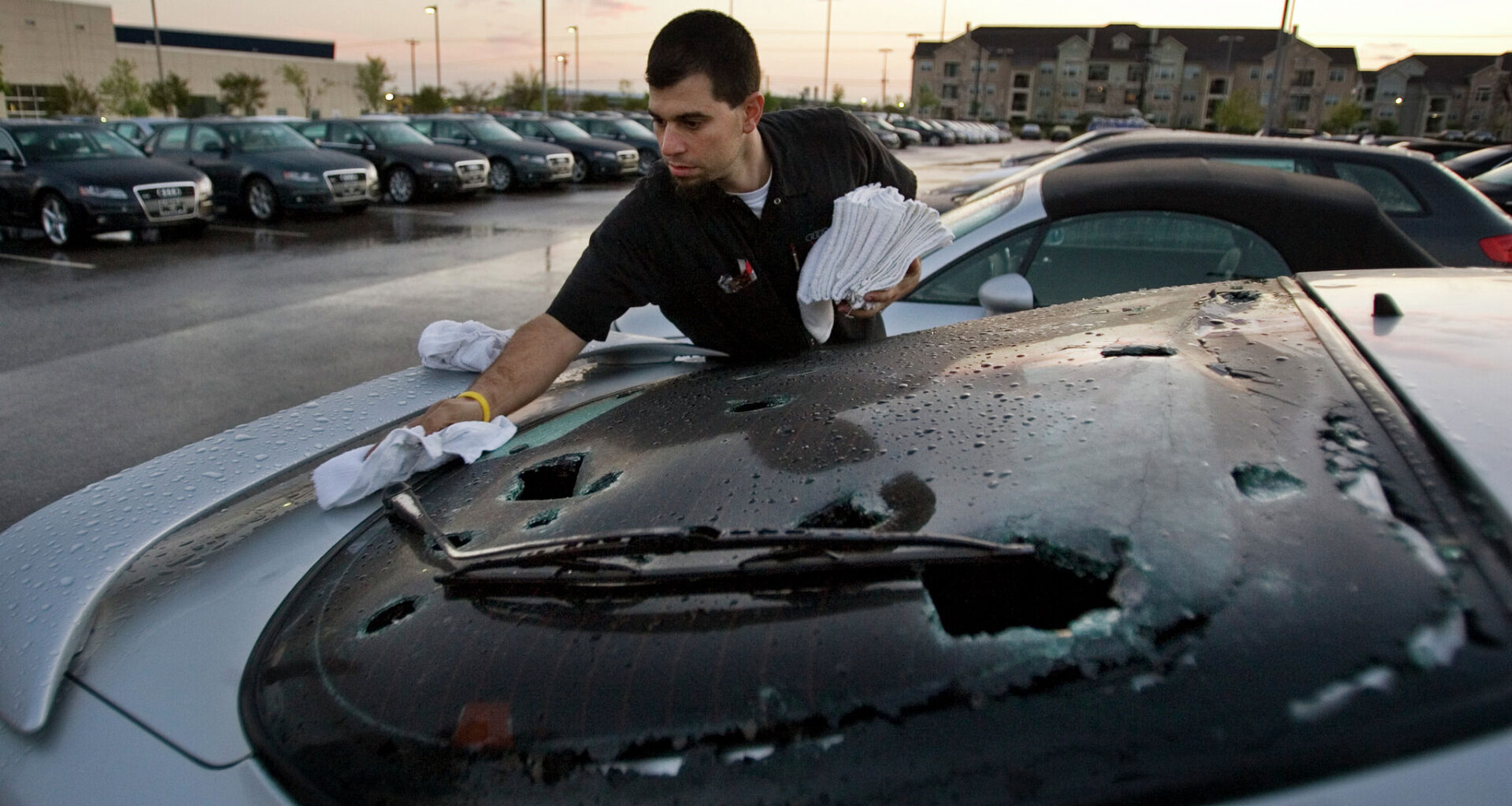
Large hail can smash windows and leave dents in exposed cars, like those damaged at the Roger Beasley Audi dealership on Pond Springs Road in Northwest Austin on March 25, 2009.
Jay Janner/Austin American-Statesman
1993: A destructive storm slammed Austin, producing tennis ball-size hail and causing $125 million worth of damage.
2005: Egg-size hail battered the Lake Travis area, resulting in $100 million in damage costs.
2009: A major hailstorm hit during the afternoon commute, catching drivers on the road. Golf ball- to teacup-size hail caused more than $150 million worth of damage along the Travis-Williamson county line.
2021: An early morning storm dropped nickel- to golf ball-size hail across Austin. This hailstorm fell during the morning commute so many cars were damaged and this one event triggered millions of dollars in roof and automobile hail damage claims.
Article continues below this ad
What is hail?
Hail is a type of frozen precipitation made of balls or lumps of ice that fall from thunderstorms. It forms when high winds, called updrafts, carry raindrops high into the cold parts of the storm, where they freeze. Those ice pieces can get lifted up and down several times, adding new layers of ice with each trip. Once they become too heavy for the updraft to hold them up, they fall to the ground.
Diagram of hail formation within a thunderstorm made by the National Weather Service in Portland.
National Weather Service
Overall, hailstorms cause a staggering $1 billion in damage costs annually throughout the United States, according to the National Oceanic and Atmospheric Administration, and it’s that time of the year again when severe weather is a common occurrence in the Lone Star State.
Article continues below this ad
Although tornadoes and straight-line winds cause significant damage, they are rare compared to hail, which often accompanies strong thunderstorms and can be highly destructive.
HAIL ALLEY: What parts of Texas see the most hail?
The most common hail is pea-size, but hailstones can grow as large as golf balls and baseballs. In extreme cases, hail can reach the size of a softball, grapefruit or even a pineapple!
Article continues below this ad
The largest hailstone in Texas history was found near Virgo Park, outside of Amarillo, on June 2, 2024, measuring 7.25 inches in length, surpassing the previous record of 6.41 inches set in Hondo in 2021.
How to protect your property from hail?
To help protect your home from hail damage, choosing a hail-resistant roofing material is key. According to roofing experts, steel and other metal roofs are among the most effective options for standing up to hail.
Article continues below this ad
When it comes to your car, the best protection is simple: Park it in a garage or under a carport. If that’s not an option, here are a few ways to reduce potential damage:
Park under a sturdy structure if possible—even a thick tree canopy can help. Don’t forget to fold in your side mirrors to prevent cracking.
Use a hail cover or thick blankets to protect your car, especially the windows.
Flatten cardboard boxes and secure them on your windshield under the wipers.
Place your car’s floor mats on the windshield, with the soft side down and rubber side facing up.
If you have a roof rack, placing a piece of plywood on top can add an extra layer of protection against dents.