
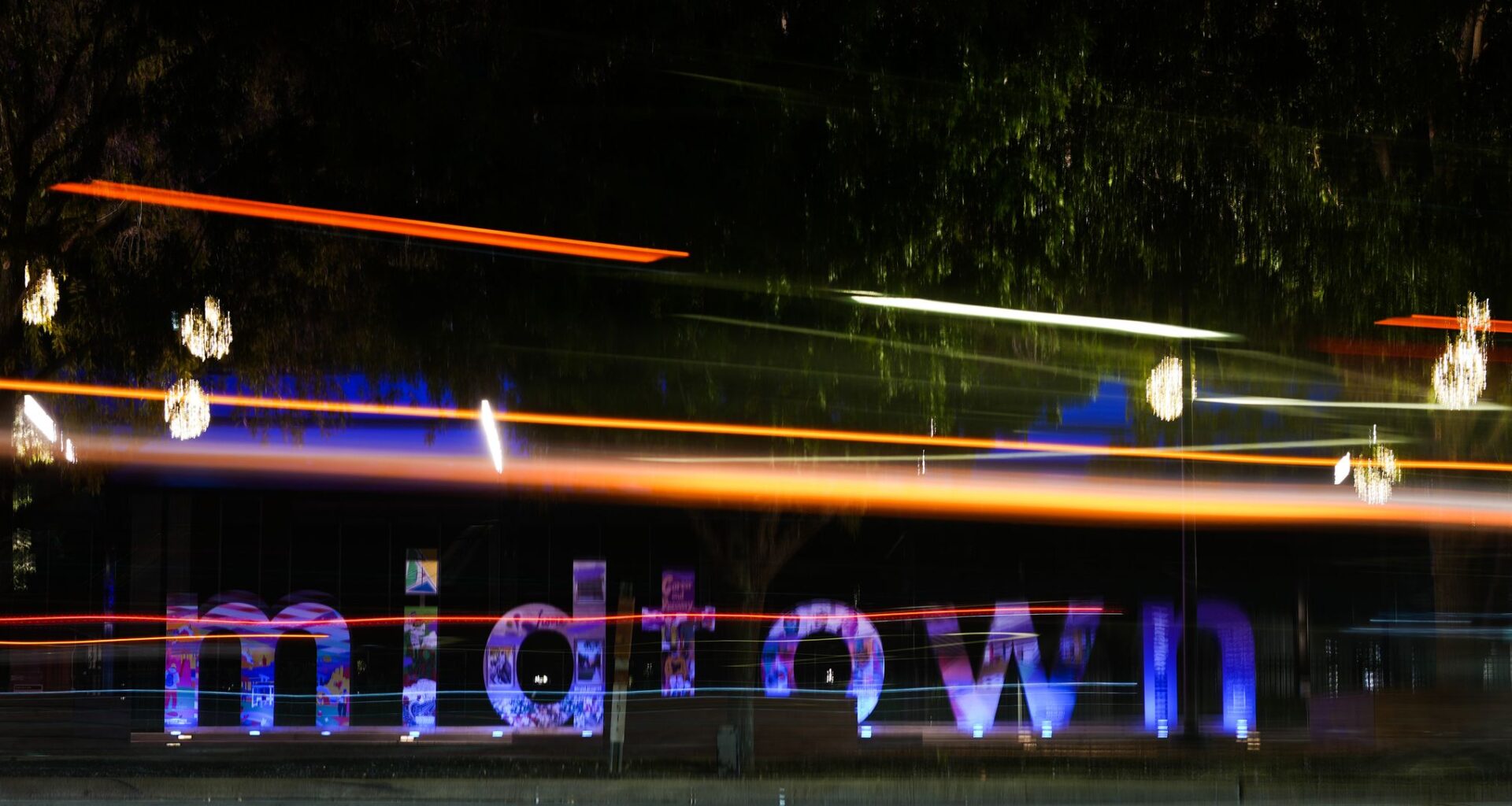
Cars drive by Bagby Park in Midtown in Houston on Thursday, Oct. 30, 2025.
Elizabeth Conley/Houston Chronicle
People wait in line for a concert at Warehouse Live Midtown in Houston.
Jason Fochtman/Staff photographer
A man sleeps on the sidewalk near the closed down Greyhound bus terminal in the Midtown area of Houston, Monday, Sept. 29, 2025.
Brett Coomer/Houston Chronicle
Michael Lewis thought of himself as an “urban pioneer” when he and his wife bought a home in Midtown in 1998. Situated just south of downtown, the neighborhood was a sparsely populated patchwork of vacant lots and blighted buildings nestled between Montrose, Third Ward and Fourth Ward.
Nearly 30 years later, Midtown has become the fastest-growing neighborhood in Houston, according to a Houston Chronicle analysis of U.S. Census Bureau data.
The neighborhood’s population grew by roughly 35% between 2019 and 2024, a surge driven by an increase in Black, Hispanic and Asian residents. Experts say the data shows a growing appetite for a dense urban lifestyle in Houston, long considered an oxymoron in the sprawling city.
Article continues below this ad
“There’s this young adult diversification taking place, and we see that as signaling that people are moving in for jobs and proximity to things to do, and that’s a big feature of what Midtown has to offer,” said Dan Potter, director of the Houston Population Research Center at Rice University’s Kinder Institute for Urban Research.
Midtown’s evolution
Before the thickets of townhomes and nightclubs took root, the only real signs of life in Midtown were in “Little Saigon,” an area around Milam Street packed with Vietnamese restaurants and grocery stores that opened after the Fall of Saigon. The corridor, though, was more commercial than residential, and by the late 1990s many businesses had started to relocate to the present-day Asiatown on Bellaire Boulevard.
But others saw the area’s potential — an inner-city neighborhood full of cheap land between downtown, Rice University and the Texas Medical Center.
Article continues below this ad
The Midtown Redevelopment Authority was founded in 1992, and City Council made Midtown the second-ever Tax Increment Reinvestment Zone soon after, developing a pipeline for public funds to be used on parks, infrastructure and beautification efforts. Reading the tea leaves, developers began to scoop up massive tracts of land in the area for housing marketed to young professionals.
Move-in trucks parked in front of Camden Property Trust’s apartment community in Midtown Houston on July 29, 2022. Strong migration to the Sun Belt, robust job growth and a tight housing market are keeping demand for apartments high, meaning rents are likely to increase this year despite worries about a recession.
Marissa Luck/ Houston Chronicle
Lewis, who now serves on the MRA board, was having lunch in the Enron cafeteria when a coworker told him about a new development of 34 townhomes being built near Baldwin Park, on the east side of Midtown. He and his wife missed the urban lifestyle in Atlanta and wanted to recreate that life in Midtown.
“We were looking to replicate that vibe we had in Atlanta, very urban,” Lewis said, making clear he was speaking in his capacity as a resident rather than a board member. “And being so close to downtown for work also meant being close to downtown for nightlife, theater … and all that kind of stuff.”
Over the ensuing decades, thousands of townhomes and apartments sprouted across the neighborhood, with new green spaces tucked in between. The city built a light rail line through the heart of Midtown, connecting it to downtown and the medical center. A host of restaurants and bars popped up to meet the needs of a young customer base with money to spend.
Article continues below this ad
In recent years, the neighborhood has grown increasingly diverse. People of color now account for 62% of Midtown’s population, up from 43% in 2019.
Allen Douglas, the recently appointed board chair of the Midtown Redevelopment Authority, said Midtown’s popularity and diversity comes in part from the variety of housing it offers to residents, from luxury apartments to modest studios to single-family townhomes.
Giselle Martinez, president of the Midtown Super Neighborhood, moved to the neighborhood in 2018. Having grown up in the small town Shepherd, Martinez said she loves Midtown for the sense of excitement, opportunity and community that comes from living in a dense urban environment.
“Why wouldn’t you want to live in Midtown? You’re literally smack dab in the middle of the city,” Martinez said. “I don’t blame people for moving here and I commend it actually. I’m glad they’re coming.”
Article continues below this ad
Unrealized potential?
Midtown’s sustained growth would appear to indicate that the vision of a vibrant urban community in the heart of Houston has been realized. And yet, some feel that the neighborhood still hasn’t quite lived up to its potential.
“There were all these catalytic projects and ideas of like, ‘This is what’s going to start the wave.’ But no big wave ever came,” Lewis said. “Over 25 years plus, Midtown never got that pop. It never took off like we thought it was going to, like it should have.”
Major corridors into downtown are still lined with vacant lots or dilapidated buildings, where there could be new housing or shopping centers. Lewis said that outside investment in the neighborhood has fallen short of expectations, given Midtown’s growing population and geographic advantages.
The conversation reached a fever pitch last year when Houston social media users eagerly debated whether Midtown had “fallen off” from its mid-2010s prime, saying it had gone through “reverse gentrification” and was becoming “the hood again.” Online commenters painted the neighborhood as a hotbed of crime, despite data indicating that crime rates in the area have fallen significantly faster than in the rest of the city.
Article continues below this ad
Martinez said the impression that Midtown is dangerous could come from its reputation as a nightlife destination, where people might emerge from bars to broken car windows or rowdy drunks on the street.
In recent years, the homeless population has become increasingly visible on Midtown streets as well, adding to the perception that the neighborhood may be in decline. But Martinez said her car windows have been busted before — by far the most commonly reported crime in Midtown — and that the perpetrators were a group of bored teenagers, rather than a homeless person.
“Everybody assumes it was the unhoused,” Martinez said. “We’re so quick to judge.”
Douglas said that in his first meeting with neighborhood police captains, he was told the most common complaints they receive are noise complaints and complaints about the homeless.
From left, A man sleeps on the sidewalk near the closed down Greyhound bus terminal in the Midtown area of Houston, Monday, Sept. 29, 2025., People wait in line for a concert at Warehouse Live Midtown in Houston.
Brett Coomer / Houston Chronicle, Jason Fochtman / Houston Chronicle
From left, A man sleeps on the sidewalk near the closed down Greyhound bus terminal in the Midtown area of Houston, Monday, Sept. 29, 2025., People wait in line for a concert at Warehouse Live Midtown in Houston.
Brett Coomer / Houston Chronicle, Jason Fochtman / Houston Chronicle
He said the redevelopment authority is taking a multi-pronged approach to quality-of-life issues in Midtown, paying for private security services and constable patrols while also working with the numerous nonprofits and faith-based groups in the area that provide services to homeless residents.
Midtown’s future
Under new leadership, the Midtown Redevelopment Authority is trying to close the page on a difficult chapter that saw tens of millions of dollars being spent on questionable ventures that damaged public trust.
“The problems of the past have been well chronicled, and rightly so, but we’re not dwelling on that,” Lewis said. “We’re moving forward, reimagining the neighborhood and the story we’ll want to tell is that Midtown is still attractive for living and open for business.”
Regarding the need for more commercial development in the area, Douglas said that the redevelopment authority is hoping to amend local ordinances that would allow Midtown to offer incentives already being used in downtown to attract businesses.
“We have developers who have approached us with interest in purchasing some of the fallow land that’s (near) the Red Line and building it up, and so all of those things tell me that we have interest,” Douglas said. “We just need to be able to engage that interest in a way that’s meaningful to developers.”
A Metro light rail train rolls up Main Street, Tuesday, Feb. 18, 2020, in Houston’s midtown area.
Mark Mulligan/Staff photographer
Midtown’s continued residential growth is difficult to project, experts say. As a whole, the city of Houston is expected to see its growth tempered over the next several years as President Donald Trump embarks on a sweeping immigration crackdown, with domestic migration to the state also slowing down.
But whether Midtown serves as a model for densification across the rest of the city could shape Houston for decades to come. Potter noted that other Inner Loop neighborhoods like Second Ward and Third Ward are already undergoing similar transformations.
“It’s an intentional effort at densification happening (in Midtown),” Potter said. “One thing to continue checking in on is whether this type of life in Houston is something people are ultimately into. There’s a part of me that wonders if it’s a flash in the pan or if it’s the next wave of development in the city?”