
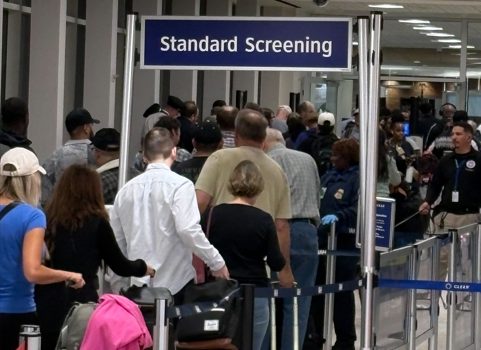
Houston’s George Bush Intercontinental Airport kicked off Wednesday with TSA security wait times at three to four hours, on the third day since the Trump administration sent ICE to assist with staffing shortages.
Photo by Peter Warren
As days turn into weeks for the partial government shutdown, Transportation Security Administration officers are being stressed to the max.
Since the shutdown began on Feb. 13, TSA employees have missed nearly $1 billion in paychecks, officials said Wednesday.
This week, a new development created a striking dichotomy between how different government employees are treated. On Monday, Immigration and Customs Enforcement officers were deployed to airports to attempt to alleviate the staffing crisis. Unlike their TSA colleagues, the immigration agents are still drawing a paycheck.
Article continues below this ad
How is that possible? To understand, you need to look at the way the different branches within the Department of Homeland Security are funded.
Same agency, different sources
Both TSA and ICE have been part of the Department of Homeland Security since the agency was created in 2002. The agency also oversees U.S. Customs and Border Protection, U.S. Citizenship and Immigration Services and FEMA, among other agencies. More than 260,000 people work for DHS.
DHS is typically funded through an annual appropriation that must be approved by Congress, and that funding bill is what’s at the center of the current shutdown. In the wake of the fatal shooting of U.S. citizens by immigration officers in Minnesota, Democrats had insisted on reforms that would put new limits on ICE and CBP operations. Among other things, Democrats have called for ICE agents to be banned from wearing masks and from conducting raids without judicial warrants.
Article continues below this ad
The Trump administration hasn’t agreed to those demands and has made counterproposals that haven’t satisfied Democrats. For want of an agreement, DHS’s annual funding has lapsed, causing the shutdown.
The shutdown ostensibly affects all of DHS’s subagencies. However, ICE and CBP have been able to continue paying their employees because of a different law passed last year: the “One Big Beautiful Bill Act.”
That bill created a discretionary fund for the two immigration agencies that effectively insulated them from government shutdowns. The Trump administration used a similar strategy to keep paying CBP, ICE and other law enforcement agencies during last fall’s shutdown.
Other employees, like TSA officers, need to wait until the shutdown ends to receive a paycheck.
What happens if TSA officers don’t report to work?
A TSA officer, left in blue, holds up the line as he paces air travelers progressing through the long lines at the security checkpoint in Terminal A at the George Bush Intercontinental Airport, Monday, March 23, 2026, in Houston. (AP Photo/Michael Wyke)
Michael Wyke/Associated Press
TSA officers are considered essential government employees and are expected to continue to show up for work, even if they aren’t being paid.
Article continues below this ad
The problems at airports seen during the shutdown have at least partly been caused by TSA calling out and not reporting for their shifts, leaving a shortage of screening officers. On Tuesday, about 40 percent of the TSA officers at George Bush Intercontinental Airport didn’t show up, according to the New York Times.
During last year’s shutdown, acting TSA Administrator Ha Nguyen McNeill said that some employees weren’t showing up for “illegitimate purposes.”
“During this challenging time, this is particularly demoralizing and unfair, and will not be tolerated,” McNeill wrote.
Still, it’s unclear if any workers faced consequences for their no-shows during the shutdown. After the 2025 shutdown ended, some TSA officers were awarded $10,000 bonuses for continuing to work.
What is ICE doing at airports?
Federal immigration agents peer over railings on the floor above the lines of air travelers progressing to the TSA security checkpoint in Terminal C at the George Bush Intercontinental Airport, Monday, March 23, 2026, in Houston. (AP Photo/Michael Wyke)
Michael Wyke/Associated Press
The Trump administration began sending ICE agents to U.S. airports on Monday after the president said they would help with staffing shortages caused by the shutdown. The agents aren’t performing security screenings, according to White House border czar Tom Homan. Instead, they are doing things like monitoring entrances and exits and performing crowd control, which the administration says could free up TSA officers to perform more specialized tasks.
Article continues below this ad
Wait times at George Bush Intercontinental Airport have fluctuated between from as long as 4 hours to as little as 35 minutes in recent days. Only two of the airport’s terminals have open TSA checkpoints as of Wednesday. The long delays at Bush are the worst in the country.
Wait times at William P. Hobby Airport haven’t been affected this week; TSA lines at the smaller facility have been 10 minutes or less.