
For many women, the way they describe perimenopause is simple: they don’t feel like themselves.
Researchers have studied that exact phrase and found it is likely the most common way women first present symptoms.
That’s why women must track their moods and symptoms consistently to advocate for medical care, such as hormone testing, local health experts said.
“Know your body. Advocate for yourself,” licensed professional counselor Mone’t Smith told a crowd at UTA. “Even if they won’t listen to you — because I know the first one I went to didn’t listen to me.”
“The M Factor 2: Before the Pause,” a documentary that explores perimenopause through expert interviews and women’s firsthand accounts, premiered at the University of Texas Arlington on March 19. Hosted by the university’s Maternal & Reproductive Health Equity Research Lab, the screening was part of a national tour with UTA serving as the official Texas host.
Kyrah K. Brown, the research lab’s director, defined perimenopause as the transitional phase leading up to menopause, marked by hormonal shifts that can show up as irregular periods, hot flashes, mood swings, sleep disruption and brain fog.
While menopause itself is clinically defined as 12 consecutive months without a menstrual period, Brown said the transitional years before that point are often overlooked.
“We say these things kind of lightheartedly, and these symptoms have become normalized,” Brown said. “But really recognizing that this may be a sign of something deeper.”
The film, co-produced by Tamsen Fadal and Denise Pines — who joined the Arlington audience via video call — is the follow up to “The M Factor” documentary, which was released in 2024.
The sequel grew directly out of audience demand, Fadal said.
“They really wanted more information about these years leading up to menopause, which could be anywhere from four to 10 years, and some of the most chaotic years of a woman’s life,” she said.
The sequel’s focus on the perimenopausal years blends clinical expertise with women’s lived stories across heart health, bone health, brain function and sexual wellness.
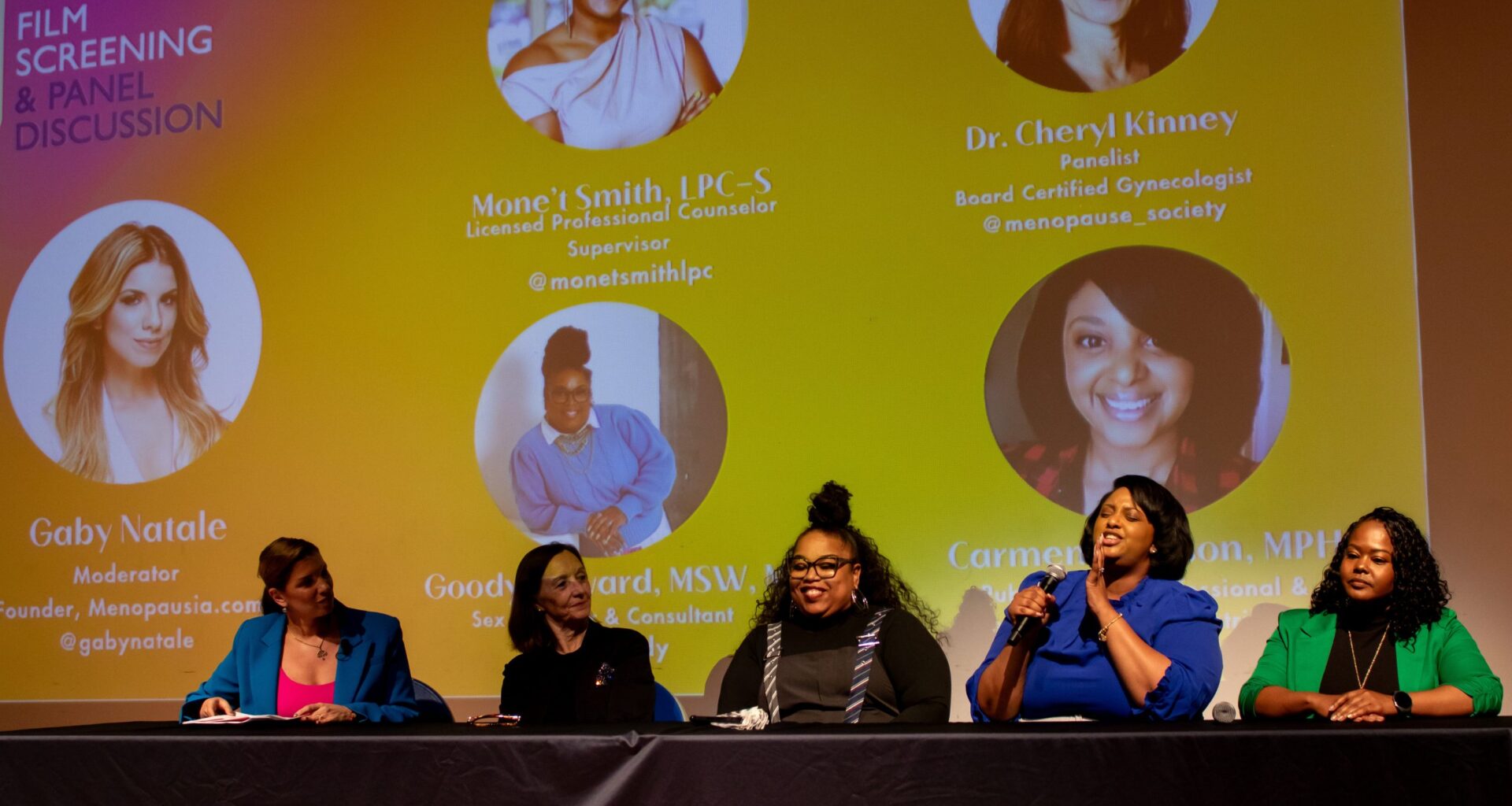
The panel, which followed the screening, was moderated by Gaby Natale, journalist and founder of Menopausia, a bilingual menopause resource. It included gynecologist Dr. Cheryl Kinney, sex educator and consultant Goody Howard, public health professional Carmen Johnson and Smith.
Johnson described her experience navigating symptoms that were initially dismissed.
“I was told by a physician that you’re too young to be experiencing these things,” Johnson said. Symptoms including extreme fatigue, sleep disruption and vaginal dryness were attributed to stress or aging. “I just don’t feel like myself.”
That phrase, referred to in the film as NFLM, or “not feeling like myself” surfaced throughout the evening. It drew audible recognition from the audience.
A recurring theme was the gap between women’s experiences and the clinical care available to them.
Kinney, president of The Menopause Society, referenced a 2002 Women’s Health Initiative study that generated alarming headlines over potential risks, which caused a generation of doctors to stop prescribing hormone therapy and to largely stop learning about menopause altogether.
“Getting your menopause information on social media is like going to a gas station to buy sushi,” Kinney said, drawing laughter from the audience.
Kinney said The Menopause Society is now funding training for the future generation of clinicians. She encouraged attendees experiencing symptoms to seek a certified provider.
Howard addressed the impact of perimenopause on sexual health, noting that the drop in estrogen affects not just physical comfort but intimacy and desire in ways that rarely get attention or treatment compared to what is available for aging men.
Natale closed the discussion with a reminder that perimenopause coincides with what is often a woman’s peak professional and financial period.
“Please do not allow anyone to reduce yourself to just a bunch of symptoms,” Natale said. “This can be the best chapter.”
Brown said she hopes the event reaches beyond those already experiencing perimenopause to partners, family members and students who could benefit from knowledge.
She pointed to workplace impact as an underaddressed dimension of the issue, saying better policies are needed to support employees managing severe symptoms.
“We have to think about it holistically, not just as a clinical issue,” Brown said.
Nicole Williams Quezada is a reporting fellow for the Fort Worth Report. Contact her at nicole.williams@fortworthreport.org
At the Fort Worth Report, news decisions are made independently of our board members and financial supporters. Read more about our editorial independence policy here.
This <a target=”_blank” href=”https://fortworthreport.org/2026/03/25/perimenopause-film-screening-brings-womens-health-conversation-to-uta/”>article</a> first appeared on <a target=”_blank” href=”https://fortworthreport.org”>Arlington Report</a> and is republished here under a <a target=”_blank” href=”https://creativecommons.org/licenses/by-nd/4.0/”>Creative Commons Attribution-NoDerivatives 4.0 International License</a>.<img src=”https://i0.wp.com/fortworthreport.org/wp-content/uploads/2021/04/cropped-favicon.png?resize=150%2C150&quality=80&ssl=1″ style=”width:1em;height:1em;margin-left:10px;”>
<img id=”republication-tracker-tool-source” src=”https://fortworthreport.org/?republication-pixel=true&post=461538&ga4=2820184429″ style=”width:1px;height:1px;”><script> PARSELY = { autotrack: false, onload: function() { PARSELY.beacon.trackPageView({ url: “https://fortworthreport.org/2026/03/25/perimenopause-film-screening-brings-womens-health-conversation-to-uta/”, urlref: window.location.href }); } } </script> <script id=”parsely-cfg” src=”//cdn.parsely.com/keys/fortworthreport.org/p.js”></script>