
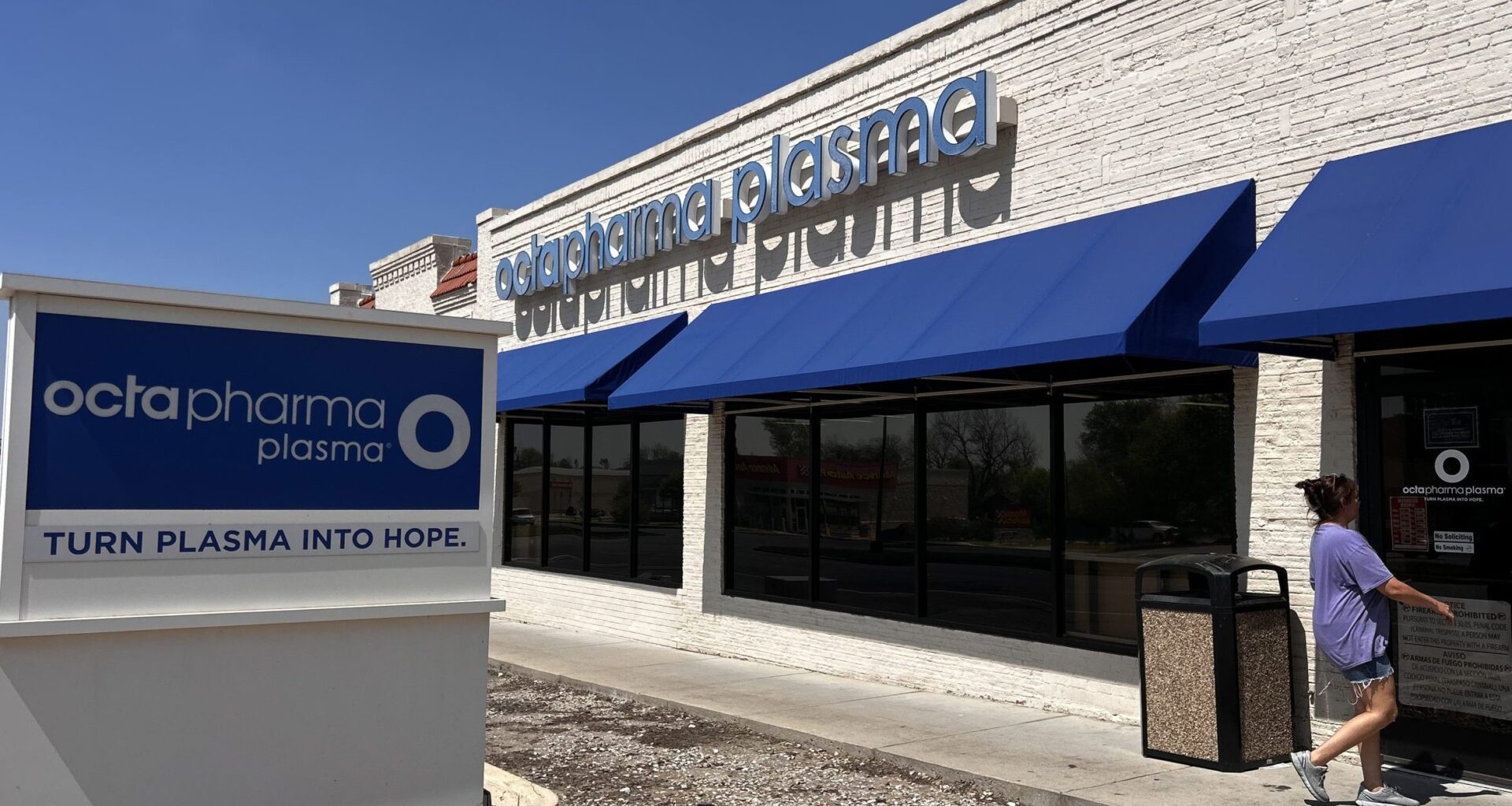
Fort Worth has about doubled the number of plasma donation centers it has over the last 20 years.
The city now has seven plasma centers and 15 across Tarrant County, according to an analysis from the Fort Worth Report. An eighth center is set to open in Fort Worth’s Riverside soon.
In 2004, the city had only three, said Peter Jaworski, a Georgetown University professor and a national expert on plasma donation.
This increase is a trend reflected nationwide. The number of donation centers more than doubled from 2014 to 2021, according to a study by researchers from Washington University in St. Louis and the University of Colorado Boulder.
Texas leads the country with the most plasma donation centers at 186 as of 2025, Jaworski said.
That growth in centers will likely continue as nations become reliant on the United States’ steady and consistent flow of the yellow liquid that makes up most of the blood in your body.
“There’s patients around the world who desperately need the medicine that plasma centers provide,” Jaworski said.
What is plasma?
Plasma is the liquid part of your blood excluding red blood cells, white blood cells and platelets. The yellow liquid is mostly made of water and contains minerals, proteins and salts. Plasma helps carry red and white blood cells throughout the body, removes waste products from the liver and kidneys, maintains blood pressure, and regulates body temperature.
Despite the name, plasma donation centers differ from regular blood donation in one distinct way — people who donate can be paid.
The procurement of plasma for money has long been discouraged by the World Health Organization. The United States is one of a handful of countries that allow donors to be paid.
Internationally, ethical debates around plasma donation for money continue. Detractors often point to the targeting of low-income neighborhoods as a touchpoint for the moral issues surrounding paid donations.
Why is plasma needed through donation?
Plasma is used in more specific ways than regular blood donation, according to the American Red Cross. It’s used for people who have experienced severe traumas — such as burns or shocks — and for people in cancer treatment.
The protein in plasma is used for therapies and medications for conditions such as hemophilia and primary immunodeficiency.
Nearly 10,000 units of plasma are needed every day in the United States, according to the American Red Cross.
However, as demand for plasma has increased and the stigma around donating has shrunk, more centers have opened in middle-income neighborhoods, according to a recent article from The New York Times.
The global need for plasma has been met mostly by the United States — 68% of plasma used worldwide comes from Americans, Jaworski said.
He calculates demand for immunoglobulin, one of the proteins in plasma needed the most for medical therapies, will increase 6%-8% annually over the next decade.
Since becoming an expert in the field, Jaworski sees the ethical debate around paying plasma donors to be hypocritical.
“I thought at the time — and still do today — that the point of collecting plasma is not to give you or me or anybody else an opportunity to express our altruism,” Jaworski said. “It’s about ensuring that patients have the medicine they need in order to live.”
Are you eligible to donate plasma?
These are the general requirements for plasma donation, according to the U.S. Department of Health and Human Services.
Be at least 18 years old.
Weigh at least 110 pounds.
Pass an exam and complete medical screening, including testing negative for hepatitis and HIV.
Have not received a tattoo or piercing within the last 4 months.
Follow a recommended diet.
Food and Drug Administration guidelines allow people to donate twice a week.
More people in the United States look to plasma donation as a source of passive income, according to recent news coverage from NBC News..
More than 75 million individual donations were made in 2025, equating to $4.7 billion in compensation, according to estimates from the Georgetown Blood and Plasma Research Group.
People generally earn $30-$100 for each donation, depending on the location of the center, according to GoodRx.
The demand is mostly rooted in need internationally and less so to match the growing desire to donate, Jaworski said.
“It’s not like these companies provide a service to the donors,” Jaworski said. “They collect the raw material that is turned into medicine for patients around the world.”
Ismael M. Belkoura is the health reporter for the Fort Worth Report. His position is supported by a grant from Texas Health Resources. Contact him at ismael.belkoura@fortworthreport.org.
At the Fort Worth Report, news decisions are made independently of our board members and financial supporters. Read more about our editorial independence policy here.
This <a target=”_blank” href=”https://fortworthreport.org/2026/03/25/donating-plasma-in-tarrant-county-where-can-you-go-and-what-to-know-beforehand/”>article</a> first appeared on <a target=”_blank” href=”https://fortworthreport.org”>Fort Worth Report</a> and is republished here under a <a target=”_blank” href=”https://creativecommons.org/licenses/by-nd/4.0/”>Creative Commons Attribution-NoDerivatives 4.0 International License</a>.<img src=”https://i0.wp.com/fortworthreport.org/wp-content/uploads/2021/04/cropped-favicon.png?resize=150%2C150&quality=80&ssl=1″ style=”width:1em;height:1em;margin-left:10px;”>
<img id=”republication-tracker-tool-source” src=”https://fortworthreport.org/?republication-pixel=true&post=461715&ga4=2820184429″ style=”width:1px;height:1px;”><script> PARSELY = { autotrack: false, onload: function() { PARSELY.beacon.trackPageView({ url: “https://fortworthreport.org/2026/03/25/donating-plasma-in-tarrant-county-where-can-you-go-and-what-to-know-beforehand/”, urlref: window.location.href }); } } </script> <script id=”parsely-cfg” src=”//cdn.parsely.com/keys/fortworthreport.org/p.js”></script>