
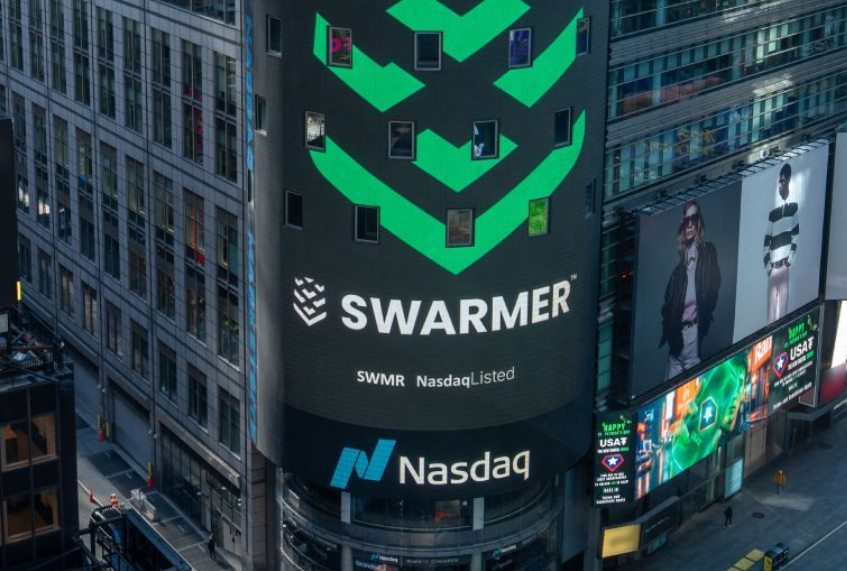
Swarmer Inc. (SWMR:NASDAQ) closed its previously announced initial public offering of 3,450,000 shares of common stock, including the full exercise of the underwriters’ option to purchase an additional 450,000 shares, at a public offering price of US$5.00 per share. The company reported net proceeds of approximately US$14.7 million after deducting underwriting discounts, commissions, and estimated offering expenses. The shares are listed on the Nasdaq Capital Market under the ticker symbol “SWMR.”
According to the company, proceeds from the offering are intended for funding ongoing operations, including expansion of capabilities and product offerings, hiring employees, integration with drone manufacturer hardware, and general corporate purposes. Lucid Capital Markets acted as the sole bookrunner for the offering.
Swarmer describes itself as a drone autonomy software company that operates at the intelligence layer rather than manufacturing hardware. The company develops autonomy, coordination, and decision-making software designed to enable large numbers of unmanned systems to operate collectively. The company stated that its systems are tested in real-world operational environments and that its software allows one operator to control multiple autonomous platforms simultaneously.
Shares of Swarmer experienced significant volatility following the company’s market debut. According to Bloomberg, “Shares of the Austin, Texas-based firm closed up 520% at US$31 on Tuesday.” The report also noted that “Swarmer Inc. shares skyrocketed as much as 700% on Tuesday, making the artificial intelligence drone software company’s debut the best trading by a U.S. stock since the Newsmax Inc.(NMAX:NYSE) blockbuster entry nearly a year ago.”
The company reported revenue of US$309,920 for the year ended December 31, 2025, along with a net loss of approximately US$8.5 million. According to its regulatory filing cited by Bloomberg, Swarmer’s platform has been deployed in Ukraine, where it has supported more than 100,000 real-world missions in an active combat environment since April 2024.
Bloomberg reported that Swarmer’s trading debut included multiple volatility-based trading halts, including one occurring shortly after the stock opened. The company had sold 3 million shares at US$5 each in its offering, which valued it at just over US$60 million at the time. Based on trading activity and outstanding shares listed in a U.S. Securities and Exchange Commission filing, the company’s market value exceeded US$380 million following its first day of trading.
Autonomous Drone Systems Scale Across Defense and Public Safety Applications
A March 20 perspective by Alessandro Saviolo noted that autonomous drones were gaining traction across public safety and security applications. He wrote that “autonomous drones are getting better, and public safety agencies have good reasons to pay attention,” adding that regulatory and research bodies were supporting pathways for broader deployment. The article stated that drones were being used to “provide rapid situational awareness, support communications when infrastructure is damaged, and help teams inspect spaces that are too dangerous or too slow to enter on foot,” highlighting their role in complex operational environments.
According to a March 25 report from SOFX, the U.S. Army awarded a US$17.58 million contract for a one-way attack unmanned aircraft system capable of striking targets more than 248 miles away without GPS or continuous operator guidance. The report stated that the platform operated as an “optional man-in-the-loop” system and navigated using onboard autonomy and digital scene matching. It also noted that defense officials stated a human should remain “on the loop” for lethal decisions as autonomous capabilities advanced, while procurement activity expanded under a broader Drone Dominance initiative.
A March 25 IEEE report examined developments in Ukraine and described how autonomy was reshaping drone deployment and battlefield dynamics. The report stated that autonomous operation reduced reliance on communications links, allowing systems to function even when signals were jammed or disrupted. It included the view that “autonomy is ‘the single most impactful defense technology of this century,'” and added that shifting from one operator per drone to one operator controlling multiple systems created “great economies of scale and an amazing cost exchange ratio.” The report also described advances in artificial intelligence that enabled drones to navigate terrain, track targets, and coordinate in groups, including the potential for “self-organizing robotic kamikaze swarms” controlled by a single operator.
The IEEE analysis further noted that large-scale deployments were generating data that improved algorithm training and system precision, while also highlighting technical challenges related to sensor performance, environmental conditions, and maintaining reliability in real-world use cases.
IPO Filing, Investment Activity, and Operational Deployment Highlight Sector Engagement
The report stated that “the IPO will transition the firm from a startup backed by venture capital to a public entity on one of the world’s largest stock exchanges,” and added that the move would provide “a path for institutional investors to directly fund Ukrainian-born battle-tech.”
The same source noted that the company had previously secured “a US$15 million investment round — the single-largest investment in a Ukrainian defense tech company since the start of the war,” and described Swarmer as developing “solutions for managing unmanned aerial vehicles (UAVs).”
In a February 22 Guardian article, Ben Makuch reported that Swarmer had recruited Erik Prince as non-executive chair following its IPO filing. In a letter to prospective stockholders cited in the filing, Prince stated, “Swarmer is a software-first defense technology company focused on collaborative autonomy and intelligent swarming, originating from the cauldron of modern combat in Ukraine.”
He added that “since April 2024, Swarmer’s platform has been deployed in Ukraine with more than 100,000 real-world missions in active combat environments, informing the software and machine-learning models that feed into it.” The same report also cited the company’s filing, which noted that “defense forces, including the U.S. Department of Defense [and] Nato allies,” viewed “autonomous drone operations” as “requiring immediate investment.”
From Interface to Intelligence: Building a Scalable Autonomy Stack
The company’s platform centers on an integrated software stack designed to support autonomous swarming operations across multiple domains. Its graphical user interface provides command and control capabilities that enable a single operator to plan, simulate, monitor, and execute missions involving up to hundreds of autonomous drones. The system includes simulation features for adaptive target acquisition and real-time mission planning, along with integration into existing battlefield management systems and secure video streaming in GPS-denied environments.
The artificial intelligence layer is designed to drive tactics and behaviors across autonomous systems, allowing them to adapt in real time to changing conditions. According to the company’s materials, each mission generates telemetry, sensor data, and operational feedback that are used to refine performance, increase resilience, and accelerate learning through what it describes as a continuous “Deploy, Observe, Adapt and Improve” cycle.
The platform is supported by a proprietary operating system built to enable scalable autonomy across different drone hardware. This system provides networking, encryption, video streaming, and hardware abstraction capabilities, allowing integration with various unmanned platforms regardless of manufacturer. The operating system is designed to maintain secure communications and data integrity under electronic warfare conditions.
The company also outlined multiple operational use cases for its platform, including coordinated strike missions, reconnaissance support, and multi-drone swarm deployments. These applications are structured to allow an autonomous approach and coordination, with the option for operator-controlled actions depending on mission requirements.
Ownership and Share Structure1
Management and Insiders hold 31.99% of Swarmer, with Alexander Fink holding the most with 21.51%. Strategic entities hold 35.30%. The rest is retail.
Swarmer has 12.8 million outstanding shares, a market cap of US$452.81 million, and a 52-week range of US$11.25 and US$65.04.
Want to be the first to know about interesting Technology investment ideas? Sign up to receive the FREE Streetwise Reports’ newsletter.
1. Ownership and Share Structure Information
The information listed above was updated on the date this article was published and was compiled from information from the company and various other data providers.