
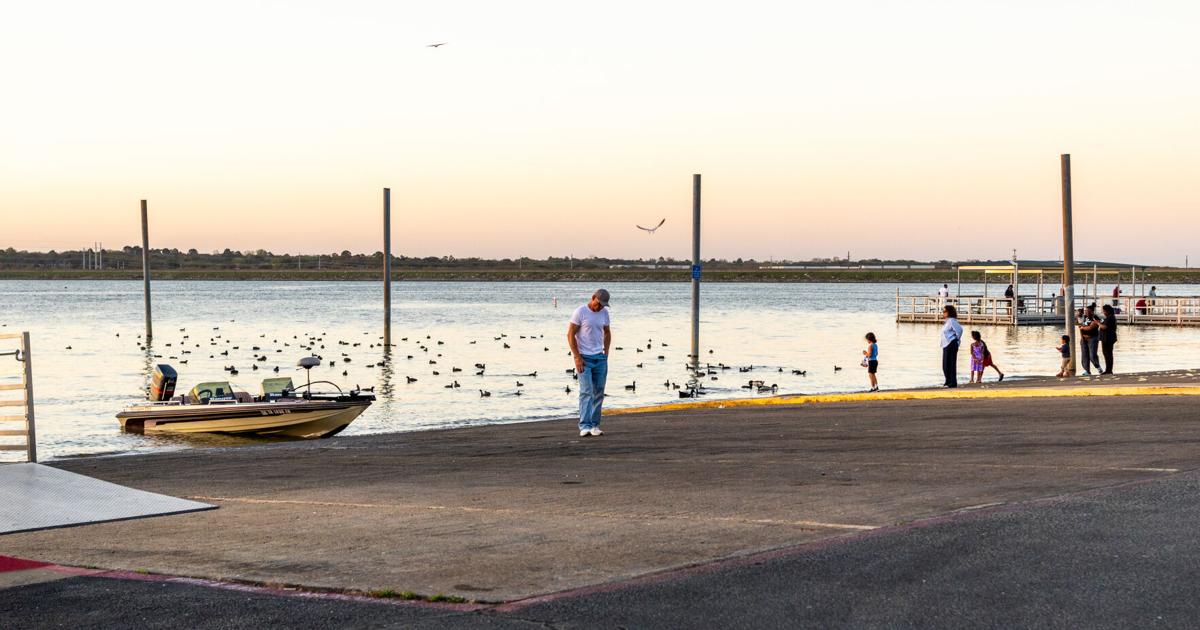


People gather along the shore of Lake Arlington on March 19. The lake is in West Arlington, approximately four miles from UTA, and is a recreational spot for the community.
Editor’s note: This story is part of a series that covers historical events, buildings and people that have made Arlington the place it is today while celebrating the city’s 150th anniversary.
Underneath the soft water of Lake Arlington sits the remains of a site instrumental to the founding of Tarrant County. Covered by time and the blue waves, there’s only a plaque on a green golf course to remember it.
On May 24, 1841, a battle took place, one of many at the time that drove Native Americans from their land. The Battle of Village Creek played a vital role in the shaping of Texas. Without it, there would be no Tarrant County — no Arlington.
“If you go to Lake Arlington Golf Course, and I think it’s the seventh tee, there is a small historical marker that says, ‘Near here is where this battle took place.’ But now it’s underneath Lake Arlington with a golf course kind of built over it as well,” said Scott Langston, former Texas Christian University Native American nations and communities liaison.
Geraldine Mills, Fielder House Museum director, said that in the mid-1950s, then-mayor Tom Vandergriff had Lake Arlington dug on what was previously Native land.
Langston said when Lake Arlington was built, it likely flooded the area where the battle took place.
“This Battle of Village Creek is really the founding event of what became the Dallas-Fort Worth metroplex,” Langston said. “And what I mean by that is we don’t have DFW today without this battle that occurred at Village Creek.”
In 1841, Village Creek was a series of settlements along the river that included the Cherokee, Muscogee Creek, Seminole, Kickapoo, Shawnee, Caddo and other nations.
Langston said these tribes had been forced out of their homelands and settled in East and North Texas, within the Wichita and affiliated tribes’ territory as refugees.
Paul Conrad, associate professor of history at UTA, said the Native refugees settled into large villages at Village Creek with members from several tribes. The Native Americans determined the area to be relatively safe upon its establishment, and it provided a good base for them to live in and travel from, Conrad said.
He said the battle was not sudden, but part of a buildup of a cycle of violence. In the 1840s, there was a shift in the government from diplomacy to aggression and anti-Native policies.
The Native peoples fought back against the Texans, attacking those living around the Red River to protect their new territories, Langston said.
To combat this, Gen. Edward Tarrant organized a group of Texas militia, Langston said. The militia went in search of the Village Creek settlements. They captured a Native person, who told them the locations. On May 24, 1841, they launched a surprise attack.
“I don’t think the term battle is very helpful in terms of helping people understand what was going on,” Conrad said.
“They’re swooping in. They’re trying to surprise people. They’re attacking. They’re burning the homes. They’re burning the villages,” he said.
There are multiple accounts of what might have happened, Langston said. One states the battle began when the Texas battalion shot and killed a woman and kidnapped another woman and a child. After the attack, the Texans took the Natives’ belongings.
Stephen Silva-Brave, Native American Student Association president, said the Texans strategically attacked when the warriors were away from the village.
“That wasn’t necessarily the last day that Native people were on this land, but it was the beginning of the end,” Silva-Brave said.
Eventually, the Native people were able to drive out the attacking force, but many were wounded and killed during the attack, Langston said. When the Texans came back in July, 400 men strong, the Natives were gone.
“The official report says that they counted at least 12 Native peoples who were killed, but it noted there undoubtedly were many more who were wounded and killed, and they based that on the amount of blood that they saw on the ground within the Native peoples’ encampments,” Langston said.
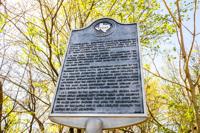
A plaque about the Battle of Village Creek stands near the Lake Arlington Golf Course on March 19. The battle was fought in 1841, following tension between Native Americans and the Republic of Texas.
He said the Texans only reported one death, Capt. John Denton, who the city Denton is named after. The Texans then looted the camp, taking food, horses, cattle and other belongings.
“One of the things that is striking to me is how little we know about the details of the people that lost their lives or were severely injured,” Conrad said. “Even if you look at historical markers and so on, they talk about the white people that were involved.”
After the battle, the residents of the settlements fled farther west, Conrad said. In 1843, a treaty between the Republic of Texas and the Village Creek tribes moved them to a reservation.
In the 1850s, many Native groups were put on two reservations west of what is now Dallas-Fort Worth. They were there for several years before they were forced out of Texas and into what was then known as “Indian territory,” now Oklahoma, Langston said.
“In the long-term, none of those tribes ended up in Texas,” Silva-Brave said. “So all of those tribes are now what you would consider Oklahoma tribes.”
Langston said the Battle of Village Creek was not an isolated incident. In 1838, Republic of Texas President Mirabeau Lamar initiated what he called an “exterminating war.”
Months after the battle, Fort Bird was established under Maj. Jonathan Bird. The fort was one of the first Anglo settlements in Tarrant County. The 1843 treaty was signed at this fort.
“I think it has to be connected to the founding and development of Dallas-Fort Worth because, within just a few months, non-Natives were moving into the area,” he said. “The Republic of Texas had a process set up whereby it would redistribute this land to settlers or colonizers.”
The descendants of those original tribes remain in Oklahoma today along with their tribal governments, but some did relocate to Dallas-Fort Worth after World War II through the federal “Indian relocation program,” Conrad said.
Silva-Brava, who is a member of a Native tribe, has lived his whole life in Dallas even though his extended family is still in South Dakota.
“We’re a very resilient people that no matter what, no matter where they move us, no matter how much they tried to assimilate us, to lose our culture and things like that, we always find a way to revitalize our languages, our cultures,” Silva-Brave said.
Conrad said that in recent years, local efforts have been made to acknowledge those who came before. Texas Christian University and UTA both have land acknowledgements. State-wide, however, little has been done to preserve history, he said.
“There are a lot of people at the local levels that are working to recognize this history and to work with Native communities. And there’s, of course, Native people that are themselves working to kind of bring attention to this history and their own culture,” Conrad said.
Langston, however, said the battle has been largely forgotten, andbecause of this, he doesn’t believe society has learned much from it.
“If we can talk about ‘remember the Alamo,’ I think we should also be talking about ‘remember Village Creek,’ as a way to recognize and honor those Native Americans who are willing to make the ultimate sacrifice to defend their families and their freedom,” he said.
@atclements03