
Recipe time! Here’s how to cook a steak:
Buy a decent cut (ask the H-E-B/CM/WF folks), take it home, sprinkle it with salt, slap it in a skillet, sizzle some butter on there, flip it, poke it, chuck it in the oven for a couple minutes, eat.
Steak is one of the simplest things to cook at home, and the secretary of Health and Human Services would love for you to memorize his new food pyramid and eat it every night. But you don’t, and you won’t, and why? Because no matter how many steaks you cook in your house, it will never be a steakhouse.
There’s nothing on the American fine dining scene quite so nostalgic. (On the non-fine-dining side there’s the diner/burger joint, of course, and on the not-exactly-American side, there’s the Italian restaurant, with its checked tablecloths and raffia-wrapped wine carafes.) In Texas, a proper steakhouse (or chophouse, as Van Horn’s is called, which linguistically is just a cute steakhouse) will hearken back to a time when the West was winnable, the plains were full of walking meat, and gold flowed like whiskey into your runneth-over cup. But now, when the West seems parched and picked-over, the beef is crammed into feedlots, and the gold, for most of us, is gone, a steakhouse has to work hard to remind us of a time of abundance once today’s check hits our table. You have to ride a fine line if you’re a Steakhouse of Today; you have to straighten your tie and put down your vape pen and clear your throat and present us with something pretty amazing to vanquish all the skepticism we’re about to bring.
You basically have to be Van Horn’s.
Van Horn’s is tiny by steakhouse/chophouse standards, tucked into a nook next to Jo’s on Second Street. Its sister restaurant, Bill’s Oyster, is also small, and like Bill’s, Van Horn’s makes clever use of its space. Most of the tables are two-tops, fortunate since many of its patrons seemed to be on (awkward first) dates. The dark coziness of the room is offset by its tall saloon ceilings and its bank of bright windows looking out onto shoppers and joggers and doodle mash-ups. One of the first things you’ll notice is how comfortable the chairs are. They look like normal brown chairs, but they cradle you like a benevolent hand and are correctly proportional to the tabletops. They’re the kind of chairs where as soon as my (male) friends sat, they began to talk of football, as if programmed. This sort of attention to detail is what’ll make Van Horn’s a repeat destination for locals and visitors alike.
The restaurant is open all day, which makes it convenient for out-of-town conference-goers eating on the company dime, but also for emboldened locals who might, on a whim, venture out past their neighborhoods and brave Downtown parking. During happy hour, from 3-5:30pm (every day!), deals abound and the place isn’t too crowded. Their tartare ($10 during HH) comes buried in a drift of parmesan so finely shaved that it looks and melts like snow. Classic drinks (Aperol Spritzes, Manhattans, etc.) are also $10 at this time and arrive icy; past the rippled glass partition, the bartenders are focused, busily shaking away. The waitstaff is knowledgeable and relaxed, the expeditors/bussers attentive, rushing to fold your napkin into a triangle every time you stand up and descending to remove unused plates and silverware.
 Credit: Jana Birchum
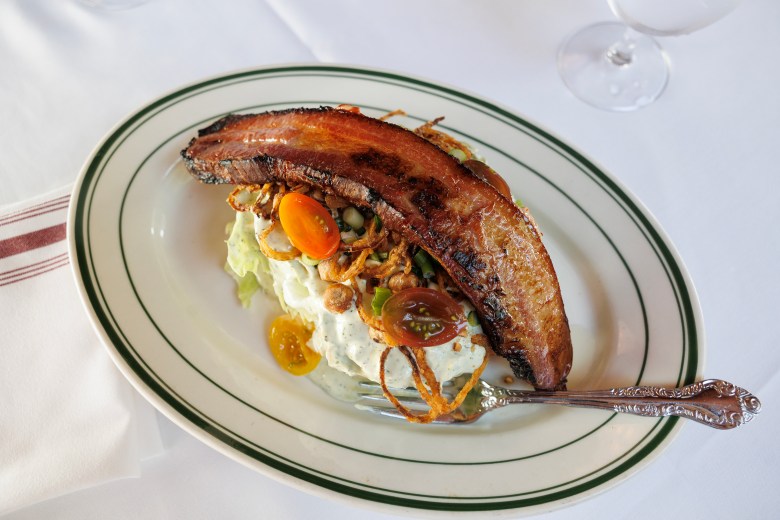
Van Horn’s must have some sort of extravagant grating machine in back they’re very proud of, because the Caesar also comes covered in that disappearing parm (a decent version, though it’s topped with distractingly sweet brioche croutons), and the au jus-soaked German potatoes are shredded almost to the consistency of hair. Continuing down the path of sides, the mac & cheese is capped with a toupee of broiled fontina and Gruyere, and the wedge salad is crowned with a thick slab of Texas-sized bacon. (You can toss all pretenses of health aside and just order the bacon for $9, which shows up smiling on your plate like the vanished Cheshire Cat.) Three-dollar mostly-PEI oysters are served with an adorable tiny Tabasco bottle and grated – very, very finely grated, of course – horseradish.
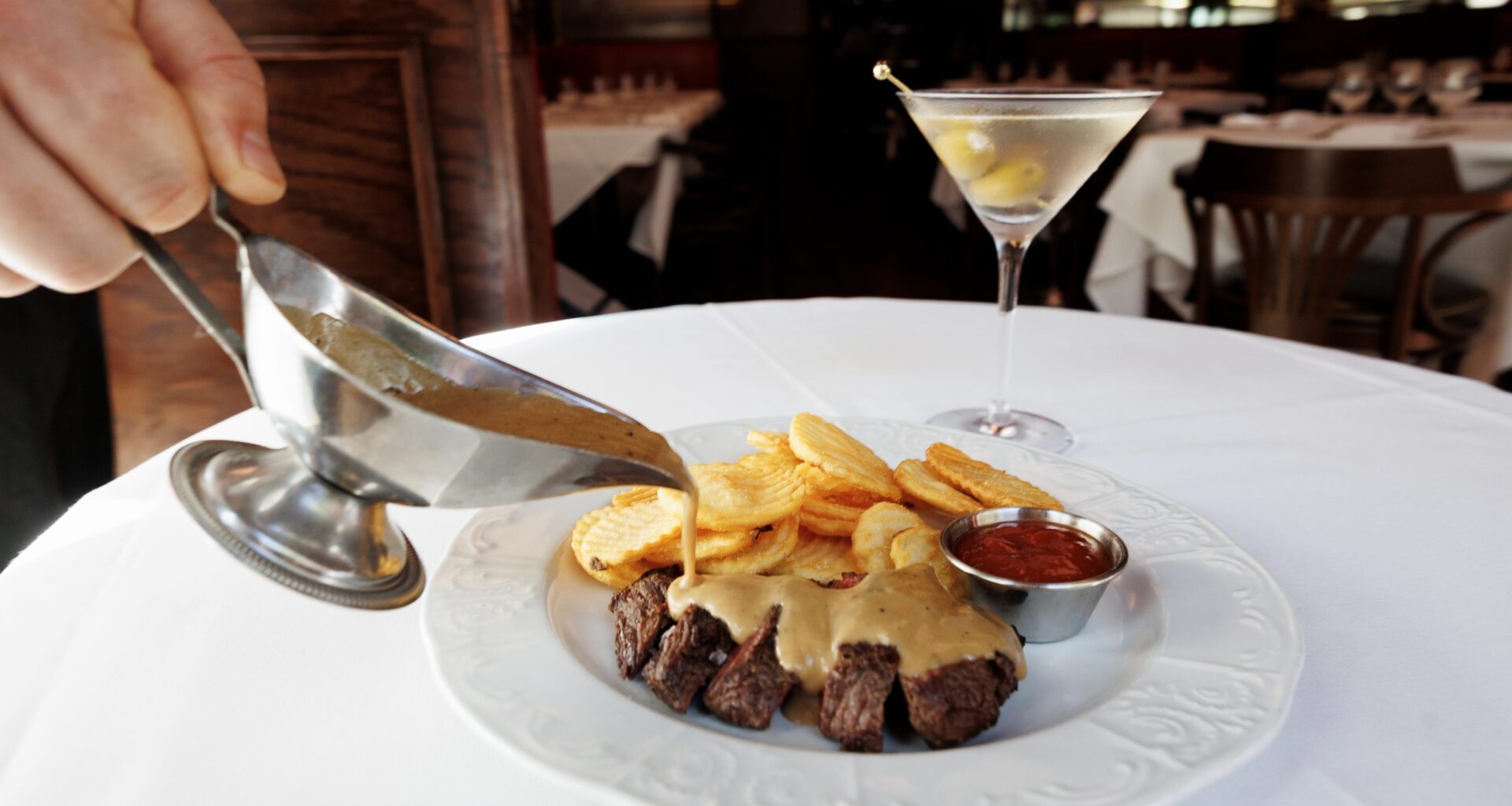
The $33 steak frites happy hour special includes a martini (they stuff their own bleu cheese olives; aw!). The steak was a tad chewy and doused with a taupe peppercorn sauce, but those frites! They’re round and paper-thin, a far cry from mealy steak fries. The bone-in NY strip ($85, not on HH) was heavily charred outside but cooked to blushing pink perfection inside, and we splurged on a bottle of Girard cab that paired not only with the steak, but also the martini, and the Sazerac, and the tablecloth, and whatever else it was placed next to.
 Credit: Jana Birchum
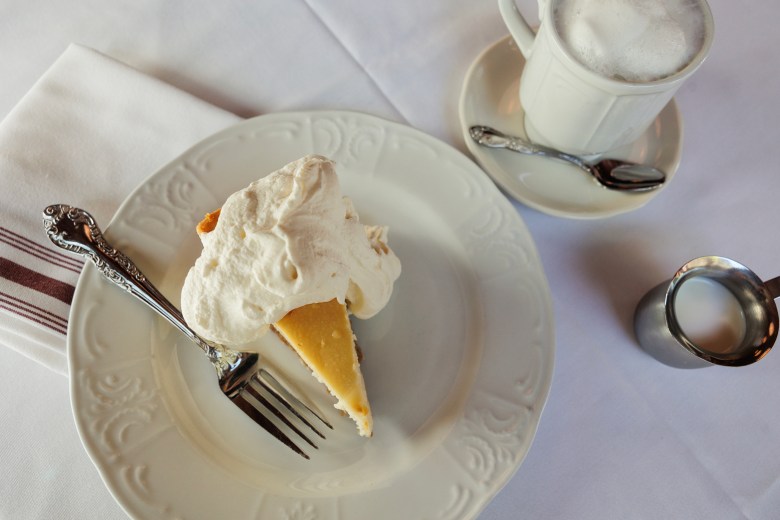
They import their cheesecake from New York, and their desserts come with a cruet of “schlag,” a thick, fluffy German whipped cream. We might have liked a tart berry drizzle to cut the decadence, but what did it matter when we were about to develop sudden gout and then slide down into my new favorite chairs for a nap?
My own steakhouse lore begins deep in the bowels of Chapel Hill Mall in Cuyahoga Falls, Ohio. After buying plastic fluorescent crap at Spencer’s, I’d meet my father at a Brown Derby chophouse and order fries and Shirley Temples. The vibe was Midwestern businessman swank: buzzy and full of the jarring, boisterous hoots of large men in loosened ties who aren’t afraid to laugh like that in public. Here we were spending money (well, here my father was), shaking hands, eating fat cuts of recently butchered American meat. I watched from behind the tall plastic menu that was half my size, never suspecting that many years from then I’d be at Van Horn’s on a drizzly day, startled into memories by that shicka-shicka sound and the rush of cool air as the door opens and diners spill in to shed their coats. “Eat that meat!” the cocktail shakers whisper. “The future is yours!”
This article appears in March 27 • 2026.
A note to readers: Bold and uncensored, The Austin Chronicle has been Austin’s independent news source for over 40 years, expressing the community’s political and environmental concerns and supporting its active cultural scene. Now more than ever, we need your support to continue supplying Austin with independent, free press. If real news is important to you, please consider making a donation of $5, $10 or whatever you can afford, to help keep our journalism on stands.