
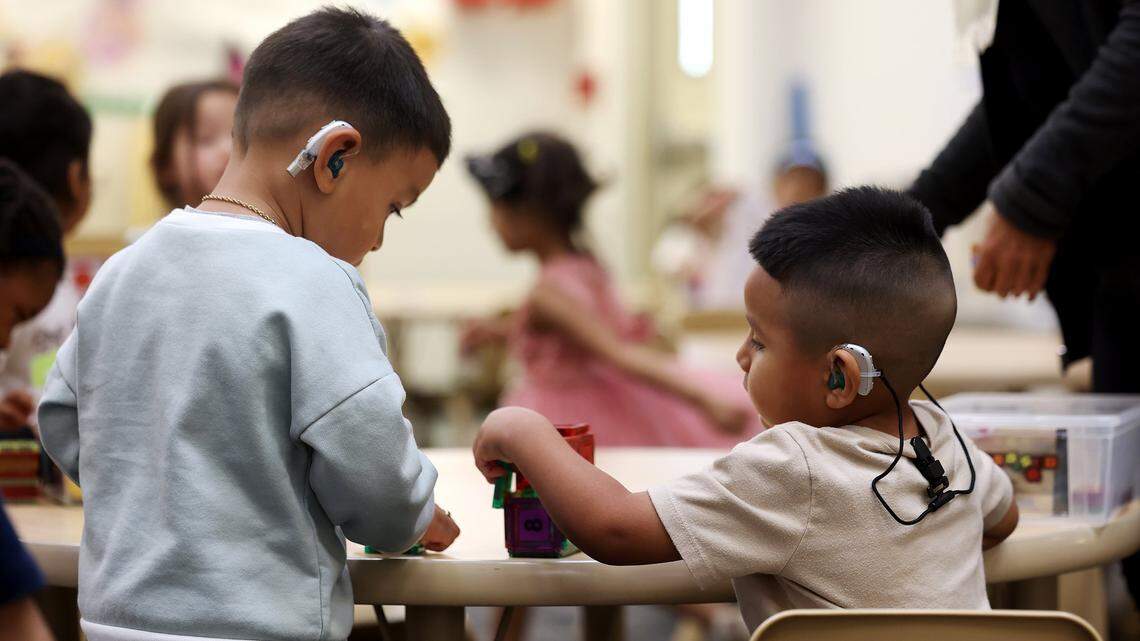
Jayden, 3, and Jacob, 3, play with blocks together on Thursday, March 5 at the Callier Center in Dallas. The Callier Child Development Program serves kids who are deaf and hard of hearing.
Amanda McCoy
amccoy@star-telegram.com
Literacy is known as the foundation that supports all learning. But for children and students with communication disorders or speech difficulties, additional support is needed to master this foundational skill that sets them up for success in school, life and relationships.
There are several communication disorders or speech and language impairments children can encounter during their early years, and early identification and treatment is key to ensuring they can succeed in academics and beyond, according to Angela Shoup, executive director of the Callier Center for Communication Disorders in Dallas. Although public school districts serve these students, other specialized programs in North Texas tailor specific services needed for these student groups.
For example, this can include speech-sound disorders and developmental language disorders, in addition to children who are nonverbal or have hearing impairments. Other conditions such as Autism Spectrum Disorder can also impact speech or language, said Laura Green, a professor at Texas Woman’s University who focuses on language and speech sound disorders, in addition to literacy.
“Reading is a language-based system, and so we have known now for many, many years that the two are completely connected,” Green said. “The more you read, the better you get at reading, and then all of those language skills continue to grow.”
Among several programs at the Callier Center in Dallas, one offered specifically focuses on children ages 3-5 with Autism Spectrum Disorder, or who could potentially be diagnosed with it later. Early CLASS — Communication, Language And Social Skills — is set up to look like a classroom but is structured like a group therapy setting, according to program director and supervisor Dominique Vasquez.
People with autism typically have areas of need with social communication, which can lead to delays in language, Vasquez said. In terms of incorporating literacy into the program, there are designated times for reading books as a group, but at the end of the day specifically, clinicians focus on regulation while creating literacy awareness.
 Student clinicians and children follow along with circle time during an early communication, language and social skills program at the Callier Center in Dallas on Thursday, March 5. Amanda McCoy amccoy@star-telegram.com
Some children are associating key vocabulary words from the page to the pictures on the page. Others might recognize certain words and want to read dialogue. Clinicians meet the children where they are and go from there.
“For a lot of our kids, just wanting to interact with a book is really difficult. Sometimes they have a really negative association. So really, even just starting and saying, ‘Literacy can be so fun.’ It doesn’t need to be like pulling teeth,” Vasquez said.
Visuals paired with words are also plastered throughout the walls of the program to help with directions, routine and increased comprehension. During group activities, clinicians also have binders open in front of each child to point out pictures of what’s being discussed.
“All of our kids are developing awareness, even if it’s partial word, whole word, sounding out words, being able to recognize words, recognizing their own name, even,” Vasquez said. “That is important that they can identify those personal pieces within literacy development and reading.”
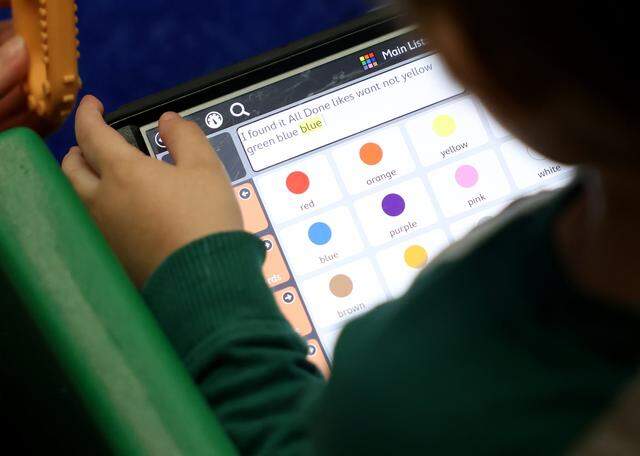 Phoenix, 3, uses an electronic device to help him communicate during circle at an early communication, language and social skills program at the Callier Center in Dallas on Thursday, March 5. Amanda McCoy amccoy@star-telegram.com
The Callier Center for Communication Disorders also serves preschool students in the Dallas Independent School District who are deaf or hard of hearing through its child development program, serving children starting at 3 years old. Labels are apparent throughout this space, too.
About half of the child’s day is spent alongside general education students while the other half of the day includes breakout sessions tailored to deaf and hard of hearing students who will learn through oral approaches or total communication, which combines hearing and sign language. The classroom curriculum embeds literacy into almost all activities.
Green, the Texas Woman’s University professor, notes that children with hearing impairments can still have difficulty hearing some of the sounds in words, even if they have cochlear implants or hearing aids. Visual phonics, which includes hand cues and symbols that represent sounds such as vowels or consonants, can be used as literacy support.
“Learning how to sound out words and learning about phonological awareness can be very challenging for them,” Green said. “We set ourselves up to help them have access… presuming competence (and) having access to phonics.”
“I think that one of the things that we have to keep in mind is that the ability to acquire language and to effectively use language is very important for literacy skills,” said Shoup, executive director of the Callier Center.
“If our speech language pathologists are working with the child in our child development program, they can work with the teachers to help carry over things they’re working on clinically with that child to make sure that’s getting reinforced in the classroom,” she added.
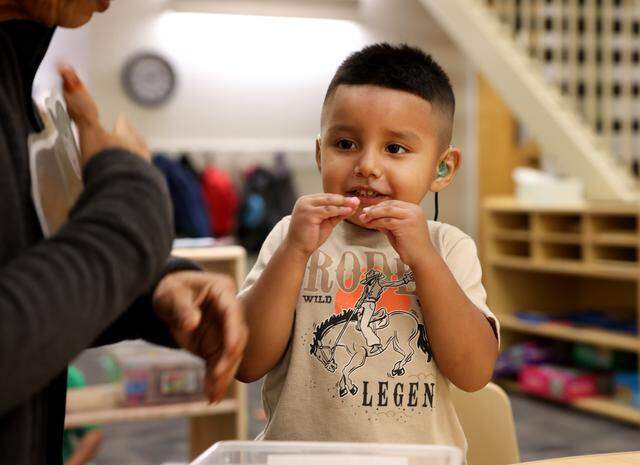 Jacob, 3, uses sign language while communicating with paraprofessional Ruth Rodriguez on Thursday, March 5 at the Callier Center in Dallas. The Callier Child Development Program serves kids who are deaf and hard of hearing. Amanda McCoy amccoy@star-telegram.com
Another partnership with Dallas ISD overlaps education with clinical services.
The Urban Collaborative Initiative — a partnership between the Callier Center, the University of Texas at Dallas and the Dallas Independent School District — aims to help the school district fill vacancies for speech language pathologists while giving graduate students hands-on experience under supervision.
The initiative also addresses oral language and early literacy for students, which involves providing low-performing pre-K and kindergarten students with 15-minute scripted lessons based on a narrative two to three times a week, said Director Judy Rich, who is a professor of practice at UT Dallas. Students are also given similar scripts and reading materials as their classmates that they can review before the teacher presents the material to the full class.
“We do a really good job with closing the gap between all students and the students that are in the intervention, especially for 4-year-olds. They’re very, very receptive to this,” Rich said. “Reading is a visual portal to language processing, right? It’s language in print. So the links between language and learning to read are just super, super important in the way the brain develops.”
Communication between clinicians and teachers is the missing piece that should be implemented more consistently across educational and clinical programs that work in tandem, said Trenace Dorsey-Hollins, executive director of Parent Shield Fort Worth.
Dorsey-Hollins’ organization, a parent advocacy group that focuses on literacy, helps parents set up Individualized Education Program, or IEP, services for their child with their school district, she said. She often is contacted by families who have children with Autism Spectrum Disorder.
As a parent of a first-grader who is nonverbal and receives various therapies at school and at home, Dorsey-Hollins is able to bridge the gap by asking for notes from clinicians on what was accomplished during sessions, so Dorsey-Hollins can build on it further at home. Dorsey-Hollins acknowledges she is more engaged than the average parent because of the nature of her work, and other parents might not know how to bridge those gaps.
A solution to this could be an annual meeting similar to an ARD meeting, or an Admission, Review, and Dismissal meeting that discusses a child’s IEP or eligibility for special education services. All adults involved with the child’s learning and clinical services are in the same room to discuss their needs and goals, she said.
“How can Fort Worth create a committee between those stakeholders: parent, school therapist, outside-of-school therapist and teacher? Even if that’s like once a year, we now at least have each other’s contact information. So if something changes, they can be in better communication,” Dorsey-Hollins said.
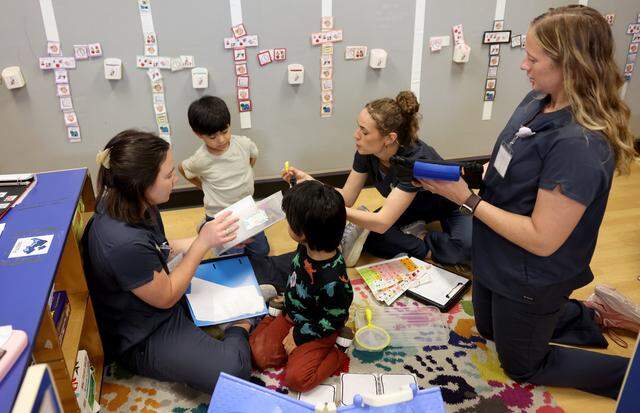 Student clinicians interact with Luiz, 4, during free play time on Thursday, March 5 at the Callier Center in Dallas. The Callier Center offers many different programs for children with communication disorders. Amanda McCoy amccoy@star-telegram.com
Rachel Betzen, a speech language pathologist and founder of Dallas Reading & Language Services, said although she and her fellow clinicians don’t consider their sessions to have direct literacy instruction, they are addressing speech and language obstacles in the context of reading.
She gave an example of clinicians using simple stories when treating children with speech disorders
“We have target words that are in there for their speech, so we’ll work on them with that. If it’s a younger kid or earlier reading level, send it home (with) maybe a list of other words to practice, so they’re working on their speech sounds, but they’re seeing it in the context of a story,” Betzen said.
“As for older kids, it could be similar. If they have goals for vocabulary or listening comprehension, or they need to work on summaries, personal narratives, even — we can kind of build that around the context of literacy, so we can put them into a story,” she added.
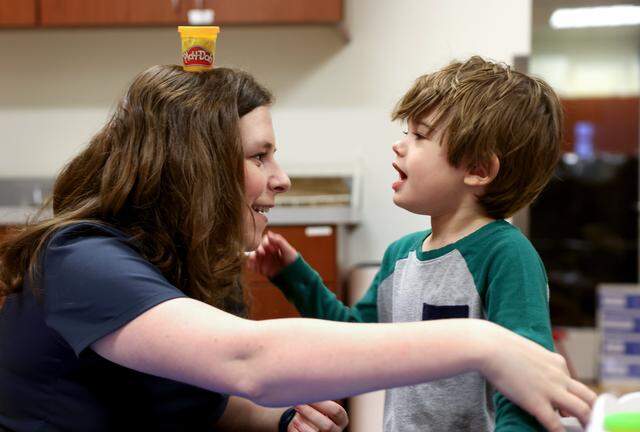 Student clinician Kathryn Jones interacts with Phoenix, 3, during a early communication, language and social skills program clinical on Thursday, March 5 at the Callier Center in Dallas. The Callier Center offers many different programs for children with communication disorders. Amanda McCoy amccoy@star-telegram.com
Mireya Colchado has taken her three children to Dallas Reading & Language Services for speech therapy services for about three years because of the literacy components, she said. Her sons Anthony and Sebastian, who are 8 and 5 years old respectively, have speech impediments that impacted their literacy skills, she said. Her 12-year-old daughter Kimberly has mild dyslexia and struggled with mixing up English and Spanish words.
Before speech therapy, it was difficult to understand Anthony and Sebastian, Colchado said.
“There are several words or letters that they cannot produce sounds for. Like the letter R: instead of saying ‘R’, they say ‘L’ and other letters as well,” Colchado said.
All three of her children are now reading proficiently and practice their skills every night.
“Every night we each read — of course, at their own reading level — either a paragraph or a whole book. For example, Kimberly is into chapter books right now. She would read one or two pages, and then we will stop, and then we will try to get Anthony to read a smaller book, and then Sebastian to read an even smaller book,” she said. “I want to make sure that their skill levels continue to progress instead of deteriorating.”
Tips for families
A 2025 guide by Maryville University gives tips for parents on how they can help develop their child’s literacy and speech skills, especially if they suspect their child might have a speech disorder. It also outlines how they can identify potential speech impediments.
To address potential speech disorders or impediments early on, parents are encouraged to discuss their concerns with physicians; ask for doctors’ screenings of hearing, vision and speech; request a special education assessment from a school district; and request a referral to a specialist such as a speech-language pathologist or audiologist.
Parents can engage in the following activities with their child to help improve their literacy and speech skills, according to the guide:
“Introducing new vocabulary wordsReading picture and story books with various sounds and patternsTalking to children about objects and eventsAnswering children’s questions during routine activitiesEncouraging drawing and scribblingPointing to words while reading booksPointing out words and sentences in objects and signs”
Fort Worth Star-Telegram
Lina Ruiz covers early childhood education in Tarrant County and North Texas for the Fort Worth Star-Telegram. A University of Florida graduate, she previously wrote about local government in South Florida for TCPalm and Treasure Coast Newspapers.