
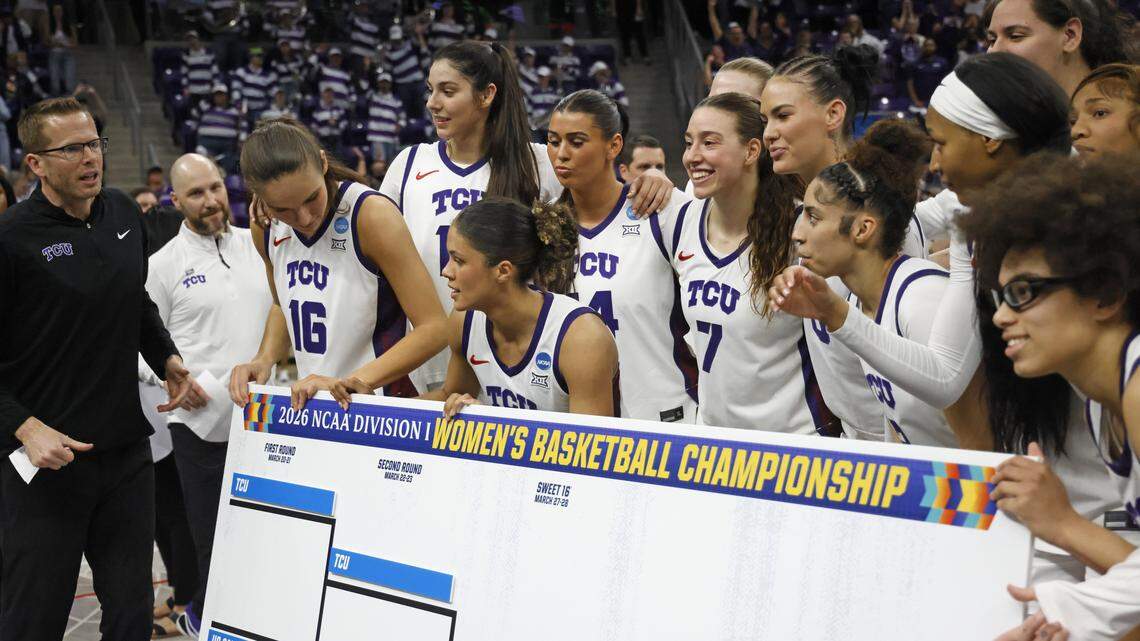
A women’s sports advocacy group has filed a new Office of Civil Rights complaint against TCU to the Department of Education, claiming the university violates Title IX laws and does not offer the same athletic opportunity for women on campus.
Champion Women, a Florida-based group that has advocated for women athletes since 2014, first filed a complaint against TCU in 2023, but updated the language of its complaint to the Education Department last week. The group also claims TCU does not offer women athletes the same scholarship opportunities as men and has a much lower recruiting budget for bringing in women athletes to the school.
“TCU is number three in the country for short-changing women in athletic scholarship dollars,” Champion Women wrote in a statement. “It’s a shame that the adults in charge aren’t fixing these violations of federal law, leaving it to 18-22 year old students. Sad.”
Title IX is a federal law that prohibits gender-based discrimination in any education program or activity that receives federal funding. It protects students, staff and faculty from sexual harassment, gender-based discrimination and also requires schools to provide equal opportunity for participation for both sexes.
In Champion Women’s complaint to the Education Department, the organization points out that TCU’s student body is predominantly women. Roughly 61% of undergraduate students at TCU are women, according to university data. But Champion Women claims that ratio is not fairly represented in student athlete participation. There are 302 female student athletes at the university compared to 365 male athletes. Champion Women claims there needs to be at least 600 female student athletes to be representative of fair athletic opportunities for women.
TCU provided female athletes with $11.2 million in athletic student aid in the 2023-24 school year, compared to $14.3 million in men’s scholarships, according to the Department of Education. Champion Women projects the university needs to spend at least $23 million in athletic student aid for women to meet equality. The organization also says that discrepancy is the third worst in the United States among all colleges.
A spokesperson for TCU told the Star-Telegram the school is aware of the complaint.
“Similar complaints were filed against approximately 100 schools three years ago. We are aware of their social media post claiming they updated data,” the spokesperson wrote.
TCU offers 13 women’s sports compared to nine men’s sports teams. Those women’s sports include basketball, beach volleyball, cross country, golf, indoor track and field, outdoor track and field, equestrian, soccer, swimming and driving, rifle, volleyball, and triathlon. The only major sport not offered by the university is softball.
One of the main reasons for the discrepancy is football. TCU does not offer a women’s sport with a roster the size of an average NCAA football team. TCU had 116 players on its 2025 football roster, with most of those players on athletic scholarship. Even with four more women’s sports than men’s sports, the number of scholarship dollars do not match the male athletes due to smaller women’s sports roster sizes. Soccer, volleyball, basketball and golf, the most prominent women’s sports at TCU, are significantly smaller in team size than an NCAA football team.
Champion Women also cites inequalities in recruiting expenses for women’s sports compared to males. TCU spent $1.8 million to recruit male athletes in 2023-24, compared to around just $571,000 for women. The organization projects at least $2.9 million would need to be spent for equality.
TCU’s discrepancies in recruiting expenses, number of athletes and scholarship aid between men and women is not much off national average across the NCAA. Men comprise roughly 57% of NCAA student-athletes compared to 43% women, according to statistics from the NCAA. Across NCAA Divisions I and II, male athletes also receive more total athletic scholarship money than women.
NCAA Division I FBS football teams can have up to 105 scholarship players, which is often the main reason for disparity in funding, even if a school has more overall women’s sports offerings. Title IX compliance does not require schools to match football spending on women’s sports since no current NCAA women’s sports have rosters of similar size.
This story was originally published March 24, 2026 at 3:49 PM.

Fort Worth Star-Telegram
Samuel O’Neal is a local news reporter at the Fort Worth Star-Telegram covering higher education and local news in Fort Worth. He joined the team in December 2025 after previously working as a staff writer at the Philadelphia Inquirer. He graduated from Temple University, where he served as the Editor-in-Chief of the school’s student paper, The Temple News.