
What began as a debate over the demolition of a city-owned building has evolved into a broader and more complex public reckoning. Architects and preservationists are urging the city to consider alternatives to demolition, while many Dallas residents remain focused on the projected $1 billion price tag—and whether city leadership is equipped to take on another costly project. Questions have also surfaced about accountability, particularly as officials cite deferred maintenance as justification for demolition, despite that responsibility falling under the city’s purview. At the same time, scrutiny has intensified around reported email exchanges that some allege point to inappropriate coordination between city officials and private interests. The controversy is unfolding against the backdrop of Dallas’ mixed track record with large-scale developments—from the American Airlines Center to the long-debated Trinity River project—raising familiar concerns about transparency, execution, and long-term impact.
What started as a question of preservation versus demolition has now expanded into a deeper conversation about public trust, fiscal priorities, and who ultimately benefits from the city’s most ambitious decisions.
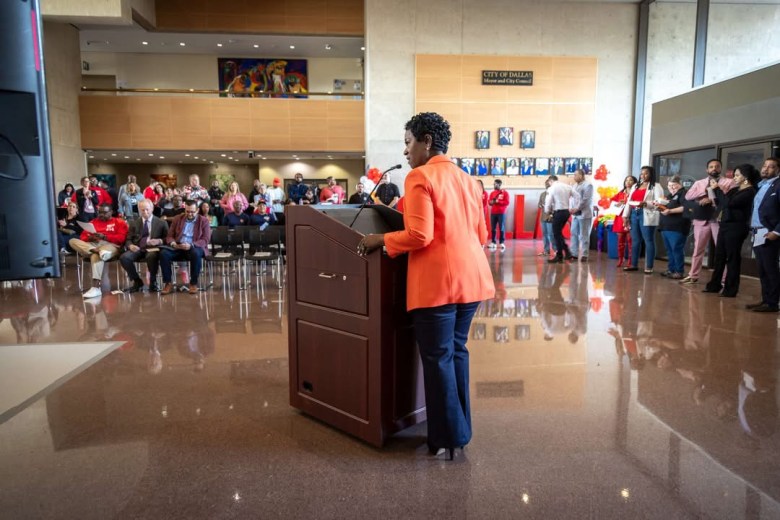 Dallas City Manager Kim Tolbert addresses guests in Dallas City Hall on Feb 13th to celebrate “214 Day of Love” Photo By: City of Dallas Office of Arts & Culture.
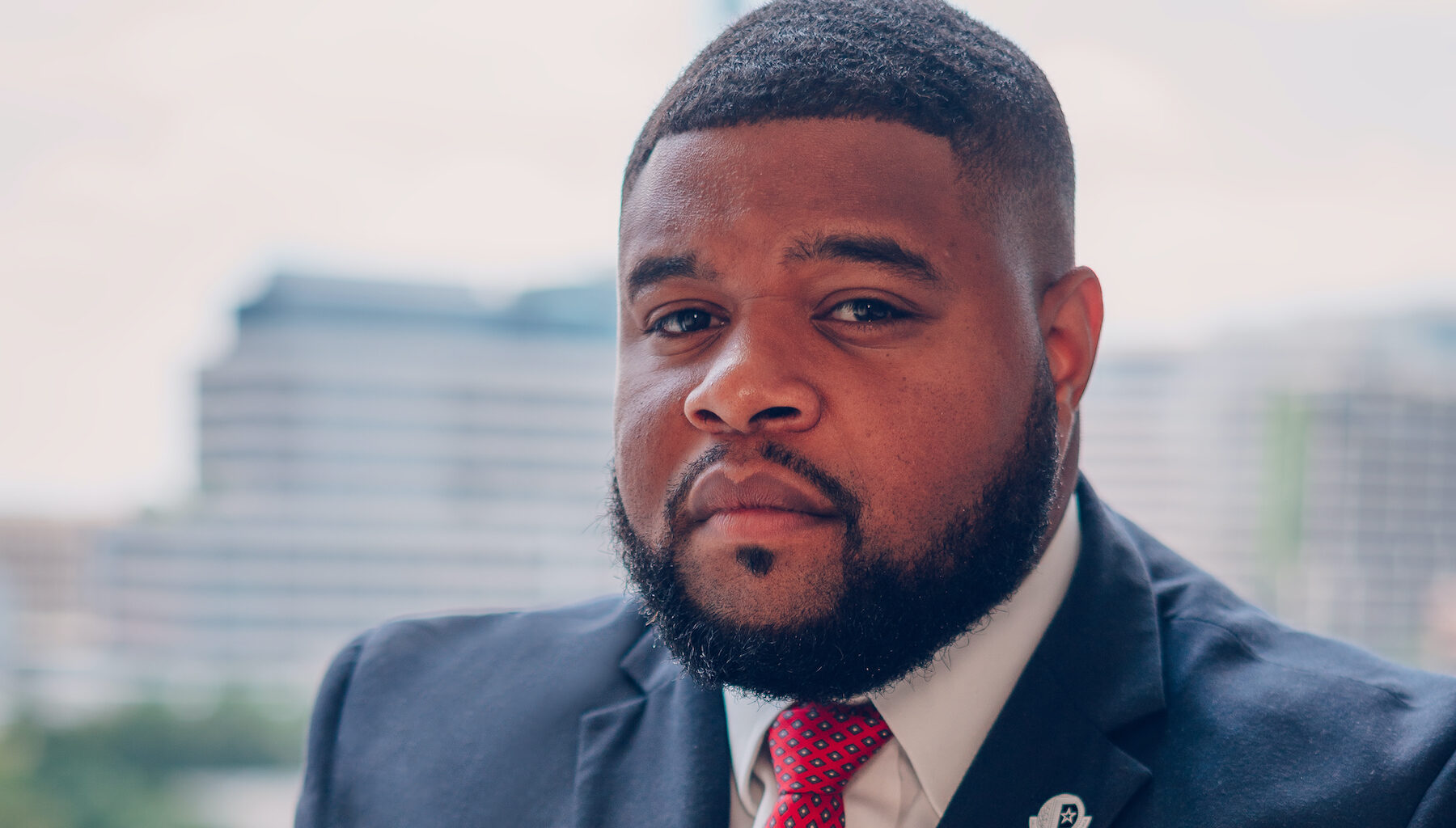
In a recent sit-down, Dallas Weekly Publisher Jess Washington spoke with President Harrison Blair of the Dallas Black Chamber of Commerce to unpack the confusion—and the conversation made one thing clear: this isn’t just about City Hall.
So… why is this such a big deal?
At the center of it all is a number that keeps coming up: $1 billion.
That’s the potential cost tied to preserving or renovating City Hall—and according to Blair, that alone should make residents pause.
“We have to stop the idea that we need to spend a billion dollars on one government asset,” Blair said.
In a city already balancing public safety, housing challenges, and major pension obligations, he argues that kind of spending forces a bigger question:
What are we willing to prioritize—and what gets left behind?
The part people aren’t talking about enough
One of the most pointed parts of the conversation centered on what Blair described as a civic knowledge gap—particularly when it comes to how Dallas residents understand bonds, budgets, and long-term planning.
“There are people showing up right now who didn’t study for the open-book test… now they’re trying to cram and understand what’s going on.”
Blair emphasized that many of the decisions being debated today—especially around City Hall—are rooted in years of policy, funding allocations, and missed opportunities that didn’t receive widespread public attention at the time.
“You almost would’ve had to be there during the 2024 bond conversations,” he said, referencing funding that was once allocated for City Hall improvements but ultimately shifted elsewhere.
According to Blair, that moment is critical to understanding the current situation.
“City Hall wasn’t a priority then,” he said. “And now all of a sudden, it’s the most important thing in the city.”
Bonds, budgets, and short-term thinking
Blair also challenged what he sees as a broader issue: residents engaging emotionally in high-profile debates without fully understanding how city budgets actually work.
“We don’t have unlimited money,” he said. “The city has to make decisions based on what’s in the budget—not what sounds good in the moment.”
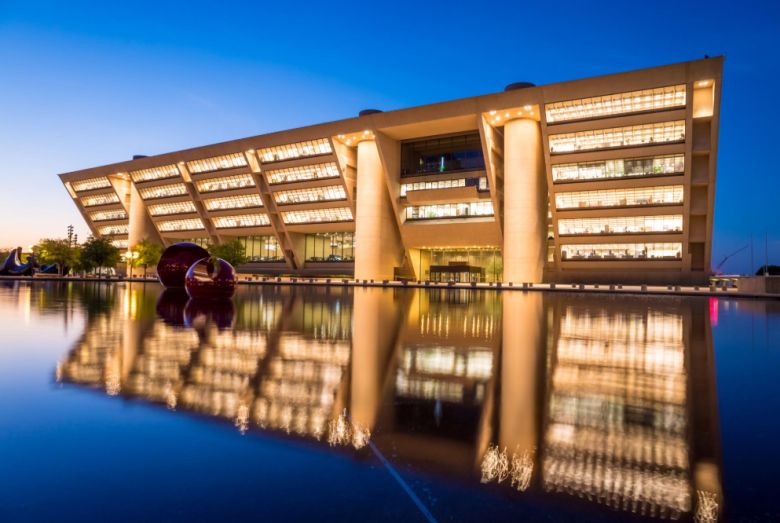 Dallas City Hall.
He pointed to the complexity of municipal finance, where decisions about bonds, capital improvements, and long-term obligations are interconnected—and often misunderstood.
“This is a 25-year decision,” Blair said. “But people are reacting like it’s a one-week issue.”
He also noted that many residents don’t track how funds are allocated or reallocated over time, which can lead to confusion when projects resurface years later with significantly higher price tags.
“You can’t ignore something for years, and then be shocked at the cost when it comes back,” he said.
Is this really a transparency issue?
Blair pushed back on the growing narrative that the City Hall debate is rooted in secrecy.
Instead, he framed it as a gap between access to information and public engagement.
“It’s not that the information isn’t there,” he said. “It’s that people haven’t been engaged in the process.”
From public reports to council meetings and budget documents, Blair emphasized that residents already have access to the information needed to stay informed—but must take an active role in engaging with it. He pointed to local elected officials as the most immediate point of accountability, encouraging constituents to ask questions and challenge decisions as a way to better understand how policies and priorities are shaped.
“People over property”
At the core of Blair’s argument is a simple but powerful idea:
The city’s resources should serve the people—not the building.
He describes the City Hall debate as a real estate and budget decision—not a quality-of-life solution.
“The question is whether we’re serving the building, or whether we’re using our resources to serve the people,” Blair said.
That distinction matters—especially as conversations shift toward redevelopment and what comes next.
Let’s be clear: redevelopment doesn’t automatically mean equity
Blair was also clear about another misconception: that saving money on City Hall would automatically translate into investment in underserved communities.
“Just because the city saves money doesn’t mean it’s going to the southern sector,” he said.
If anything, he argued, the opposite is more likely—unless communities actively organize and advocate for where those resources should go.
“That’s up to us,” Blair said. “That’s not something the city is just going to hand out.”
The conversation also widened to include Dallas’ position in a rapidly evolving regional landscape.
Blair pointed to nearby cities like Frisco, Plano, and Irving as examples of municipalities aggressively pursuing growth and development—often at Dallas’ expense.
“If we’re not careful, we’ll lose our competitive edge,” he said.
He framed the City Hall site as a potential economic driver—one that could generate revenue, attract business, and activate downtown in ways the current structure does not.
So what should residents actually do?
Blair’s call to action was direct: get informed, then get involved.
“We have to start educating people,” he said. “Because without that, people are reacting emotionally—and they could be wrong.”
He called on community leaders, chambers, and media organizations to host conversations that break down complex issues like budgets, bonds, and redevelopment in ways residents can actually understand.
Because ultimately, he said, the future of Dallas won’t be decided by one vote or one meeting—but by how informed and engaged its residents choose to be.
This isn’t just a “Dallas City Hall” story
After publishing President Blair’s op-ed on the City Hall demolition—and following the viral engagement across social media—the conversation further reinforced his leadership role in helping to bridge that gap.
This isn’t about telling people what to think—it’s about making sure they understand what’s at stake.
Related