
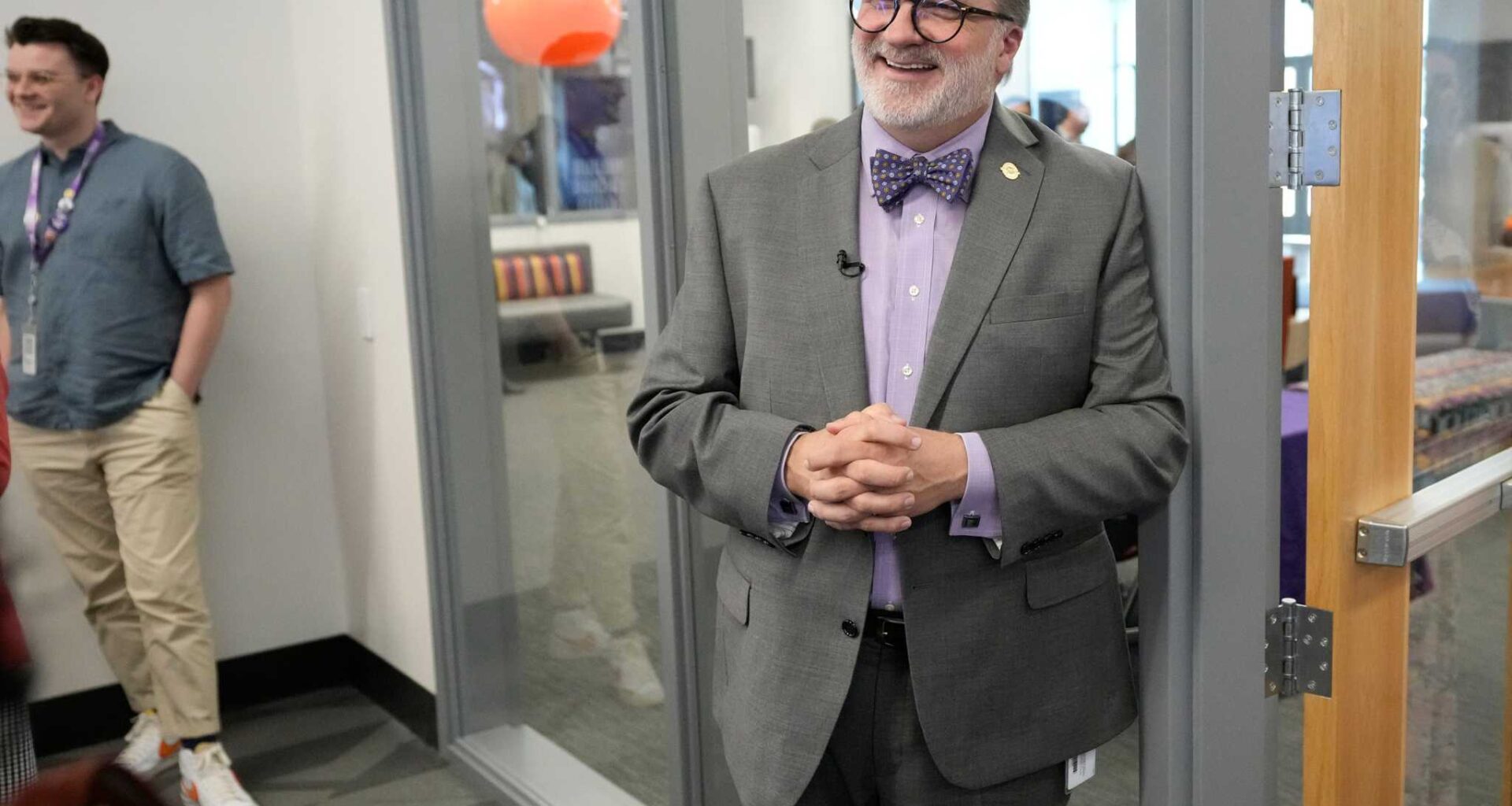
Austin Community College Chancellor Dr. Russell Lowery-Hart tours the new Welcome Center at ACC Highland Campus on Monday October 16, 2023. ACC won a $875,000 grant from the Trellis Foundation to build human-centered AI tools that will help connect students to campus support.
Jay Janner/American-Statesman
Austin Community College Chancellor Russell Lowery-Hart knows people worry about artificial intelligence. He worries, too. But he also has a plan to lead his 80,000-student community college district through this moment of technological upheaveal.

Earlier this month, the Trellis Foundation, a Round Rock-based nonprofit focused on improving access to higher education awarded ACC a three-year $875,000 grant to launch “human-centered” AI initiatives.
Article continues below this ad
In an interview, Lowery-Hart said his office will spend the next year building out an AI system that will proactively respond to students needs not by replacing human support, but by connecting students to the college’s resources proactively.
The foundation, he said, “understand (s) the moment that we’re in with AI, and that there needs to be in higher education a leading response,” Lowery-Hart said. This approach will make ACC a national leader in using AI to improve student outcomes without replacing human support, he said.
ACC aims to launch a new AI agent in 2027. The new program will use student and financial data to identify when students could benefit from more support from the community college before they are at risk of dropping out due to academic, financial or personal challenges. The system will reach out to students with resources and times to book appointments with the appropriate staff. Lowery-Hart said the AI system will be an internal creation, making the data much more protected than if it was outsourced.
“Right now, we’re doing great work in basic needs, but it’s always in response when a student’s in crisis, then they have to reach out, then they have to apply,” Lowery-Hart said. “We think what we can do is use the (AI agent) to identify students that may be on the precipice of a crisis before they’re in crisis.”
Article continues below this ad
The college has bolstered emergency funds and food pantries since it launched its strategic plan in 2024, and also has mental health, tutoring and advising resources. The AI agent could connect students to these resources when it identifies there’s a need.
If a student is below their class’ grade average on assignments, the AI agent might suggest they access tutoring support to stay on track and show available appointments, Lowery-Hart said. This will help reduce a student’s wait time before getting help.
“It has to improve our student outcomes. It has to reduce time to service. It has to make our bureaucracies more streamlined, functional and effective in getting students more immediate interventions and connections,” Lowery-Hart said about AI. “Once we get this right, Trellis and ACC will then share our lessons learned with the nation as a whole.”
The initiative builds off ACC’s strategic focus on strengthening basic needs support for students to help them complete their goals, with an eye toward raising the college’s degree and transfer completion rate from 46% in 2024 to 70% by 2030.
Article continues below this ad
ACC’s updated technology system won’t be used to replace what support staff provide. Instead, by automating what can be a tedious process of students finding resources, applying for them and making appointments, staff will have greater availability and response times for requests for advising, mental health support and financial aid information.
The Austin community college system will also use the grant to launch a bootcamp to teach local nonprofits and businesses how to use AI to accelerate their impact. For instance, the seminar may teach them how to identify where services are needed and delegate bureaucratic tasks. The college is piloting the program now with the Greater Austin Asian chamber and plans to launch it across the city in May, the chancellor said.
The goal with both initiatives, Lowery-Hart said, is “not using AI to replace humans, but to use AI in a ways that maximizes our humanity.” Once the internal AI system is launched, ACC will publicly share best practices and what they learned, he said.
Article continues below this ad