
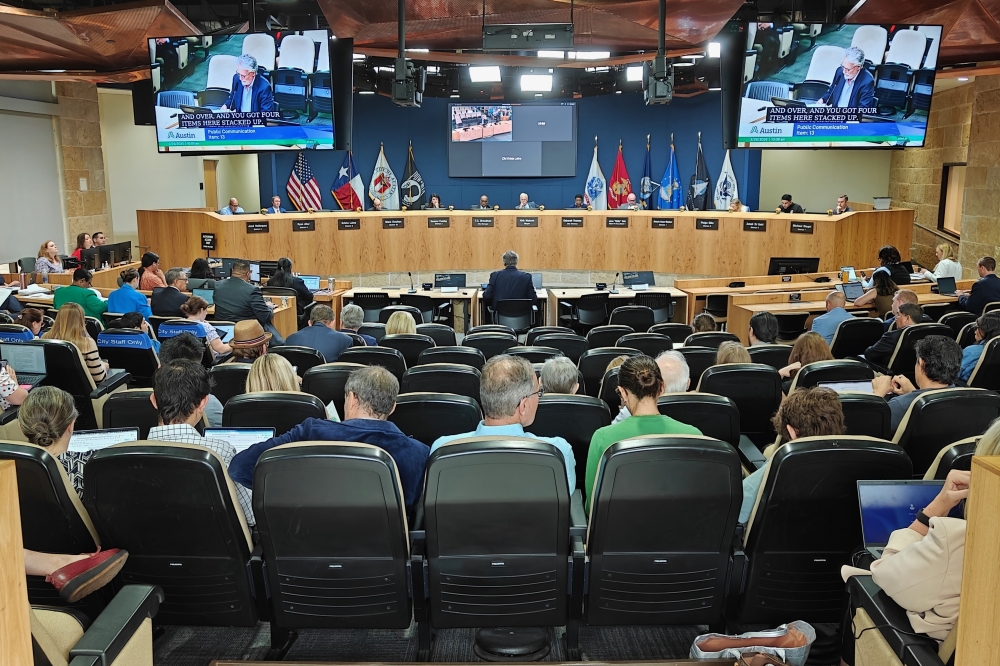
City Council took the first step toward broadening the types of multiunit housing that can be built in Austin neighborhoods and allowing more mixed-use development citywide.
What happened
On March 26, council advanced the creation of two new zoning categories over the year ahead.
One is meant to support more multiunit “missing middle” housing at scales in between single-family homes and bigger apartment complexes. The other is aimed at transit- and pedestrian-oriented developments blending residential and commercial space, from smaller corner stores to larger mixed-use buildings.
 City Council is building on a recommendation from city planners to create Middle Residential, or MR, zoning to encourage missing middle housing development. (Courtesy city of Austin)”Middle missing housing is the next logical step in this council’s goal to make housing accessible and affordable,” Mayor Kirk Watson said in a statement. “Having a well-rounded, robust, and active housing market means addressing what’s missing, and these mid-density developments are what’s missing. Building missing middle will broaden housing choice, which we know is crucial to building a life here in Austin, Texas.”
Read more about the zoning proposals here.
The context
Specific details for the two concepts forwarded in a resolution from council member Paige Ellis are still to be determined. Her approved resolution builds on a January study by city planners that evaluated Austin’s current stock of missing middle and mixed-use development and laid out policy recommendations to expand those options.
That study outlined how Austin’s existing land development code has mainly favored single-family or large multifamily residences since its 1984 adoption, while multiunit options like townhomes and cottage courts became far less common.
Planners contended that more missing middle and mixed-use construction could improve housing affordability and improve residents’ access to amenities and quality of life. They also noted Austin’s code has yet to comprehensively address last year’s Senate Bill 840—legislation that allows commercial building in residential zones, but may not align with some local planning and affordability goals.
 New zoning proposals could encourage various mixed-use development. (Courtesy city of Austin)Better mixed-use zones will support a wide variety of development, Ellis said, from desired denser apartment projects near downtown and transit lines, to smaller businesses near neighborhoods. She referenced her vision of opening a flower shop and living upstairs after her eventual retirement, a setup that’s not common in Austin today.
“Right now, we don’t have that type of stock available for people who want to own small businesses. We don’t have enough starter home spaces. We don’t have enough places for folks to downsize within their own community when they retire or they become empty-nesters,” she said.
Put in perspective
The move to extend Austin’s missing middle and mixed-use zoning drew mixed, but generally supportive, reactions from residents ahead of council’s vote. As with other recent attempts to revise Austin’s development rules, approval came from those favoring new options for residential density who view the changes as tools for housing access and affordability.
“I think we all know housing affordability is a problem, and housing affordability depends on housing supply,” said District 7 resident Adam Hootnick, founder of a modular housing builder. “Yet single-family and massive complexes cannot be our only answers. We need innovation in housing, we need thoughtful development that matters.”
Most officials also supported the approach, with several stating the changes will help create housing opportunities, provide for more affordable options in the market and build out walkable and friendly communities.
Other residents said council is pushing an unnecessary upzoning, representing an overreach from City Hall following other development initiatives like the Home Ownership for Middle-income Empowerment, or HOME, initiative.
“Why are single families always being targeted on this entire process? You want to put missing middles in the neighborhoods, but … there are unintended consequences,” said Southwest Austin resident and former mayoral candidate Jeffery Bowen.
Council member Marc Duchen cast a vote against the plan, saying the changes could negatively impact his constituents and may not create cheaper housing options.
“I just worry there’s a great chance that that item produces a lot more market rate and luxury cottage [courts] and townhomes, and that’s about it,” he said.
What’s next
This spring’s vote is just the first step toward creating the zoning categories and eventually seeing development take place under the policies. The city will spend the next year drafting the zoning districts, a process officials said will require “robust” engagement with builders, neighborhood groups, housing advocates, and city boards and commissions.
Ellis’ resolution sets a March 2027 deadline to revise the city code with the new zoning. That step will be followed by further public discussions about which parts of Austin the policies should be applied to.