
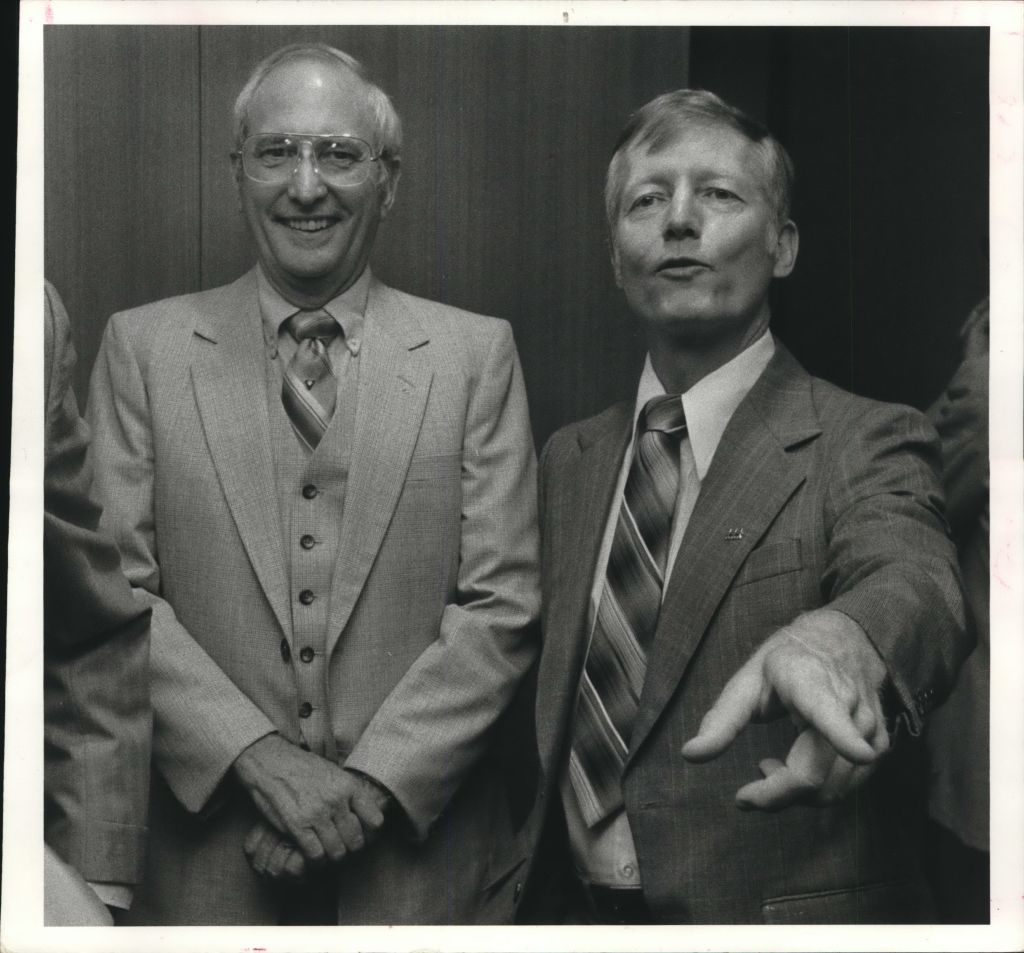
HOUSTON, TEXAS – SEPTEMBER 14: Harris County Commissioner Jim Fonteno, left, and County Judge Jon Lindsay begin celebrating after voters Tuesday overwhelmingly authorized the county to issue $900 million in bonds to build toll roads. Advocates called the proposal a major step toward solving area traffic woes. County Commissioner Jim Fonteno, left, and County Judge Jon Lindsay celebrate victory in September 1983, when voters overwhelmingly approved $900 million in bonds to build toll roads. Since then, county officials have borrowed $1.6 billion to build tollways. Lindsay and Fonteno are the only remaining elected officials who served on Commissioners Court at the time of the vote. Harris County Judge. (Timothy Bullard/Houston Chronicle via Getty Images)
Houston Chronicle/Hearst Newspap/Houston Chronicle via Getty Imag
Signs point out that parts of Highway 249 will become a toll road, Friday, Dec. 14, 2012, in Houston. ( Nick de la Torre / Houston Chronicle ) (Photo by Nick de la Torre/Houston Chronicle via Getty Images)
Houston Chronicle/Hearst Newspap/Houston Chronicle via Getty Imag
For decades, a belief has persisted in Harris County that toll roads will eventually be free once the roads are paid off.

“In 1983, the idea was simple: We’ll build this road, and when it has paid for itself, we’ll make it a freeway,” a Houston Chronicle article from 2007 reported.
Article continues below this ad
The idea has spread like a game of telephone over the years, but the official record tells a different story.
Voters approved the toll road system in 1983, enabling the county to collect tolls “so long as any of the bonds are outstanding,” per official ballot language. In the 43 years since, those bonds have multiplied, tying tolling not to a timeline, but instead to an ever-renewing stream of debt.
In 1983, Harris county voters passed a proposition that would allow the county to take out a $900 million bond “for the purpose of paying the cost” of infrastructure like bridges, tunnels, overpasses and highways to meet population demand.
The greater Houston area had undergone a massive population boost in the prior decade, growing by almost a million residents. Referred to as the “fastest rising city in America,” the region was in need of a more robust transportation network to alleviate growing traffic and allow for more widespread housing development.
Article continues below this ad
The Harris County Toll Road Authority opened, administering the initial $900 million to pay for what is now known as the Hardy and Sam Houston tollways. Beltway 8’s first major section, between the Southwest and Katy freeways, opened in June 1988.
On the surface, the idea then was that the debt owed to a variety of investors would be “supported and secured” from the revenue generated from toll fees.
However, the language never indicated a set timeline to make the debt off, tied tolls to the payoff of a specific road or prohibits the county from taking on more debt if it chooses.
That open-ended structure has left key details about how the system works, in addition to how long it lasts, largely misunderstood by the public.
Article continues below this ad
The misconception was referenced in a 2024 conversation between the Houston Chronicle and late Harris County Judge Jon Lindsey, who is credited as one of the architects of the toll road authority.
“Just as in 1983, Lindsay said, most drivers do not fully understand the financing end of the toll roads, even if they think it is as simple as borrowing money to pay for construction,” Houston Chronicle reporter Dug Baley wrote.
After initial stretches of Sam Houston and Hardy toll roads were opened, Harris County moved forward on several tollway expansion projects. Over the years, Sam Houston would be expanded by 88 miles to run around the city of Houston, coming to a final completion in 2011.
With expansion and additions like the Westpark Tollway and Fort Bend Toll Road, the toll road authority today manages 128 center lane miles and 830 lane miles across the county. As a result, the debt that once was $900 million, has now exceeds $3 billion.
Rather than shrinking, that debt is continually extended, with new bonds issued even as older ones are paid down. A 2025 Fitch Ratings report, for example, notes the county plans to issue additional toll road bonds that will not be fully paid off until 2055.
Article continues below this ad
Yet at the same time, the system remains extremely profitable, with toll road revenue bringing in roughly $800 million from drivers annually.
“In the meantime, it’s producing all this excess cash flow. And so the question is, what should you do with it,” Bill King said in an interview with Chron.
King, a former mayor of Kemah and Public Finance Fellow at Baker Institute, has been among those raising questions about the system’s structure, particularly how it can carry massive debt with consistent surplus.
“There’s kind of this urban myth out there that when they set up the toll road, as soon as the debt was paid off, it would go free,” King said. “There was never anything in the original documents, nobody ever promised that or talked about it.”
Some groups like Texans for a Toll Free Highway have labeled it as a “broken promise,” saying previous campaign literature supported the idea of eventually-free toll roads.
Article continues below this ad
Politicians on both sides of the aisle have also echoed the claim. For example, just two months ago a Dolcefino Media report quoted Texas Rep. Briscoe Cain on the issue: “We were told that tolls would go away once the roads were paid off. Instead, Democrats running Harris County turned it into a forever tax and a real cash cow for Houston politicians,” Cain said. While Cain’s office verified the quote, the Republican House member declined to elaborate to Chron on how he thinks this idea has persisted.
Meanwhile, Democratic County Judge Lina Hidalgo also brought up the rumor during a June spat with the auditor’s office over the county’s purchasing and procurement process.
“Its a disservice to taxpayers, who by the way, were told they weren’t going to keep paying tolls, and not only do they keep paying tolls, the toll money was spent without a procurement process,” said Hidalgo during the June 26 meeting.
But, in reality the system is “not even close” to paying off its debt, said King.
Article continues below this ad
Despite that, hundreds of millions of dollars are pulled from toll revenues each year and redistributed to county commissioners for other projects. In recent years, those transfers have totaled roughly $150 million to $200 million annually. Apart from what commissioners choose to share, they are not required to publish a detailed breakdown of how they use this money for the public.
As a result, the model, at its core, is cyclical. Borrow money to build roads, collect tolls to pay that debt, then issue new debt while using surplus revenue elsewhere.