
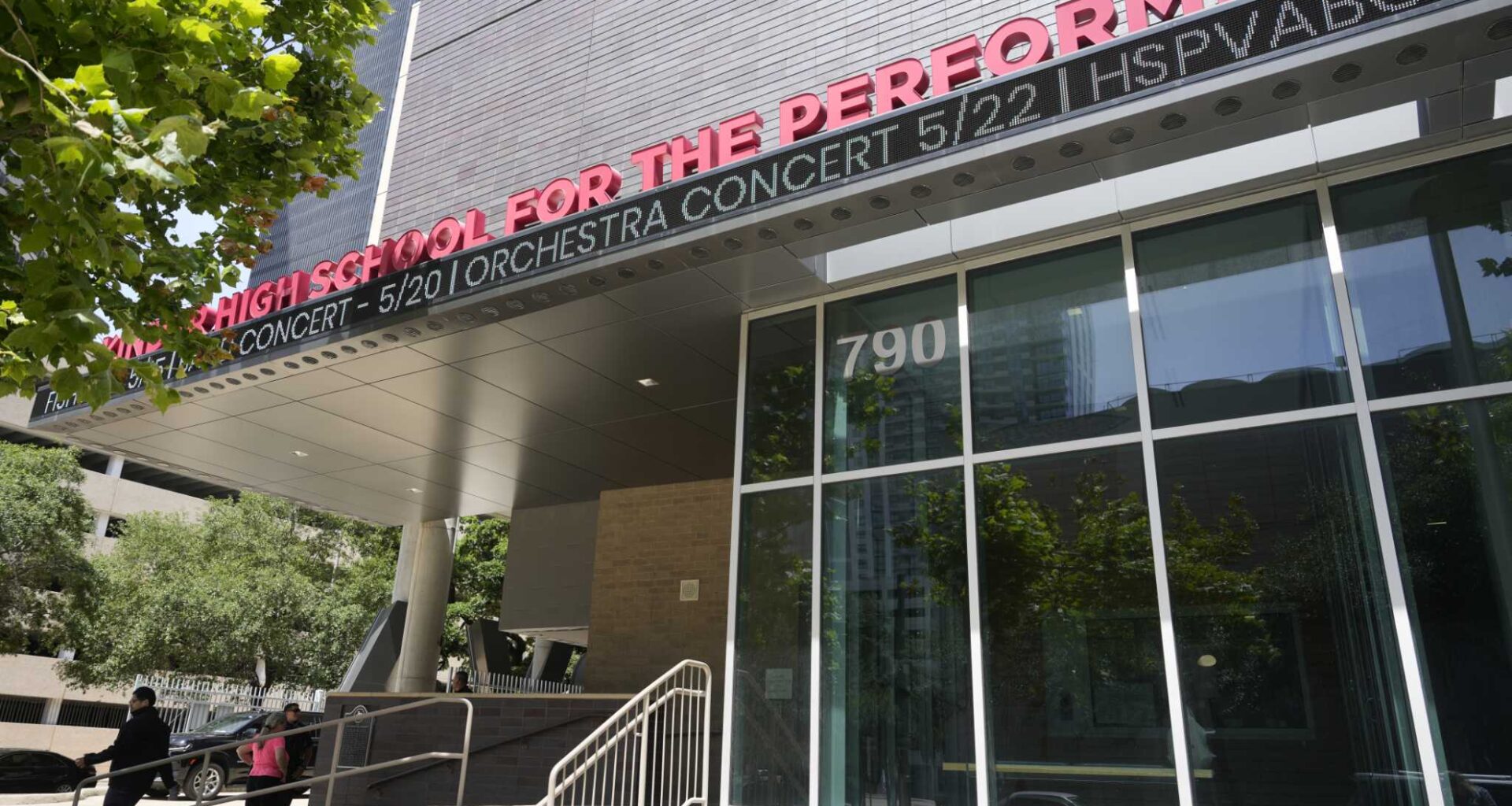
Kinder High School for the Performing and Visual Arts is shown in Houston, Wednesday, May 14, 2025.
Melissa Phillip/Houston Chronicle
Four of Houston ISD’s most prestigious magnet high schools will have new outside managers, after the district’s state-appointed Board of Managers approved outsourcing school operations.
The move will place school management in the hands of nonprofits, meeting some parents’ hope to break away from HISD’s strict reforms while sparking questions about their financial management and accountability.
“I only wish more HISD schools had this opportunity, because right now this is one of the only pathways for schools to preserve what makes them successful,” said Naomi Doyle-Madrid, whose children have attended two of the schools with new partnerships.
Article continues below this ad
The district approved five-year contracts with nonprofits for the Kinder High School for the Performing and Visual Arts (HSPVA), Energy Institute High School, Challenge Early College High School, Houston Academy for International Studies, as well as a contract with education nonprofit Collaborative for Children to help manage pre-K centers.
HSPVA Friends is the longest running nonprofit among the high school-affiliated nonprofits. Two of these nonprofit organizations are new and registered with the state in the last several months.
The contracts were still under negotiation two weeks ago, leading the district to delay the vote and schedule it for a meeting typically designated for employee hearings. The contract approvals clear the way for HISD to submit an application to the Texas Education Agency for approval by a March 31 deadline.
Article continues below this ad
These contracts, which HISD did not release to the public before the final vote, will bring an estimated $1,400 per student of additional state funding. HISD will allow those high schools to receive 80% of that funding, state-appointed Mike Miles said. The other 20% will go toward HISD students outside those schools.
The final vote drew a smaller crowd — 25 people signed up to speak — than the previous meeting when the board was set to vote. Leaders with the nonprofits and schools asked the board to vote yes. The nine managers approved the contracts with a unanimous vote after an hour of deliberation in closed session. Afterwards, state-appointed superintendent Mike Miles gave the audience two thumbs up, and district officials congratulated school representatives.
The vote was welcomed by several of the magnet schools’ leaders as a way to sustain their programs and innovate.
“HSPVA was founded in 1971 as an innovative campus within Houston ISD,” HSPVA’s principal Priscilla Rivas said. “For its time, it was a true pioneer, a bold reimagining of what public school could be when arts excellence and academic rigor were intentionally intertwined. Now, more than five decades later, we find ourselves at another important crossroads.”
Lori Lombropoulos, the founding principal of Energy Institute High School, said the school has been asking for this kind of partnership for years.
Article continues below this ad
“And if you’ve ever stepped foot on our campus, you know that innovation is the soul of Energy,” Lombropoulos said. “You see it in our public exhibitions where students defend their learning to professionals. You see it in our engineering design team solving real-world problems. You see it in our championship robotics teams competing at the highest levels. These experiences are not add-ons. They are at the core of who we are, and they require stable, sustainable funding to maintain quality and access for all students.”
DEPARTURE: Top HISD official hired to lead Fort Worth ISD as deputy superintendent in new takeover
‘Earned autonomy’
These contracts are called partnerships, under the state law known as Senate Bill 1882. Since the state took over HISD, the vast majority of schools have lost the autonomy to make decisions on instructional model, procedures and practices.
Elements of Miles’ reform model — called the New Education System — are used at virtually every school in the district, including some of its highest-performing campuses.
Article continues below this ad
Top-performing high schools in 2024 were promised exceptions to Miles’ “defined autonomy framework.” Schools rated “level 4” — including all four high school campuses approved for partnerships — were told they can make decisions on programs, curriculum, instructional model, time devoted to core subjects, budget, staffing, principal compensation and more. They could request their own school start times or testing calendars, opting out of districtwide standards.
But HISD says now these top-performing high schools may make their own decisions on schedules, staffing, and pay through these partnerships.
At the March 19 board meeting, Miles said HISD’s managed instruction has helped boost its school ratings, but acknowledged it “may stifle initiative and innovation.”
“The right to innovate has to be earned,” Miles said. “We call that earned autonomy. And we have several schools in this district who have earned the right to do way more innovation and autonomy.”
To earn this autonomy through outside partners, the high schools must have at least four consecutive years of “A” ratings in the state’s A-F state accountability system.
Article continues below this ad
MATH: HISD launches new ‘Accelerated Math’ pathway to enroll more eighth graders in Algebra 1
The road to SB 1882 partnerships
Orlando Riddick, who was promoted to be HISD’s chief of strategic initiatives in September, said the contracts would have financial “guardrails” and bring around $1,400 per student from the state to those schools.
An HISD spokesperson declined multiple requests to interview Riddick or a colleague and did not respond to written questions seeking to clarify Riddick’s March 19 board presentation.
Riddick said Miles first considered elementary, middle and high school data as a “proof point” for partnerships. He looked at schools with four years of A ratings, smaller achievement gaps between student groups and stable enrollment.
Riddick said he and Miles went “through an interview in regards to ‘do you accept this as an opportunity, and if so, you need to go back to your community… and share this opportunity to launch forward.’” It is unclear if Riddick was referring to school or nonprofit leadership.
While Riddick said they started with seven schools, four moved forward with applications this year. Eastwood Academy High School, Carnegie Vanguard High School and DeBakey High School for Health Professions may seek outside managers next year.
Miles said that middle schools may be considered for partnerships in the future.
Riddick said after that engagement in September or October, campuses decided to move forward three weeks later. Riddick did not share who was surveyed, but referenced going back to the schools’ community of parents and teachers.
Friends of the Houston Academy for International Studies and Friends of Challenge Early College High School were approved by the state but not the federal government for tax-free exemptions, Riddick said.
A team led by the school principal filled out applications — some more than 200 pages long — to submit to the TEA. They detailed academic performance, curriculum, governance, operations and facilities, and finances, Riddick said.
HISD Energy Institute High School is seen in Houston, Monday, April 7, 2025.
Kirk Sides/Houston Chronicle
A group of five members — including Riddick and employees under the chief of schools, chief of staff, and geographic division chief, and a representative from the regional education service center — spent two days reviewing and scoring at least 80 categories in the applications.
The applicants, including the school principal and nonprofit leader, had to answer questions from the group, which then submitted recommendations to the superintendent, according to Riddick.
The contract approval for four high schools and HISD pre-K comes weeks after the board approved 12 school closures and colocations.
Five-year performance contracts
While Riddick highlighted “financial controls” in his presentation earlier this month, the district did not provide further details. The contracts were not made public in the board’s agenda. Riddick said on March 19 that schools must meet certain performance requirements or will go on “probation.” HISD did not respond to questions on who would supervise probation.
Riddick said the nonprofits must have a board, officers, committees and conflict-of-interest safeguards. The local regional educational service center — known as Region 4 — will train those boards.
The nonprofits must meet certain performance requirements, including keeping their A ratings, campus-wide goals and outcomes for certain students. Those nonprofits must also narrow achievement gaps between certain student groups.
The schools will participate in HISD school choice for the upcoming school year but may create their own process for following years. Any new enrollment policy must comply with state law.
HISD will continue to own the facilities, while the nonprofit is responsible for “day-to-day care” and following requirements for maintenance and repairs. HISD would not confirm if that means the nonprofit is responsible for building maintenance and repairs.
Melissa Jacobs Thibaut, Houston Academy for International Studies’ founding principal, described the school achieving students’ success with minimal resources.
“My belief from that first day was that we were building a school not only that I, but every Houstonian resident, would be proud to have their child attend. Despite our limited facilities and resources, first in a temporary building on a parking lot and now in a 1960 elementary school, we have excelled,” Jacobs Thibaut said.
CABINET CHANGE: Houston ISD names a new Chief of Communications after October departure
Early financial details for high schools
While the partnership could give schools more autonomy, the additional state funding that comes with it could benefit the entire district. Miles said 80% of the extra estimated $1400 per student from the state would go to students at these partnership campuses, but the remaining money would go to students attending other HISD schools.
“The rest of the students outside the 1882 (partnerships) will receive some portion of that,” Miles said.
The extra funds could bolster the finances of HISD as it grapples with declining enrollment. Miles’ New Education System, aimed at lifting up student test scores at historically underserved campuses, is costly. The district is also seeking to tie teachers’ salaries to their evaluation scores, not years of service, which could increase costs as well.
Like districts across Texas, the state’s largest school district is facing several funding threats. HISD has resorted to closing schools and approving a small tax increase — allowed due to Hurricane Beryl— to support Miles’ vision as enrollment — and the funding tied to it — decline.
HISD gave the nonprofits “a menu of services” they can choose to opt into, such as grounds services. If the nonprofit wishes to opt out of a service, HISD will give it the funding for the nonprofit to carry it out.
“And we audit you,” Riddick said then. “We audit you independently. We audit you functionally. Every year, you will have a formal audit. And we can come in monthly as well to audit the books.”
The school logo is seen in the office of HISD Energy Institute High School in Houston, Monday, April 7, 2025.
Kirk Sides/Houston Chronicle
HISD’s chief financial officer will have an accountant dedicated to these schools, Riddick said. HISD will manage all of the financial aspects for three of the schools, while one school has “the legs … to be able to operate and move further along.” HISD declined to answer clarifying questions on the reconciliation and budget process.
Board member Michelle Cruz Arnold asked what baseline funding goes to the campus, district and nonprofit partner. Riddick did not give an amount, but said each school will receive a “base” funding and additional “incentive” amounts related to its number of special education, emergent bilingual, and career and technical education students.
The school’s employees work for HISD, but the nonprofit must take on at least one employee, Riddick said. The district and nonprofits negotiated staff compensation at that time, two weeks prior to the vote.
Alene Coggin, HSPVA Friends’ executive director, said she wants teacher compensation at the performing arts high school to match the teachers’ talent.
“We have an office,” Coggin said. “It’s across the street from the school, and we’re able to walk back and forth to visit with the teachers every day and to just listen to their needs. And I have a board who’s paying very close attention. They pay close attention to their metrics. They pay close attention to what the teachers are accomplishing in the art areas based on international trends, national trends.”