
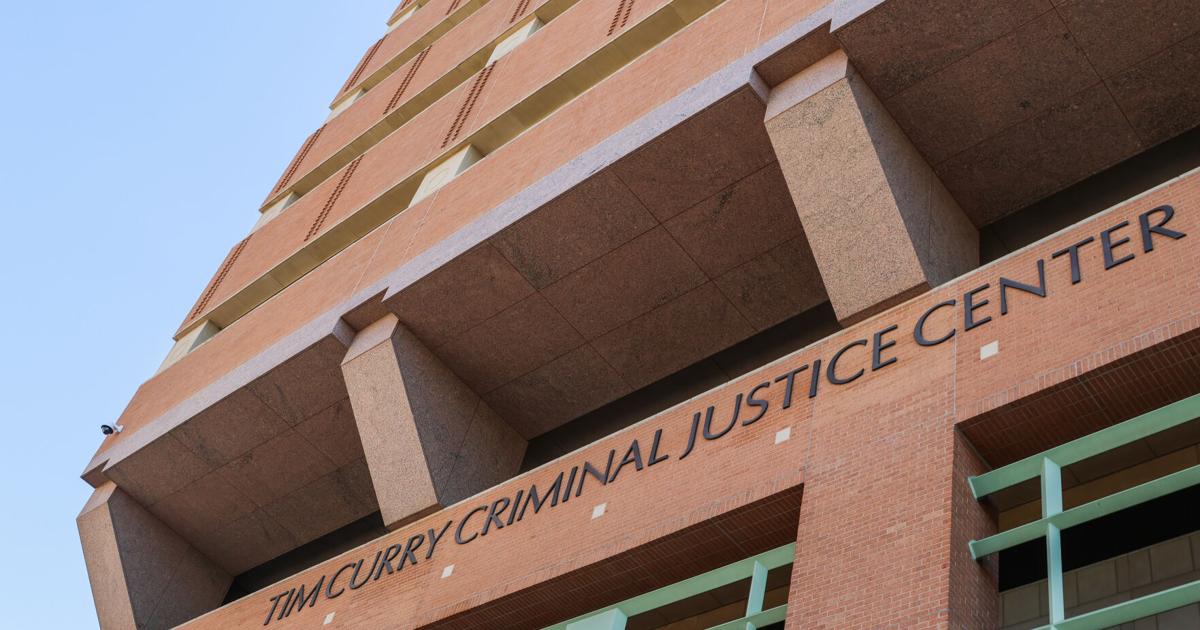

The Tim Curry Criminal Justice Center sits on Belknap Street on March 26 in Fort Worth. A Tarrant County jury chose not to indict the woman arrested in relation to a 1991 cold case, which UTA students assisted police with.
UTA students aided police in a 1991 cold case that recently led to an arrest, but a Tarrant County jury last week declined to indict the woman arrested.
The no bill was issued when the assessment jury determined that the evidence and the allegations presented did not warrant criminal charges.
The arrest of Janie Perkins resulted from a partnership between a UTA criminology course and the Arlington Police Department. The class researched the early 90s killing of Cynthia Gonzalez.
On Sept. 17, 1991, Gonzalez was reported missing by her ex-husband. A few hours after she was reported missing, her vehicle was found abandoned in a neighborhood in the 900 block of Cedar Springs Terrace. Officers looked into the possibility of her being kidnapped, according to an Arlington Police Department press release.
On Sept. 22, 1991, the body of an unknown female was found on private property in a rural area of Johnson County. She had been shot multiple times. Through fingerprint comparison, the Tarrant County Medical Examiner’s Office positively identified her as Gonzalez.
Since then, detectives have pursued multiple leads but never made an arrest.
During the fall semester, students reviewed the case in a cold case class taught by Patricia Eddings, distinguished senior lecturer and director of the forensic applications of science and technology minor.
Throughout the semester, the students sifted through the case details, reading statements and assessing evidence.
An Arlington Police Department spokesperson said in a statement that the department respects the decision of the grand jury.
“We stand behind the investigative efforts of the detectives who worked on this case over the past three decades, and the efforts of the UT Arlington students who assisted as part of our cold case partnership with the university,” the statement said.
Jacey Concannon, a biology senior with a forensics minor and a student in the class who assisted with the case, said in an email that there are a lot of moving parts when building a case and gathering evidence.
“I am proud of the work our group and students in the class put in,” Concannon said. “We were able to gain connections and see the different steps it takes to examine a case. Sometimes it takes a fresh set of eyes to see something new.”
Trial specialist Kim D’Avignon said in a statement that trying cold cases can be difficult.
“Over time, witnesses can pass away or become unable to testify. Also, cold cases don’t have some of the modern technological resources like cell phone data and cameras,” D’Avignon said in the statement. “Sometimes these factors can leave us without the admissible evidence needed to prove a case beyond a reasonable doubt.”
D’Avignon said she and the department remain hopeful that new information will emerge that will allow Tarrant County to reopen the investigation and present charges again to the jury.
Miles Brissette, who provided counsel for Perkins, said in a statement that Perkins and her family are looking forward to moving beyond the trial.
“The Perkins family is grateful to the Tarrant County Criminal District Attorney’s Office and to the members of the Grand Jury for taking the time to conduct a thorough, evidence-based review,” Brissette said in the statement.
@tay._.sansom