
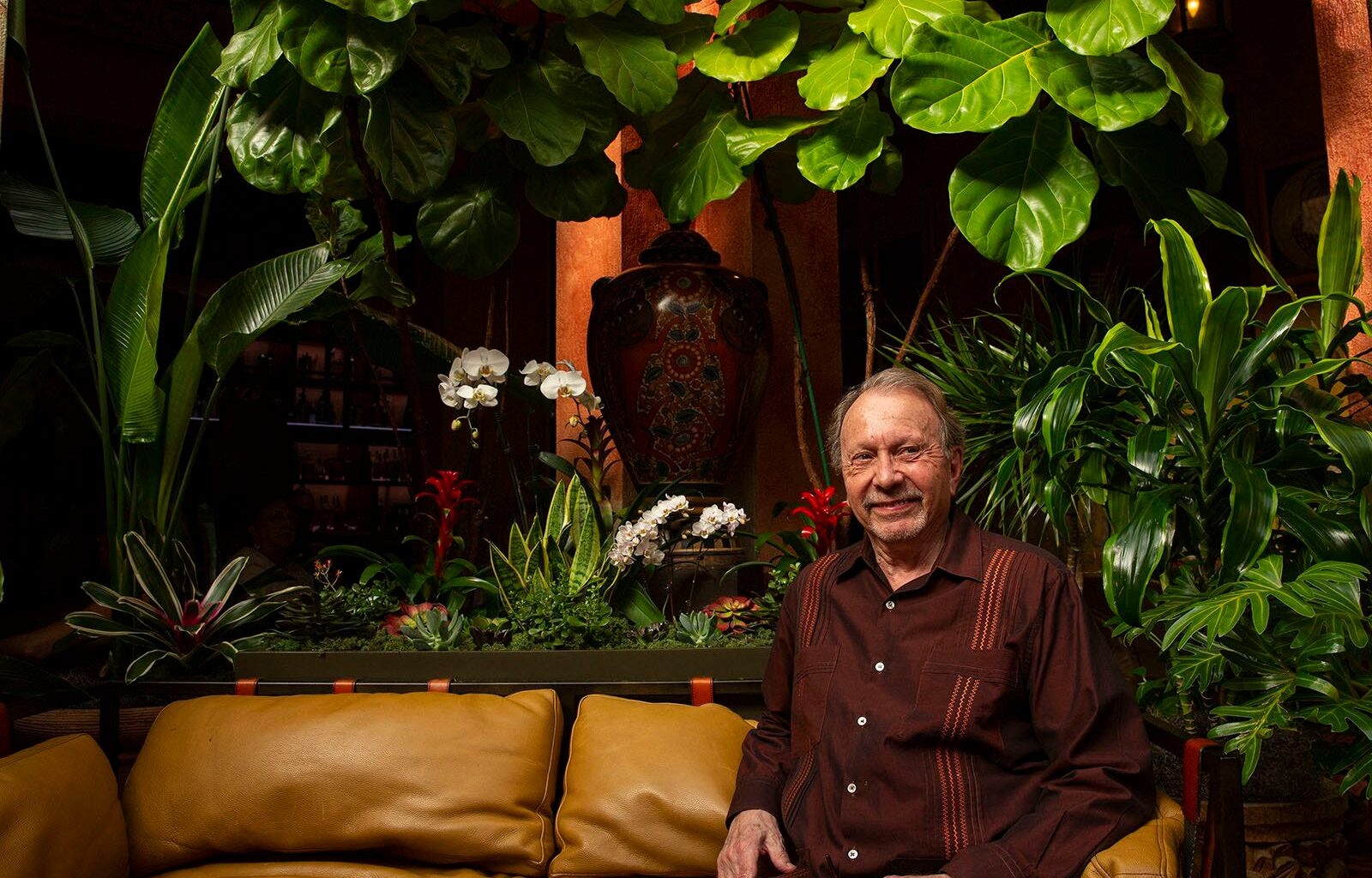
Tom Gilliland opened Fonda San Miguel with his late business partner, chef Miguel Ravago, in 1975.
Mikala Compton, Mikala Compton/American-Statesma
Jim Duncan, a retired city planner, has written more than 600 short histories of Austin businesses. We introduced him and this series, “Jim Duncan’s Austin,” on July 6. This week, we adapt three of his histories of Mexican restaurants. Last week, we covered Spanish Village, Matt’s El Rancho, Tamale House and Rosie’s Tamale House. — Michael Barnes

1975: Fonda San Miguel
(In 2025, this newspaper published several stories about the 50th anniversary of Fonda San Miguel, a unique dining experience in a city filled with singular restaurants. It belongs, too, among these short histories of Mexican restaurants.)
Article continues below this ad
Founded in 1975 at North Loop Boulevard and Woodview Avenue near Hancock Drive, it was one of the first restaurants in Texas to focus exclusively on authentic regional cuisine from Mexico’s interior culinary epicenters.
It transports diners to a stylish restaurant in Mexico City, Oaxaca or the Yucatan. But Fonda is more than a fine Mexican restaurant; it is also an unofficial art gallery, social salon and culinary archivist.
Co-founder and owner Tom Gilliland has presided over Fonda for its full 50 years. His co-founder, Miguel Ravago, died in 2017. Gilliland continues to honor Ravago’s legacy with an ongoing commitment to Mexican cuisine and hospitality. On most nights, you’ll find him circulating in the dining room, greeting old and new customers.
Gilliland has a similar passion for art and has collected museum-quality Mexican and international pieces on exhibit in the restaurant.
Article continues below this ad
Early this year, Gilliland opened a new restaurant next door called “Tzintzuntzan,” which translates to “Place of Hummingbirds.” It serves breakfast and lunch, meals not offered at Fonda San Miguel.
1982: Chuy’s
Mike Young, left, and John Zapp, seen in 1995, opened the original Chuy’s on Barton Springs Road in 1982.
AMERICAN-STATESMAN FILE
Chuy’s is the house that Elvis never left.
Article continues below this ad
It is also the most successful Tex-Mex restaurant chain to ever come out of Austin.
The first Chuy’s opened in 1982 on Barton Springs Road and provided seating for about 60, a women’s restroom the size of a broom closet and a men’s restroom out back.
Four decades later, the chain employs more than 7,400 employees in 100 restaurants in 15 states, mostly in the South and Midwest.
Co-founders Michael Roger Young and John Anthony Zapp had a vision of a “fun and funky” Tex-Mex restaurant that possessed Austin-style weirdness and served authentic, fresh food in a fun atmosphere that was appealing to everyone.
Article continues below this ad
Young and Zapp decorated their first roadhouse with an oversized velvet Elvis painting, and all restaurants thereafter included an Elvis shrine. Each location also comes with unique thrift shop-style decor that includes fish wearing sunglasses.
Since 1988, the Chuy’s Children Giving to Children Parade has annually collected toys that are distributed to underprivileged children by the Austin police department.
Young and Zapp sold their majority interest in Chuy’s in 2006. Young retired from the board in 2017, and Zapp stepped down in 2018.
Steven J. Hislop has been Chuy’s president/CEO since 2018. In 2024, Darden Restaurants bought Chuy’s for $605 million. Young died in 2023.
Article continues below this ad
1987: Serranos Cocina y Cantina
Serranos Cocina y Cantina now operates four Austin locations.
David P. Smith/Serranos
“Have peppers — Will travel” could easily be Café Serranos’ epigram.
After naming their restaurant after a Mexican chili pepper that heat-ranks somewhere between the jalapeño and habanero, David Quintanilla and Adam Gonzales peppered Central Texas with a baker’s dozen more of their mesquite-grilled Tex-Mex restaurants.
Article continues below this ad
When they opened their first Café Serranos at 321 W. Ben White Blvd., it was at the end of a building boom in Austin and the beginning of a five-year recession. So, when they ended up in 1992 with three more restaurants — Symphony Square, East Riverside Drive and Research Boulevard — it was considered an “incredible” business accomplishment.
By 1996, they added locations on West Anderson Lane, North Interstate 35, West Lake Hills and Barton Springs Road, bringing their total to eight.
In the 2000s, they opened four more locations on Sixth Street and South MoPac, and in La Frontera and South Park.
Over the years, Café Serranos has sponsored many community events, such as hot sauce festivals and travel contests.
Article continues below this ad
In 2017, Serranos was rebranded, highlighting its mesquite grilling and award-winning salsas and fajitas.
Today, four of the 14 locations are still open: Lakeline, South MoPac, South Park and Cedar Park.
Three recent histories from this series
Neon, motor courts and mobsters: A history of Austin motels
Article continues below this ad
The weird, wonderful toy shops Austin grew up with
From bread to blues: Four classic Austin bakeries and the stories behind them
Please send tips and questions to mbarnes@statesman.com
Article continues below this ad