
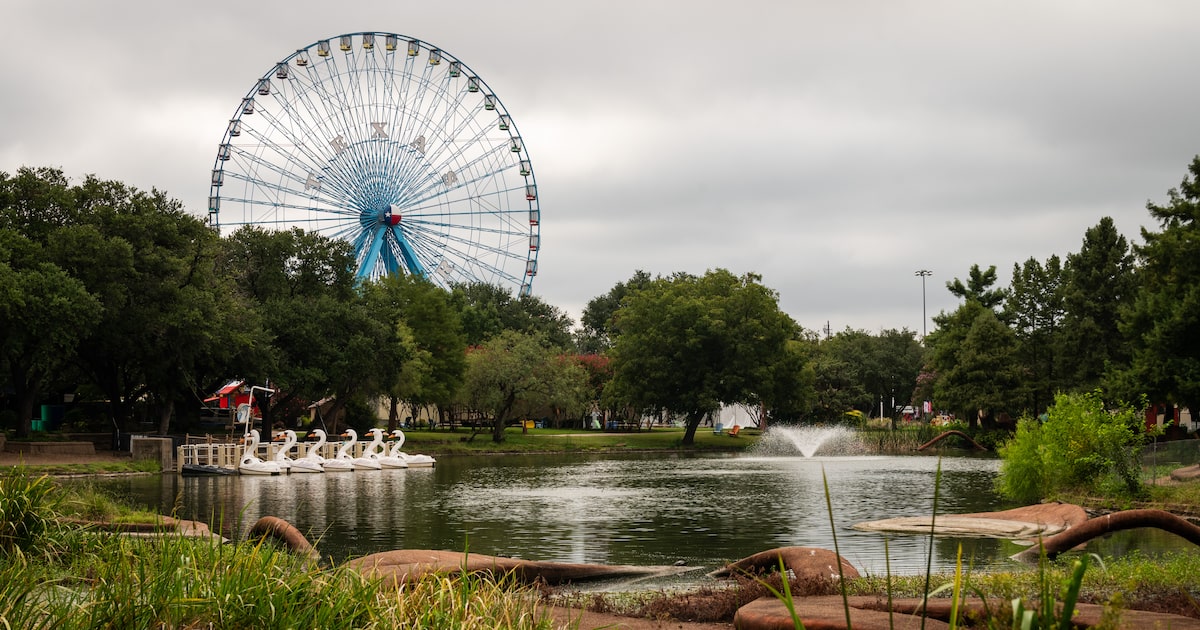
With hopes to generate revenue for Fair Park, Dallas leaders are considering replacing a sea of parking spaces with new development, possibly a hotel, restaurant or store, as part of a plan presented by the city’s park department.
The development would join a new community park in replacing parking mostly used during the annual State Fair of Texas.
Development could generate enough revenue at the city-owned Fair Park to maintain and operate the 277-acre grounds, said deputy park department director Ryan O’Connor, who presented the idea during a briefing to Park Board members Thursday. He added that the park department plans to seek proposals and start a process to identify the best options.
“I’m not trying to get super ahead of ourselves, but this could be the piece of the puzzle that we’ve been seeking for so long, that could yield that revenue that we need to fully monetize Fair Park,” O’Connor said.
Breaking News
The park department began managing Fair Park in September, scrambling to transition and set up contracts for services like security and events after a tense split from its previous operator.
On Thursday, park department leaders touted the improvements to the fairgrounds, including major repairs to HVAC systems and upgrades to irrigation and landscaping.
“We reintroduced high school football to the Cotton Bowl. We’ve launched a weekly market and we’ve established recurring meetings with key departments to collaborate on work outside of Fair Park,” said Brett Wulke, the general manager at Fair Park.
Dallas handles transition
Previously, Dallas contracted with Fair Park First to manage the park, which in turn hired Oak View Group to run day-to-day operations.
The city terminated the contract last year, with officials stepping in to take direct control as the city worked to rebuild its management structure. Since the contract ended, documents show OVG has sought $5 million in damages from Dallas, saying the city improperly ended the agreement, refused to pay invoices for work performed before the termination and failed to reimburse certain expenses and investments.
Related
Park officials have accused OVG of failing to hand over key financial information and telling event organizers their agreements with the city were ending. OVG has refuted this, saying park officials never requested the financial records before the handover and that it was simply notifying its licensees that OVG would need to transition all contracts to the city.
“In a functional transition, we would have sat with the previous operator,” Wulke said Thursday. “Instead, those clients were notified their events were canceled and we were left picking up the pieces and it took a significant amount of time on our staff to put that all back together.”
Several contracts for the park’s management are still pending. The city is also in talks with several large festivals, continuing to pursue opportunities for Fair Park, Wulke said.
City plans new approach
The park department has been leaning into nontraditional revenue opportunities in the park system, O’Connor said, “because we have to.”
The city is looking to Brooklyn Bridge Park in New York as one of its inspirations. The park has a small amount of space available for private development, which pays for the park and goes into a capital reserve fund, O’Connor said.
“The elements of the private development really blend into the park in a way that doesn’t detract from the functionality of the park,” he said.
Related

With development, revenue could come to Fair Park through lease payments or other mechanisms. O’Connor said that beyond revenue, development could drive attendance toward other venues on the fairgrounds.
“We can’t continue to have a hole, a metaphorical hole, in the campus that’s really nothing more than parking,” O’Connor said.
Officials consider options carefully
Still, Fair Park is over a century old, said Rudy Karimi, the District 14 park board member, warning it’s an important piece of the city’s historic identity.
“There’s a fine line that we’re going to walk, and we have to walk this very, very carefully,” Karimi said. “When you look around at what’s happening in our city right now, the discussions around what we’re going to do with City Hall and the development there, this creates a lot of disruption within people. It creates a lot of heartache.”
That tension will be magnified when talking about Fair Park and real-estate-driven development, he said. However, he added it’s something to consider and said, “there’s no doubt in my mind why it’s needed.”
John Jenkins, the park department director, said Fair Park has been the “toughest political issue to solve in this.” He said he’ll constantly be involving the community and ensuring there’s an upside for them.
O’Connor said the park department also plans to consider whether new development complements the park and benefits neighboring communities.
“We want this to be reflective of the character of Fair Park,” O’Connor said, adding, “Folks have been trying to figure out for a long, long time: What are we going to have to do at Fair Park to make it successful?”
New development could be an answer and it should be explored fully, O’Connor said. Park officials plan to brief a City Council committee next month.
This reporting is part of the Future of North Texas, a community-funded journalism initiative supported by the Commit Partnership, Communities Foundation of Texas, The Dallas Foundation, the Dallas Mavericks, the Dallas Regional Chamber, Deedie Rose, Lisa and Charles Siegel, the McCune-Losinger Family Fund, The Meadows Foundation, the Perot Foundation, the United Way of Metropolitan Dallas and the University of Texas at Dallas. The News retains full editorial control of this coverage