
Taylor city hall building in downtown Taylor, Texas.
Cristela Jones/Cristela Jones/MySA
Despite residents opposition, community leaders of a small Central Texas town approved plans for a more than $2.5 billion data center near Samsung’s chip plant. Taylor City Council members unanimously voted in favor to annex and rezone part of the land where the proposed development will be during a meeting on Thursday, March 26.

Dallas-based developer KDC can now move forward with construction on “Project Comal,” an employment center plan with a data center on 220 acres that neighbors Samsung’s semiconductor factory. This comes as several Taylor residents have been fighting against data centers moving into the city, due to potential environmental, health and traffic impacts on the community.
Article continues below this ad
The Halt Taylor Data Centers Coalition held a press conference one day before city council’s vote, urging city leaders to prioritize creating Digital Infrastructure Zoning, which involves specialized land-use planning for local governments to regulate data centers. The group is also collecting signatures for a petition that would remove data centers from Taylor’s zone code and future development until that infrastructure is created.
“We must adopt clear regulations that protect our citizens, resources and quality of life before any more large-scale industrial projects are
considered,” Taylor resident Sarah Winters said in a release.
At Thursday’s meeting, city leaders were joined by representatives of KDC and Taylor’s Economic Development Corporation to discuss the project’s new details based on community concerns. While the data center received strong support from local officials, some residents reiterated those concerns over a lack of transparency and local support.
Article continues below this ad
“We came here today to tell you that promises don’t equal regulation,” Taylor Resident Carrie D’Anna said Thursday. “We wouldn’t have known about how much electricity they had ordered unless we asked. We wouldn’t have known about how many generators there were unless we asked…We’re not being heard. We’re being heard in the way that you hear a child and you convince them, ‘it’s going to be okay, my idea is better.’”
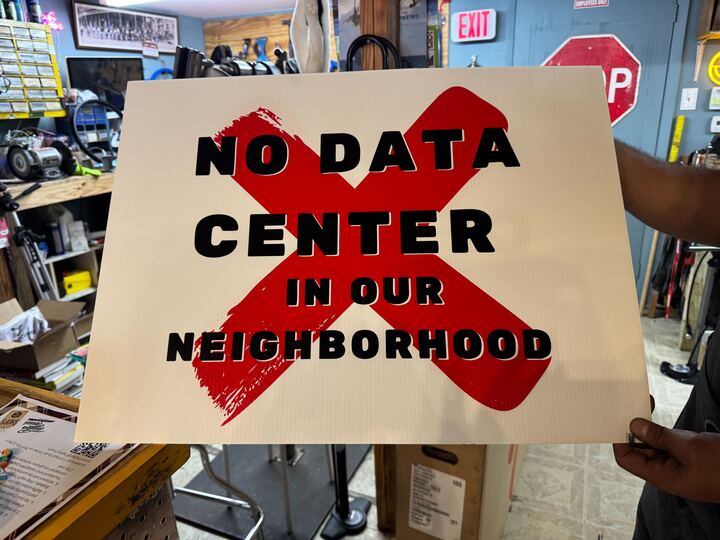
A no data center community sign at Taylor Bike Co. in downtown Taylor, Texas.
Cristela Jones/Cristela Jones/MySA
Bill Guthrie, senior vice president of land development at KDC, said the company has been partnering with the City of Taylor to create ordinances that will require Project Comal to reduce public water usage by using a closed-loop cooling center and having on-site storm water detention.
Article continues below this ad
“That’s a promise that we’ve made previously, but this ordinance defines that and it’s capping the amount of water, and protecting Taylor’s water supply,” Guthrie said. “We’re committing in this ordinance to reduce the pre-developed levels of run-off, specifically on the northwest side of the site where we’ve heard through our communications that that’s a sensitive area.”
KVUE reports that residents say the proposed data center would be located approximately 200 feet from their community, and with the nearby Samsung plant already generating more traffic, many also worry construction on the project will make things worse. KDC wants to build at least six large industrial buildings on the 220-acre campus, which would include electrical infrastructure, detention ponds, a dedicated right of way and commercial spaces.
Ben White, president and CEO of the Taylor Economic Development Corporation, said at Thursday’s meeting that KDC’s $2.5 billion project is estimated to bring in $145 million to the city over the next decade. He added that the project could also generate an estimated $70 million to benefit the school district.
Welcome to Taylor sign on Main and 4th Street in downtown Taylor, Texas.
Cristela Jones/Cristela Jones/MySA
“That’s an average of $14.5 million a year, new taxes to the city,” White said. “And what that provides y’all the opportunity to do [is] to build rec centers, to improve roads, to do whatever you need to do as a council for this community.”
Article continues below this ad
Taylor Resident Pamela Griffin, who sued Blueprint Data Centers alleging that its proposed project would use up the city’s natural resources like water, spoke directly to city council leaders on Thursday, criticizing their actions.
“Our community comes first, we put y’all up here to do our business not the big business’ business and we need y’all to do it right. So far, y’all have been doing it wrong,” Griffin said. “Yes we want Taylor to grow I understand we need to grow, but we need to be smart about it.”
KDC developers requested a zoning change to employment-center zoning, which would mean more flexible designs to support major industrial employment. The data center is projected to generate 3,000 construction jobs over three and a half years and more than 360 jobs once operational.
Article continues below this ad
However, once data centers are built they typically employ 35 to over 100 people, which residents argue that rezoning the land as an employment center is misleading. Other Texas cities like San Marcos and College Station have successfully convinced their city councils to deny proposed data center projects in the past six months, but for now it doesn’t seem like Taylor is on that same path.