
Sonic paprika spiced Thursday night’s Dallas Symphony Orchestra program of music by Hungarian composers, and by a German who turned Hungarian tunes into musical bestsellers.
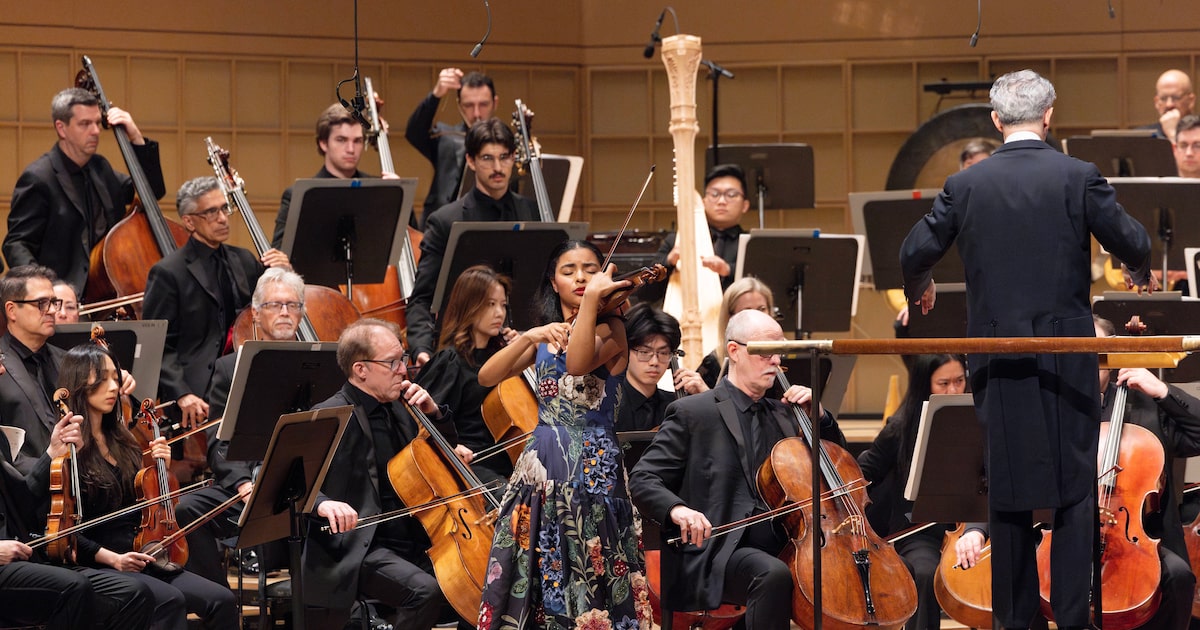
With music director Fabio Luisi back on the Meyerson Symphony Center podium, the concert included a dazzling performance of a work the DSO hadn’t played since giving its 1956 premiere: Miklós Rózsa’s Violin Concerto.
From the middle of the 19th century, a number of European composers explored and arranged songs and dances from Roma and other Central European folk traditions. Their modal melodies were “exotic” to ears accustomed to Austro-Germanic concert music, as were dance rhythms alternately dreamy, swirling and stamping.
Liszt’s Romanian Rhapsodies inspired Brahms’ Hungarian Dances. Zoltán Kodály and Béla Bartók traveled around countrysides collecting tunes to be turned into piano, violin and orchestral compositions.
News Roundups
Kodály’s Romanian Folk Dances, composed in 1915 for piano and arranged for orchestra two years later, occupy a mere six minutes. Bartók’s 1933 Dances of Galanta, about 16 minutes’ worth, draw on tunes from the eponymous town — then Hungarian, now in Slovakia. Both works, with aptly tangy orchestrations, got splendid performances, with particularly fine solos from principals Alexander Kerr (violin), Gregory Raden (clarinet) and James Romeo (piccolo).
Representing Brahms at his most populist, his 21 Hungarian Dances were composed for piano four-hands and subsequently arranged by Brahms and others for solo piano and orchestra. Luisi led spirited performances of two orchestrated by Brahms (Nos. 1 and 3), one by Paul Juron (No. 4) and two by Martin Schmeling (Nos. 5 and 6). What fun!
The performance of the Rózsa just missed the 70th anniversary of its world premiere, the DSO then led by Walter Hendl, with the most famous violinist of the day, Jascha Heifetz. CDs of their subsequent recording are still available.
Best known as the composer of nearly 100 film scores, including Spellbound, Ben Hur and King of Kings, Rózsa helped established a late romantic-dramatic musical language as the lingua franca of film music. (Other practitioners included fellow European emigrés Max Steiner and Erich Wolfgang Korngold and the American Bernard Herrmann.)
Born in Budapest, classically trained in Leipzig, Rózsa worked in Paris and London before settling in Hollywood in 1940. He maintained a lifelong parallel career as a composer of concert music.
Given the Violin Concerto’s extravagant flash and flair, as well as soaring, yearning lyricism, you might wonder why it’s rarely performed. Well, it calls for a first-class violinist, and the orchestra is challenged to coordinate all sorts of tricky rhythms and textures.
On Thursday it had a soloist of jaw-dropping virtuosity, but also suave musicianship, in Amaryn Olmeda. An Australian native not yet 20, currently studying at the New England Conservatory, she dispatched the most fearsome leaps, scurries and double stops as if no trouble at all. Luisi and the orchestra collaborated with élan.
In comments before the concert’s second half, Luisi identified the non-Hungarian “surprise” piece opening the concert. (I’m pledged to keep the secret until after all performances.) The previous concert’s unidentified piece was the “Blumine” movement Mahler inserted in his First Symphony, but subsequently dropped.
Details
Repeats at 7:30 p.m. Friday and Saturday at Meyerson Symphony Center, 2301 Flora St. $31 to $196. 214-849-4376, dallassymphony.org.
 Dallas Symphony’s Wagner ‘Ring’ cycle coming out online and on CDs
The recordings are from the orchestra’s Meyerson Symphony Center performances.
 Review: Dallas Symphony concert again included a surprise
The orchestra also performed Alfredo Casella’s Second Symphony and Samuel Barber’s 1939 Violin Concerto.