
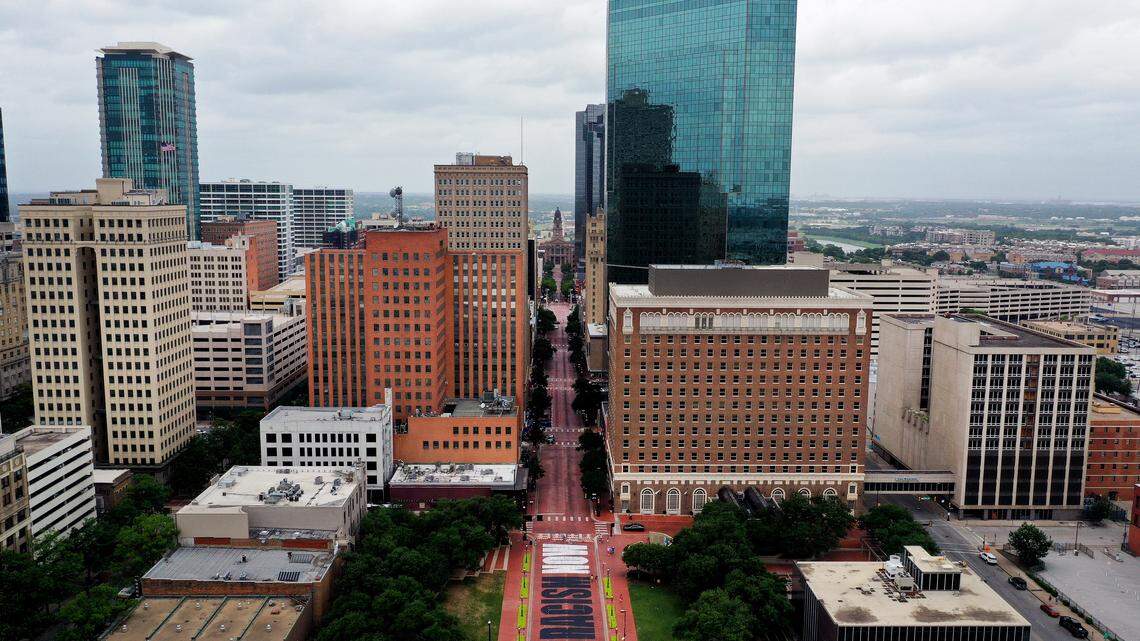

Fort Worth, Texas. (Photo by Tom Pennington/Getty Images)
Tom Pennington
Getty Images
Texas is famous for having no state income tax, a selling point that draws new residents from across the country every year. But for homeowners in Fort Worth, that tax-free paycheck comes with a catch: higher property taxes, elevated sales taxes, and monthly housing costs that add up quickly.
Understanding what you’ll actually pay — beyond the sticker price of a home — is essential for anyone considering a move to one of North Texas’s fastest-growing cities.
Fort Worth Home Values: A Competitive Entry Point
Fort Worth’s housing market remains more affordable than much of the country, but prices vary widely depending on the neighborhood.
According to Zillow, “The average Fort Worth, TX home value is $295,822, down 3.1% over the past year, and homes go to pending in around 46 days.”
That figure sits well below the national average. HonestCasa says, “As of early 2026, the median home price in the Fort Worth metropolitan area sits at approximately $340,000, reflecting the broader trends of migration patterns, local economic growth, and evolving buyer demand. Compared to the national median home price of roughly $410,000, Fort Worth offers a relatively competitive entry point for homebuyers, especially compared to coastal markets.”
But as HonestCasa also notes, “the sticker price alone doesn’t tell the full story. To truly understand affordability, you need to factor in income requirements, tax obligations, insurance premiums, and the ongoing costs of homeownership.”
Neighborhood Prices Tell Different Stories
Where you buy in Fort Worth matters — a lot. Home prices can swing by tens of thousands of dollars depending on the part of town.
HonestCasa writes, “Sundance Square: Typically 15-25% above the city median, with homes averaging $408,000 Southside: Close to the median at around $340,000, offering a balance of value and amenities Cultural District: Often 10-20% below the city median, with homes around $289,000, popular with first-time buyers”
That range — from $289,000 in the Cultural District to $408,000 near Sundance Square — means buyers at different budget levels can find options across the city. First-time buyers in particular may find the Cultural District an accessible starting point, while those seeking walkable urban amenities near Sundance Square will pay a premium.
No Income Tax, but Higher Taxes Elsewhere
Texas’s reputation as a low-tax state deserves a closer look. While residents keep every dollar of their paycheck free from state income tax, the state makes up the revenue in other ways.
AARP says, “The Lone Star State does not have an individual income tax, corporate income tax, inheritance or estate tax. Texas compensates for its lack of income tax revenue with a higher sales tax. The average combined state and local sales tax rate is 8.2 percent. Texas also has a 1.36 property tax rate, which is higher than most of the other states without an income tax, but it offers a homestead exemption that excludes the first $140,000 in appraised value from taxation and an additional $60,000 exemption for adults who are 65 and older or disabled.”
Those two figures — an 8.2 percent average sales tax rate and a 1.36 property tax rate — are worth paying close attention to. Property taxes in particular represent a major ongoing expense for Fort Worth homeowners, one that can significantly shape monthly budgets.
While the statewide property tax for Texas sits at 1.36%, most Texas homeowners can expect rates between 1.6% and 2.5%, according to Home Tax Solutions. Tarrant County does tend to fall into the higher range.
The homestead exemption provides meaningful relief, shielding the first $140,000 in appraised home value from school district property taxation. Other local taxing entities may offer additional exemptions, though amounts vary. Older residents and those with disabilities get additional help through the $60,000 supplemental exemption.
What Fort Worth Homeowners Actually Pay Each Month
So what does it cost, month to month, to own the typical Fort Worth home? The numbers are concrete.
According to HonestCasa, “To purchase the median-priced home in Fort Worth with a conventional 30-year mortgage at a 6.5% interest rate and a 20% down payment ($68,000): Estimated monthly mortgage payment: $1,768. Monthly property taxes: $510. Monthly homeowner’s insurance: $158. Total estimated monthly housing cost: $2,436.”
That $2,436 monthly figure breaks down in a way that underscores just how much property taxes factor into Fort Worth homeownership. At $510 per month, property taxes alone account for roughly one-fifth of the total housing cost — nearly as much as what some renters pay for an entire apartment in lower-cost markets.
What Income Do You Need?
HonestCasa applies a widely used affordability benchmark to Fort Worth’s housing costs. “Based on the 28% rule, you would need a household income of approximately $72,000 per year to comfortably afford the median home. Of course, many families stretch beyond this guideline, especially in competitive markets. The Consumer Financial Protection Bureau offers helpful calculators to assess your personal affordability.”
That $72,000 household income threshold provides a useful reference point for prospective buyers. For families earning below that level, stretching into homeownership may mean tighter budgets elsewhere — a trade-off many households make, but one worth calculating carefully before signing on a mortgage.
The Bottom Line for Fort Worth Buyers
Fort Worth remains more affordable than the national market, with a median home price roughly $70,000 below the national median of approximately $410,000. But the absence of a state income tax doesn’t mean the cost of living is low across the board. Higher property taxes and an 8.2 percent average sales tax rate fill the gap left by that missing income tax.
For anyone weighing a home purchase in Fort Worth, the real question isn’t just what the house costs — it’s what the house costs every single month, long after the closing papers are signed.
This article was created by content specialists using various tools, including AI.
Related Stories from Fort Worth Star-Telegram
Miami Herald
Lauren Jarvis-Gibson is a content specialist working with McClatchy Media’s Trend Hunter and national content specialists team.