
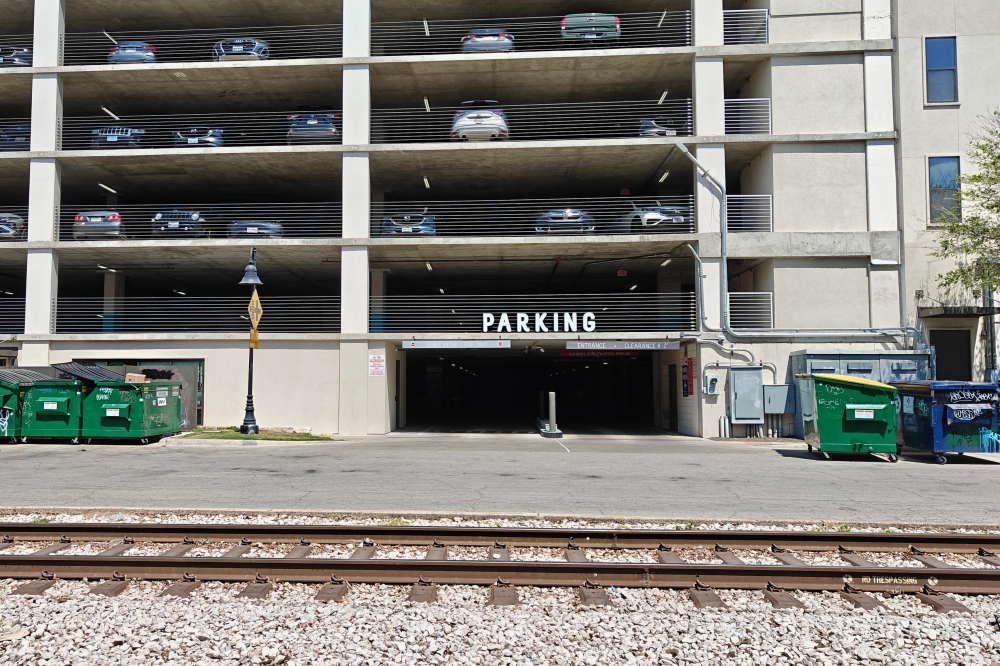
City Council is seeking to limit the amount of new parking that’s build around future light rail lines.
What’s happening
Code amendments to cap the amount of parking built along transit corridors are now in the works after a March 26 council vote.
A resolution from council member Krista Laine calls to explore limiting off-street parking in new development near Austin’s equitable transit-oriented development, or ETOD, districts. Those zones are being implemented near planned Austin Light Rail lines through Central, East and South Austin.
 Austin’s equitable transit-oriented development, or ETOD, planning is aimed at supporting denser, walkable communities near future light rail lines. (Courtesy city of Austin)The proposed ETOD parking caps would follow the city’s recent elimination of minimum parking space requirements for new construction, a policy some officials have framed as a barrier to development and affordability.
Laine said a “soft cap” on parking is meant to encourage more intentional planning near transit, and support a more walkable and affordable city.
“My colleagues and I are not pretending we live in an Austin where most people don’t need a car. We know that’s not where we are. But we also know that there is a real tendency to overbuild parking, driven by financing mechanisms that are completely outside the City’s control. That over-parking has a cost of fewer and more expensive homes, as those costs get passed on to every single resident, whether they own a car or not,” she said in a statement. “This resolution meets Austin where it is while pointing toward where we want to go.”
Caps on new parking near transit were previously proposed in a city-sponsored report from the Urban Land Institute, which advised establishing parking maximums in places like downtown and eventually expanding such regulations to other parts of town.
 Parking maximums near transit lines were suggested in a 2024 ULI report. (Courtesy Urban Land Institute)While Laine’s resolution advanced with majority support from city officials, council member Marc Duchen said he believes the policy may prove to be more of a burden for some residents and is unrealistic for Austin to implement.
“We are not Chicago, we’re not Portland, we’re not the Netherlands, we’re not Boston. We don’t live in a temperate area. We live in a place that we profoundly enjoy—and I mean profoundly, 105 degree summer weather, that’s going to last six months of every year, and it’s only getting worse,” he said. “The idea that many of my constituents are going to embrace biking and scootering alternatives because we decide to make it more challenging to park and drive just seems unrealistic to me.”
One more thing
Separately, council also approved a plan to begin splitting parking fees from residential rents in Austin. Another resolution from council member Zo Qadri noted the costs of building parking spaces are eventually passed on to tenants, and that lower-income residents or those who don’t drive essentially subsidize the service for their neighbors.
His measure was billed as promoting consumer choice by allowing tenants to pay only for the parking they need, building on recent attempts to cut down on unexpected expenses for renters in Austin. Council voted in 2024 to eliminate hidden or “junk” fees from the rental process, and final rules for that concept will be set later this spring.
“Most of my time in Austin, I’ve been a renter and there have been many instances where I’ve lived in apartments where the parking wasn’t decoupled,” Qadri said March 26. “I know one of the speakers talked about an average cost being about $214 a month; it carries a lot of weight. It carries a lot of weight with young folks, with renters, with folks just getting by.”
Council advanced both resolutions after Qadri and other officials formally recognized this March as Parking Reform Month.
Honored to recognize Parking Reform Month in Austin.
From eliminating parking mandates to building a more affordable, people-centered city, this progress reflects years of coalition building and community advocacy. Grateful to those who led before us. pic.twitter.com/bob5SdBX24
— Council Member Zo Qadri, District 9 (@CMZoQadri) March 26, 2026