
Even in its off years, the Texas Legislature never quite slumbers. “The Lege” only meets every other year but feels the need to remind you of its existence throughout its hibernation. Committees are formed and various figures signal their intent to study this or file bills to deal with that. It can be taken partly as a courtesy: here, enterprising reporters and members of the public, is what you can expect to take psychic damage from in roughly six to eight months. For the real freaks out there, those in charge of the Lege often toss in a doozy.

This week, Texas House Speaker Dustin Burrows (R-Lubbock) threw a curveball when releasing his interim charges for the next legislative session. Most were standard Republican fare: lowering property taxes, looking for fraud and waste in government, fretting about foreign threats to Texans. But on his list, Burrows also directed lawmakers to study annexing parts of New Mexico into Texas.
Burrows directed the newly-created Governmental Oversight Committee to study the implications of “adding to Texas one or more contiguous counties of New Mexico.” The committee is then to recommend any legislation needed to absorb parts of New Mexico into Texas. This appears to be a recent special interest for Burrows. In February Burrows posted a news article to X from the Albuquerque Journal detailing an effort by leaders in Lea County, New Mexico to secede from that state.
Article continues below this ad
“Texas would gladly welcome Lea County back to Texas, where it rightfully belongs,” Burrows said.
There are few precedents for states absorbing parts of other states like Texas is proposing. While Texas redrew its border with Oklahoma in 2024 over a water dispute, neither state gained or lost size. If Texas was to absorb Lea and Roosevelt counties, it would gain 6,849 square miles of territory. But Burrows is not entirely wrong. That land, once upon a time, was part of Texas.
A contentious border
When it declared independence in 1836, the Republic of Texas claimed a large chunk of what is now New Mexico as well as parts of Oklahoma, Colorado and Wyoming. Mexico never recognized either Texas’ independence or its claims over that territory. When the Republic of Texas was eventually annexed by the United States in 1845, these disputed claims became a problem that resulted in the Mexican-American War.
Article continues below this ad
In 1848, after the war, Mexico ceded its northern and western territory to the U.S. Texas continued to claim parts of this land, which eventually became the New Mexican territory, until the Compromise of 1850, when Congress passed bills dealing with the question of how to institute slavery in newly acquired U.S. territory.
Texas, admitted as a slave state, accepted $10 million from the government to cede its claim on parts of the New Mexican territory. Texas’ borders were defined as what they are today, giving us a nice-looking shaped state that you can buy various items of.
Absorbing secessionist New Mexican counties would upset this post-1850 order. But we should view the New Mexican annexation talk less as an exercise in real legislation and instead as Burrows throwing a bone to Texas secessionists with his “it was originally Texas” line. While Texas secessionists are a small minority, they are a grassroots part of the Texas Republican party that Burrows needs to keep his grip over the Legislature. It appears that Burrow has some help across the border in his native Lubbock.
Article continues below this ad
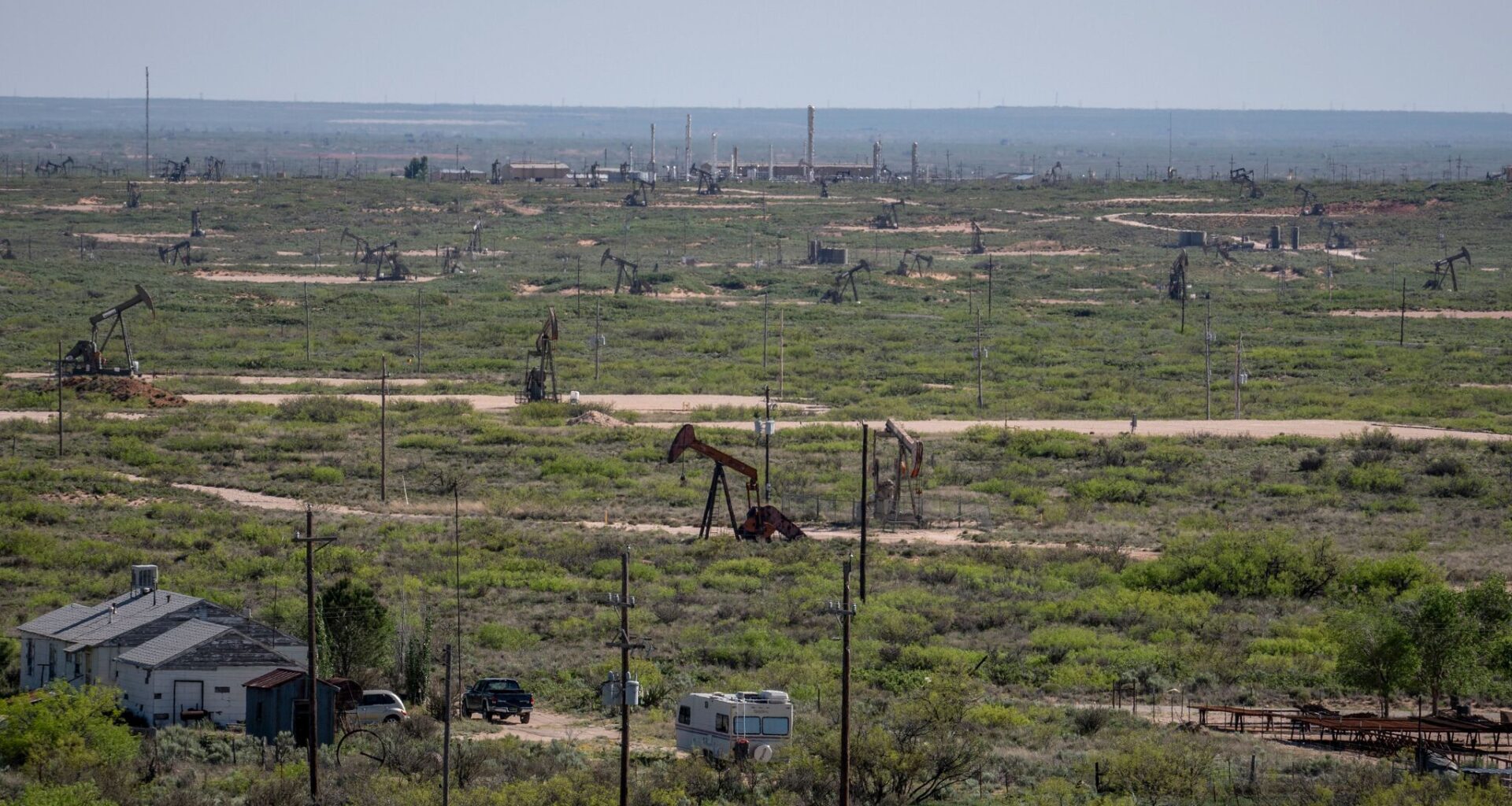
Pump jacks operate near Maljamar on April 23, 2020 in Lea County, New Mexico.
PAUL RATJE/AFP via Getty Images
Secession fever
New Mexico State Rep. Randall Pettigrew, who represents Lea County, and Rep. Jimmy Mason, representing Roosevelt County, in January proposed a bill allowing residents of three counties to vote to secede from the state. (President Donald Trump and Congress also would have to approve). That bill went nowhere in the legislature. Neither Pettigrew nor Mason responded to a request for comment from Chron, but Pettigrew told the Albuquerque Journal that the bill was motivated by tensions between the oil-rich, conservative southeastern counties who have clashed with the Democratic-controlled New Mexico state government.
“My colleagues on the left and the Emerge New Mexico (a training program for Democratic women planning to run for public office) people up here want all the money,” Pettigrew told the ABQ Journal. “They just want to spend it the way they want and they want to control oil and gas at the same time. It’s time to take the control away from them.”
Article continues below this ad
The odds of any of this happening are slim to none. Pettigrew himself noted that the bill never received a hearing and that he didn’t consult local leaders about it. But it appears that his proposal got at least one fan in Texas Rep. Carl Tepper, who will sit on Burrows’ committee studying New Mexican annexation.
“There was a state representative or two from New Mexico who were expressing frustration with the government in Santa Fe,” Tepper told a local outlet. “They have expressed an interest in being annexed by Texas, of course, they were originally Texas to begin with.”
And for their part, secessionist New Mexicans aren’t optimistic. Former Roswell Mayor and State Rep. Dennis Kintigh told the Santa Fe New Mexican that while he thought it was a good idea, he doesn’t see it happening.
Article continues below this ad
“I think secession is a fantasy, a fun fantasy,” Kintigh told the Santa Fe New Mexican.