
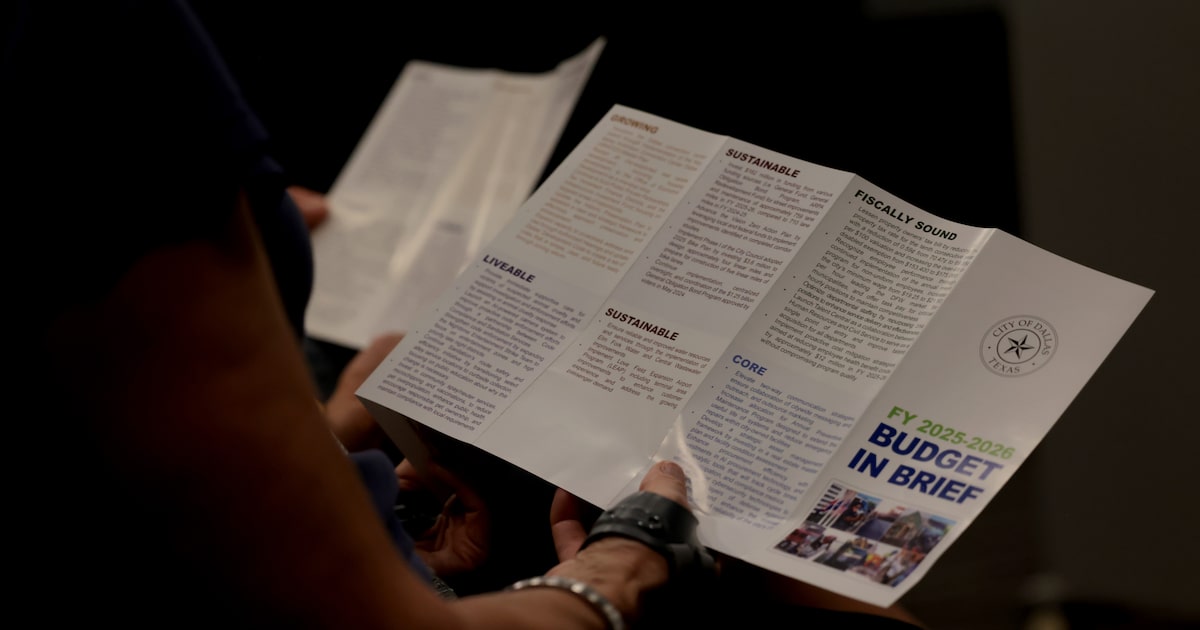
Across Dallas this past week, residents have been attending town halls to get a sense of what’s in store as the city crafts a new budget.
Dallas will start this process by examining its $5.4 billion planned budget it included with last year’s budget. Officials will spend months trimming, adding to and massaging the financial books to address residents’ priorities.
Several challenges lie ahead.
Property tax and sales tax collections — making up the bulk of what the city uses to keep the lights on — have come in lower than forecast. The city’s budget is also tied to a voter mandate to divert half of any new revenue year over year to close the funding hole in the police and fire pension system. This could mean the city would have to make hard choices.
Last year, the library system took the earliest hit. Positions within the city government were cut. And now there’s a growing call to look at the city’s spending on maintenance and repair of all city-owned properties.
Political Points
The question of whether to repair and keep City Hall or relocate out of the downtown building looms over these discussions.
Residents attended meetings in person and virtually to advocate for libraries, arts funding, street repair, bike lanes and homelessness services. Some brought up the City Hall building and what the city’s plan was to prevent facilities from falling into long-term disrepair.
Here are the key takeaways.
Potential cuts to libraries were top of mind
At Fretz Park Branch Library, residents handed questions to city officials on note cards. Assistant City Manager Dev Rastogi read out the first one directed to council member Bill Roth, who oversees the North Dallas district.
“What is your position on possible library closures?” Rastogi read aloud, adding other parts of the question that sought the council member’s opinion on the city’s proposed regional model and cuts to library funding.
“I’m not interested in cutting any library funding,” Roth replied.
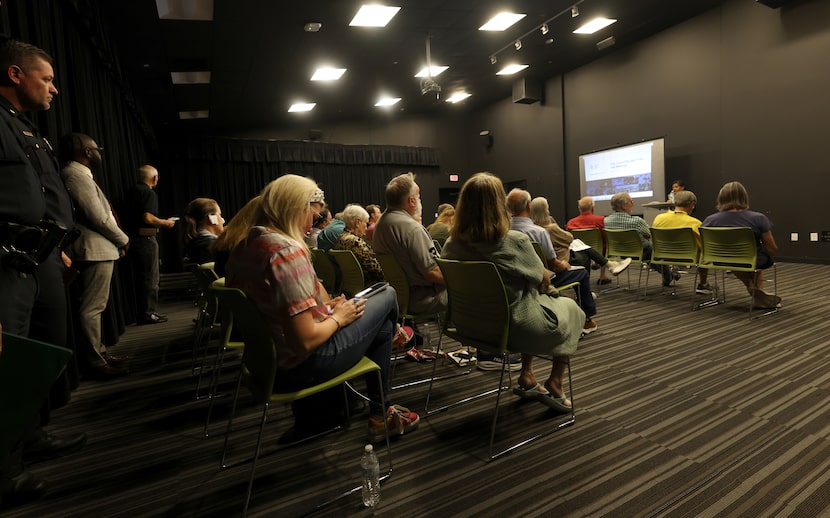
Concerned residents of District 11 listen to a city staff assembled presentation on the budget process. The townhall meeting, sponsored and conducted by City of Dallas District 11 Council member Bill Roth, was held at Fretz Park Branch Library in Dallas on March 26, 2026.
Steve Hamm
Library officials unveiled ideas for a regional model that would concentrate resources and services into fewer, larger regional libraries with expanded hours and programming, while closing several smaller neighborhood branches.
Four neighborhood branches – Oak Lawn; Skyline, in the Buckner Terrace area; Renner Frankford, in Far North Dallas; and Arcadia Park, in West Dallas – could be on the chopping block to save about $2.6 million in annual operating costs.
Similar questions came up in other parts of the city. Some residents wore red T-shirts, advocating to save libraries. In a joint town hall for Districts 2, 7, 9 and 14, council members took a strong stance to preserve smaller libraries.
Council member Paula Blackmon said it was possible for the city to find money for neighborhood libraries but it required political will.
Council member Paul Ridley said the four libraries under consideration will only cost between $3 million to $3.5 million to keep open. “I think that’s a small portion of our budget that deserves a priority,” he said. Council member Adam Bazaldua said he was confident the upcoming budget “will be inclusive of all libraries staying open.”
Public works and street repair discussed
At the Singing Hills recreation center in southern Dallas, residents brought up the state of roads and potholes.
About 15 residents attended the budget town hall meeting with council member Lorie Blair, and the majority of their questions centered on how the city budget works, how departments get funded and how residents could get more involved in the budget process.
Many wanted the city to prioritize improvements to code compliance and the city’s infrastructure.
Brittany Gulley, a longtime District 8 resident, said she was concerned about potholes and wanted to know how residents could report them and other issues to the city. Blair said the city is a data-driven entity and that the more 311 requests residents submit, the more the city would help prioritize what needs to be done.
Up north, Rastogi, who oversees departments focused on transportation and infrastructure, said the city was aware “there’s work to be done in the streets” amid residents’ concerns that the streets and alleys “were deplorable.”
Rastogi explained the city has 11,000 lane miles. “That’s basically equivalent to driving to Alaska and back and then halfway, then back to Alaska again,” Rastogi said. “And I told them, I really don’t want people stuck in Alaska.”
Residents worried about items that could be put on the back burner
The city dedicates more than 60% of its funding to public safety and much of the growth is attributed to paying growing salaries to retain and recruit first responders. The city is also on the hook to hire 4,000 cops after voters changed the city’s charter in 2024.
Additional staffing could also mean the budget may be stressed elsewhere.
Residents asked whether the city will preserve funding for the bike plan in next year’s budget. Meanwhile, recent news of the city collecting less sales tax than it anticipated prompted one resident to ask whether the financial picture had already put the climate plan “in the back seat.”
Park Board member Rudy Karimi threw his support behind animal services. “I want to make sure they’re not left out,” he said, adding that residents had been hearing challenges about managing cat colonies and controlling that population. “It’s clear to me, there’s a gap,” he said.
Tim Annick, a District 14 resident and part of a committee at the Dallas Museum of Arts, said he was shocked to hear the city was considering cutting 15% of the arts budget. Annick described arts as an “economic engine” of the city.
Annick said funding for public arts infrastructure is what kept top talent and businesses in Dallas.
“If we lose that, we might lose a lot more than maybe can be made to show on a fiscal year ’27 budget,” Annick said.
How to pay for a new City Hall facility?
Greg Johnston, president of Preservation Dallas, said he was surprised the discussion about City Hall hadn’t come up at all in a Thursday meeting he was attending.
Johnston asked how backers of relocating City Hall planned to pay for a new facility when it didn’t have the money to “maintain the robust structure that we own” currently.
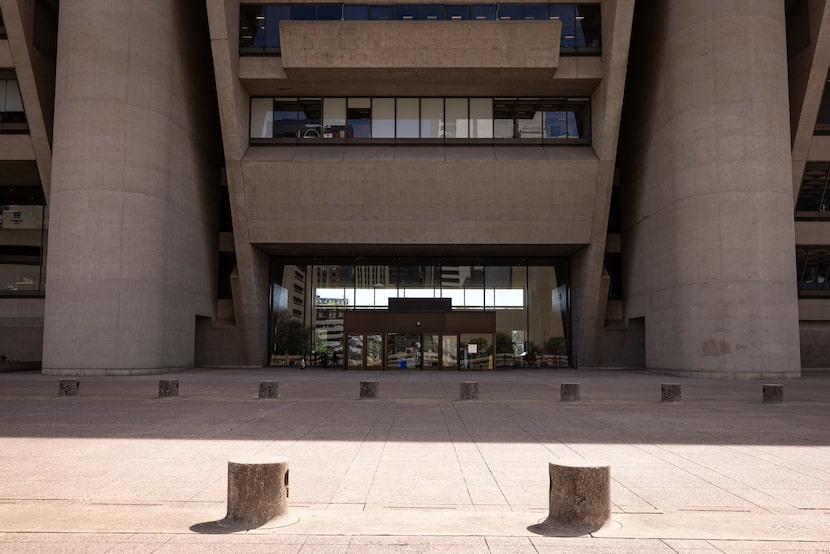
The main entrance of Dallas City Hall on Wednesday, March 18, 2026.
Angela Piazza / Staff Photographer
In North Dallas, Roger Hall asked what the city’s plan was to address its track record of maintaining public facilities. Council members and staffers have been grappling with cost estimates that peg corrective repairs to the City Hall building at $329 million and more than $1 billion for full modernization over 20 years.
The city last invested $14.5 million for maintenance of all its properties, and the city has about 500 buildings in its portfolio. Several residents said it was not enough, especially since the lack of maintenance appeared to have put City Hall in dire straits.
“What is the plan today, so that we don’t have this in one to five years from now?” Hall asked about City Hall cost estimates.
City officials said those answers would be clearer over the summer when the budget will be unveiled.