
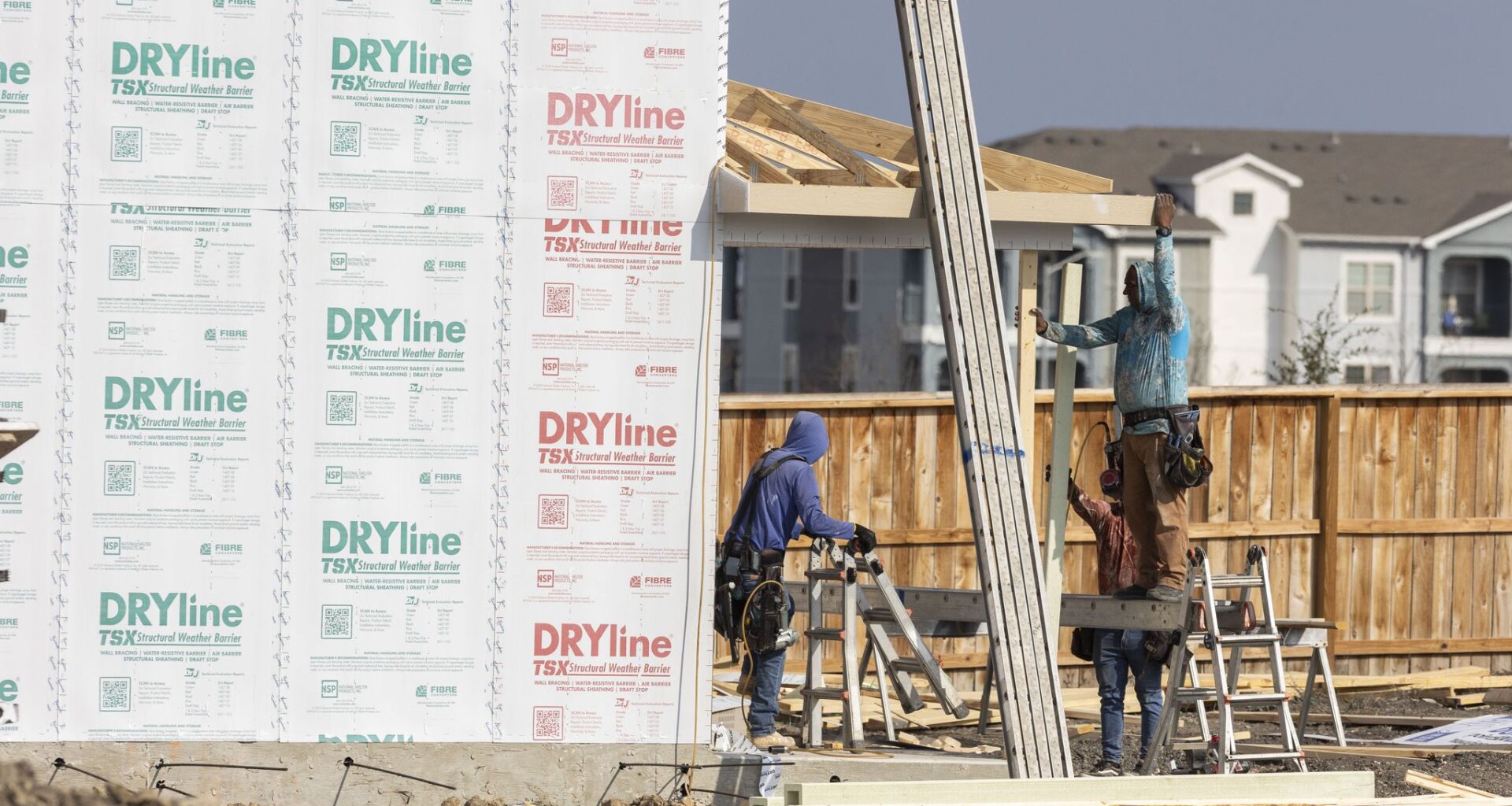
A construction crew worked at a home construction site earlier this year near Marlin Dock in Medina Valley. A Dallas Fed report, “At the Heart of Texas,” found that the San Antonio metro’s large local real estate, construction and development sector grew rapidly during 2016 through 2023.
Katina Zentz/San Antonio Express-News
Texas may have plenty of other inherent economic advantages, including a central location and a long international border, but its high concentration of major metropolitan areas is also a significant factor behind the state’s long-term success, according to a new report from the Federal Reserve Bank of Dallas.

The state additionally benefits from the proximity of those major cities to each other — the Austin, San Antonio, Houston and Dallas-Fort Worth metropolitan areas are all less than 300 miles from each other — because of an agglomeration effect that enables firms to easily share talent and collaborate, said Laila Assanie, a senior business economist at the bank who worked on the report.
Article continues below this ad
“There’s a flow of ideas, so more innovation happens,” Assanie said. “And we see this play out in history.”
Called “At the Heart of Texas,” the bank’s new report aims to offer a comprehensive look at the economies of 12 of the state’s metro areas, including the four major Texas Triangle metros — which all rank among the country’s 25 most populous — and smaller urban areas like Amarillo, McAllen–Edinburg–Mission and Tyler-Longview. The Dallas Fed last published a “Heart of Texas” report in late 2018; for this edition, researchers included data from 2016 through 2023.
RELATED: AI-driven imports rise as Texas holds lead in U.S. exports
San Antonio Express News Logo
Make us a Preferred Source on Google to see more of us when you search.
Add Preferred Source
It’s a time period that reflected the state’s particularly strong economic recovery from the pandemic, which was driven by Texas’ relatively lax business shutdown policies and its lower cost of living, Assanie said, which drew more people to the state amid the broader remote work boom.
Article continues below this ad
The report focused on what it refers to as “industry clusters,” or groups of similar businesses that end up concentrating together and, because of the enhanced benefits that come from concentration — like specialized industry knowledge and resources — “typically exceed the national average in their share of employment, output and earning.”
To measure each Texas metro area’s industry concentrations, the researchers created “location quotient,” or LQ, scores that compare various sectors’ local concentrations relative to the sectors’ national concentrations. The researchers also evaluated whether sectors were growing or declining in each metro area.
The analysis effectively offered new numerical insight into some of the state’s best known economic trends: In Greater Austin — a metro area that in recent years has become famous as a new tech hotbed — the researchers found that the IT manufacturing and services sector had an LQ score of 2.8, representing a concentration nearly three times that of the national average.
Construction continues on Samsung’s new plant near Taylor. Dallas Fed researchers found that the IT manufacturing and services sector in the Austin metro area had an LQ score of 2.8, representing a concentration nearly three times that of the national average.
Aaron E. Martinez/Austin American-Statesman
In San Antonio, insurance services ranked as the most concentrated, although that industry saw modest job losses while other sectors, like the large local real estate, construction and development sector, grew rapidly. The sector also scored highly in Fort Worth-Arlington-Grapevine, where it registered as fast growing and highly concentrated.
Article continues below this ad
RELATED: Port San Antonio added $20B to Texas economy in 2024, state report shows
In metro Houston, energy and mining remained the region’s most concentrated industry, with an LQ score above 2, even as it was overtaken by business services as the sector accounting for the largest share of the region’s jobs.
The report also offered new data on Dallas’ famous business and financial sector boom: Although neither sector registered as Dallas-Plano-Irving’s most locally concentrated (that was IT manufacturing and services), business services tallied an above-average LQ score of around 1.5.
The data also showed the business services sector was the metro area’s largest, representing more than 17% of all jobs, and among its fastest-growing. Dallas’ surging financial sector, representing nearly 5% of local jobs, recorded a concentration score of around 1.8.
Article continues below this ad
Analysts also expect Texas to recover some of its economic mojo: In 2025, employment in the state was virtually flat, representing a major downshift from previous years, when the state added jobs at an average of around 2%. This year, though, economists expect the state to add around 155,000 new jobs, representing a growth rate of 1.1%, according to a recent Dallas Fed projection.
The report’s authors also expect Texas to continue benefiting from AI-related investment and certain deregulatory policies, although they also cited headwinds in the form of tariff-related costs and labor shortages stemming from the Trump administration’s immigration policies.