
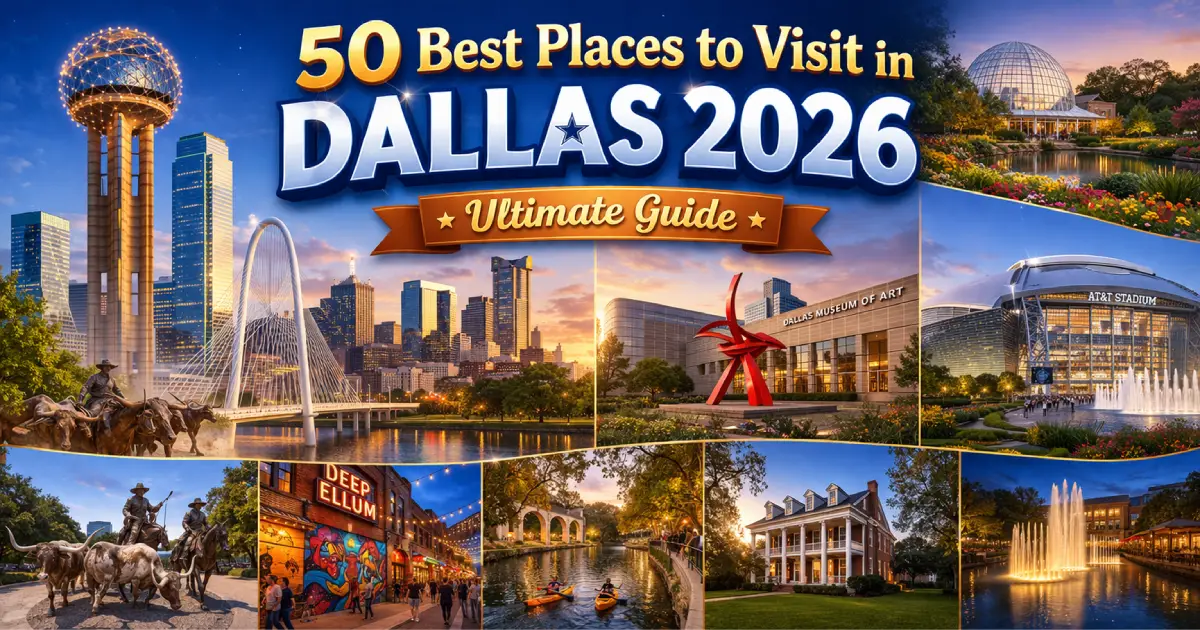
Places to Visit in Dallas — From Dealey Plaza to Deep Ellum, the Arts District to Bishop Arts
By Travel Tourister | Updated March 2026
Dallas’s places to visit are as surprising as the city itself — a metropolis whose reputation for freeways, football, and Big D swagger conceals the largest contiguous urban arts district in the United States (68 acres with museums designed by Renzo Piano, Zaha Hadid, and I.M. Pei), a neighborhood in Oak Cliff (the Bishop Arts District) that is the most genuinely walkable and most culinarily independent commercial district in any Texas city, a public park suspended over a highway (Klyde Warren Park) that is the finest daily gathering space in Texas, a history museum in a former sniper’s perch window above Dealey Plaza that is the most emotionally specific historical site in any American city, and a day-trip destination 30 miles west (the Fort Worth Stockyards, the Kimbell Art Museum) that independently holds two of the finest free experiences in the American South. Dallas’s places are distributed across a sprawling metropolitan area — but the finest ones are concentrated in four or five geographic clusters that a visitor with a car and three days can fully explore.
I’ve mapped Dallas’s best places across multiple visits and every neighborhood — the Sixth Floor Museum’s sixth-floor perspective down to the assassination X on Elm Street in November light, the Nasher Sculpture Center’s garden on an October afternoon when Piano’s skylight system and the live oak canopy conspire to produce the finest light for looking at sculpture in Texas, the Deep Ellum mural corridor on a Friday evening when the Shepard Fairey and local artists’ work is lit from below and the music from Trees and Club Dada overlaps in the street, the Bishop Arts District on a Sunday morning when Emporium Pies is pulling its first day’s pies from the oven and The Wild Detectives bookshop has its tables out on the sidewalk, and the Klyde Warren Park on a Thursday afternoon when the food trucks are running and the downtown office workers and the Arts District museum visitors and the Uptown dog walkers are all using the same five acres of deck park over a freeway simultaneously. Each place confirmed the same truth: Dallas’s finest places reward the visitor who leaves the hotel corridor and finds the city’s genuine character in the neighborhoods, the parks, and the free museums that the DFW convention bureau does not adequately advertise.
This comprehensive 2026 guide covers Dallas’s 50 best places using verified information from Visit Dallas, years of on-the-ground exploration, and honest assessments of which places deliver genuinely memorable experiences. We organize places by category — iconic landmarks, arts and museum district, parks and outdoor, neighborhoods and districts, sports and entertainment venues, Fort Worth day trips, and hidden gems — with realistic visit times, costs, and strategic advice for building a Dallas itinerary that captures the full city.
Dallas Places by Category
Category
Top Places
Best Area
Cost Range
Iconic Landmarks
Dealey Plaza, Sixth Floor Museum, Reunion Tower
Downtown
Free–$18
Arts & Museums
DMA, Nasher, Crow Museum, Perot Museum
Arts District
Free–$25
Parks & Outdoors
Klyde Warren Park, White Rock Lake, Dallas Arboretum
Downtown, East Dallas
Free–$20
Neighborhoods
Bishop Arts, Deep Ellum, Uptown, Knox-Henderson
Citywide
Free to explore
Fort Worth Day Trips
Stockyards, Kimbell Art Museum, Sundance Square
30 miles west
Free–$16
Iconic Dallas Landmarks
1. Dealey Plaza — THE MOST HISTORICALLY CHARGED PLACE IN DALLAS
Why It’s Essential: Dealey Plaza — the grassy triangle at the western edge of downtown Dallas where President John F. Kennedy was assassinated on November 22, 1963 — is the most emotionally specific public space in any American city and the most visited outdoor historical site in Texas. The assassination’s geography is immediately comprehensible from street level: the triple underpass at the plaza’s western boundary, the grassy knoll’s wooden picket fence on the north side of Elm Street, the Texas School Book Depository’s southeast corner sixth-floor windows clearly visible from the assassination X marked in the street pavement, and the concrete pergola from which the Zapruder film was shot from the north side of Elm Street. All of it is free, open 24 hours, and more spatially specific than any photograph or documentary has adequately conveyed.
The assassination X on Elm Street: The X marked in the pavement (repainted periodically by the city) marking the point where the fatal shot struck the motorcade — the most visited single pavement marking in American history
The grassy knoll: The sloping grass and wooden picket fence north of Elm Street where witnesses reported hearing shots — the most contested 30 square yards of ground in American forensic history; free to walk
The triple underpass: The concrete underpass at the plaza’s western boundary — the point the motorcade was aiming for when the shots were fired; visible from the Elm Street approach
The Dealey Plaza National Historic Landmark: The plaza’s full geometry — the reflecting pool, the pergola, the colonnades — is a 1930s WPA landscape that predates the assassination and has been frozen in its pre-1963 configuration by the National Historic Landmark designation
Cost: FREE; Dealey Plaza, Commerce/Elm/Main Streets, Downtown Dallas; open 24 hours; free parking on weekends on Commerce Street
2. The Sixth Floor Museum at Dealey Plaza
Why Essential: The Sixth Floor Museum in the former Texas School Book Depository — where the Warren Commission concluded Lee Harvey Oswald fired the shots that killed Kennedy — is the most carefully presented and most emotionally affecting history museum in Dallas. The preserved sniper’s perch window in the southeast corner of the sixth floor, behind glass in its 1963 configuration, and the view from that window down to the Elm Street Z-turn is the most forensically specific and the most historically consequential view available through any museum window in the United States. The audio guide (included with admission) is the most essential museum audio guide in Texas.
The sniper’s perch (Oswald’s alleged firing position): The southeast corner window with stacked boxes preserved behind glass in the 1963 configuration — the most contested single preserved scene in American forensic history
The view down to Elm Street: The precise sight line from the sixth floor to the assassination site — the oblique angle, the range, and the Z-turn all immediately comprehensible from this window in a way that no photograph has replicated
The Zapruder film: Continuously screened in the museum’s viewing area — the 26-second home movie that remains the most analyzed film in American history
The seventh-floor observation area: A newer addition providing a less constrained view of Dealey Plaza from above — the finest elevated view of the full plaza geometry available to the public
Cost: $18/adult; jfk.org; 411 Elm Street, Downtown Dallas; open daily 10 AM–6 PM; audio guide included
3. Klyde Warren Park
Why It’s Dallas’s Finest Public Space: Klyde Warren Park — the 5.2-acre deck park built over the Woodall Rodgers Freeway trench between the Arts District and Uptown, opened 2012 — is the most successful urban park project in Dallas’s history and the city’s most daily-used public gathering space. The park suspends five acres of green space over a major urban freeway to reconnect two neighborhoods that the highway had divided for 50 years, and the result is the most democratic and the most continuously active public space in Dallas: food trucks (Thursday–Sunday), free fitness programming, a children’s playground, a dog park, a reading room, outdoor concerts, bocce ball courts, and the steady cross-section of Dallas’s full population using it simultaneously from 7 AM to 10 PM.
The food truck park (Thursday–Sunday): The finest rotating food truck selection in Dallas — the Thursday lunch crowd from the adjacent downtown office buildings and the weekend visitors from Uptown and the Arts District produce the most socially diverse food truck dining in North Texas
The connectivity: Klyde Warren Park is the physical connection between the Arts District (DMA, Nasher, Crow Museum, Winspear Opera House) and the Uptown neighborhood (McKinney Avenue restaurants, hotels, the Katy Trail) — the most important pedestrian infrastructure investment in Dallas’s recent history
Free programming: Yoga classes, fitness sessions, children’s storytelling, and weekend outdoor concerts — all free, all on a posted schedule at klydewarrenpark.org
Cost: FREE; klydewarrenpark.org; 2012 Woodall Rodgers Freeway, between Arts District and Uptown; open daily
4. Reunion Tower
The 470-foot geodesic sphere atop the concrete shaft of Reunion Tower — the most recognizable element of the Dallas skyline since 1978 — is the finest elevated public view of Dallas accessible to general visitors. The GeO-Deck (the outdoor wraparound observation level) delivers the complete Dallas skyline, the Trinity River corridor to the southwest, the Fair Park dome to the east, and on clear days the Fort Worth skyline 30 miles west.
Digital telescopes: The GeO-Deck’s interactive telescopes with real-time zoomed views of specific Dallas landmarks — the most technologically enhanced observation deck experience in Texas
Five Sixty by Wolfgang Puck: The rotating restaurant below the GeO-Deck — the most dramatically positioned restaurant in Dallas, completing a full rotation every 55 minutes; the finest dinner view in the city ($65–$100/person)
Cost: $17/adult; reuniontower.com; 300 Reunion Boulevard, Downtown Dallas
5. Perot Museum of Nature and Science
Thom Mayne’s Morphosis-designed 2012 building in Victory Park — a 170,000-square-foot concrete and glass cube suspended above the street on a diagonal approach that is the most architecturally distinctive science museum building in Texas. The 11 permanent exhibition halls include the T. Boone Pickens Life Then and Now Hall (the finest Texas fossil collection at any Dallas museum), the Energy Hall (the most Dallas-specific exhibit — the geology and economics of the Texas petroleum industry), and the Moody Family Children’s Museum (the finest STEM engagement for young children in North Texas).
The building exterior: The most photographically striking museum building in the Victory Park area — Mayne’s concrete and glass cube is the finest piece of aggressive contemporary architecture in downtown Dallas
Cost: $25/adult, $17/child; perotmuseum.org; 2201 N. Field Street, Victory Park; open daily
Arts & Museum District Places
6. Dallas Museum of Art — FINEST FREE MUSEUM IN TEXAS
Why Essential: The Dallas Museum of Art — the largest and most comprehensively collected art museum in Texas, with 68 galleries spanning 5,000 years of art history in Edward Larrabee Barnes’s 1984 building on Flora Street in the Arts District — offers free general admission to its permanent collection always, making it the most generous major museum in Texas and one of the most generous in the United States. The pre-Columbian Americas collection (the most significant collection of ancient Americas art at any Texas museum), the Impressionist and Post-Impressionist holdings, the decorative arts wing, and the contemporary American collection justify the visit regardless of the special exhibition programming.
The ancient Americas collection: Olmec jade figures, Maya polychrome ceramics, and Aztec stone sculpture of extraordinary quality — the most significant pre-Columbian collection at any Texas museum, free always
The Wendy and Emery Reves Collection: The Reves family’s personal collection installed in a recreated Mediterranean villa setting — the most unusual installation format in the DMA, presenting European masters (Monet, Renoir, Van Gogh, Toulouse-Lautrec) in a domestic environment rather than a gallery white cube
Late Nights (third Friday of each month): Free admission until midnight, with live music in the atrium — the most festive museum evening in Dallas
Cost: FREE general admission; special exhibitions $16–$22; dma.org; 1717 N. Harwood Street, Arts District; closed Monday
7. Nasher Sculpture Center
Why It’s the Finest Place in the Dallas Arts District: Renzo Piano’s 2003 building and garden in the Arts District — housing the private sculpture collection of Raymond and Patsy Nasher, assembled over 40 years into one of the finest collections of 20th-century sculpture in the world — is the single finest museum experience accessible in Dallas. The outdoor garden (one acre, mature live oaks, Piano’s skylight system managing the natural light) is the finest outdoor museum space in Texas and the single most beautiful place to spend an October or April afternoon in the entire DFW area. The indoor galleries (Serra, Brancusi, Giacometti, Matisse, Picasso, Calder) are the finest concentrated sculpture experience in Texas.
The outdoor garden: Piano’s one-acre garden with 22 sculptures in a landscape of mature live oaks — the most beautiful outdoor museum space in Dallas; the garden at 10 AM on a clear October morning is the finest single moment in the Dallas Arts District
The indoor galleries: Richard Serra’s “Vortex” (a 2-inch-thick curved steel plate generating a specific physical experience of space and weight), Brancusi’s “Torso of a Young Man,” and Giacometti’s standing figures in Piano’s controlled natural light
The Nasher Prize: The $100,000 annual award to a sculptor making a significant contribution to understanding sculpture’s possibilities — the award ceremony is the most important single annual event in the Dallas Arts District
Cost: $10/adult; nashersculpturecenter.org; 2001 Flora Street, Arts District; closed Monday
8. Crow Museum of Asian Art
The most undervisited excellent museum in Dallas — the Crow Museum houses the finest collection of Asian art in North Texas (Chinese jade and bronzes, Japanese netsuke and folding screens, Indian temple sculpture, Southeast Asian bronzes, and Korean celadon ceramics) in a compact, beautifully lit building by Edward Larrabee Barnes that is perpetually less crowded than its Arts District neighbors despite housing objects of comparable quality and significance. Free always.
The Chinese jade collection: The most technically extraordinary objects in the museum — Chinese jade carvings spanning 3,000 years of production, from Neolithic implements to Qing Dynasty decorative objects
The Japanese netsuke: The most intimate and most individually engaging objects in the collection — miniature carved toggles (1–3 inches) of extraordinary technical accomplishment
Cost: FREE; crowmuseum.org; 2010 Flora Street, Arts District; closed Monday
9. AT&T Performing Arts Center (Winspear Opera House)
Zaha Hadid’s 2009 opera house in the Arts District — the most architecturally ambitious building in the Dallas Arts District and one of Hadid’s most successful completed buildings, with a 2,200-seat auditorium of exceptional acoustic design (among the finest opera house acoustics in North America), a retractable acoustic ceiling, and the red glass disc canopy covering the outdoor plaza that has become the most photographed element of contemporary Dallas architecture. The Dallas Opera and the Dallas Black Dance Theatre both use the Winspear as their primary performance venue.
The red glass canopy: Hadid’s most specific Dallas contribution — a suspended disc of red-fritted glass that shades the outdoor plaza and produces the most architecturally distinctive entry sequence in the Arts District
Free outdoor space: The AT&T Performing Arts Center’s Strauss Square and the surrounding outdoor areas are free to visit at any hour — the most accessible world-class architecture in Dallas requires no ticket
Cost: Free outdoor; $35–$175 for performances; attpac.org; 2403 Flora Street, Arts District
10. Morton H. Meyerson Symphony Center
I.M. Pei’s 1989 masterwork — the most technically accomplished concert hall in Texas, with the finest acoustics of any Texas performance venue (Pei worked with acoustician Russell Johnson on a design that can be tuned from chamber music to full orchestral sound via adjustable banners and ceiling panels), a 2,062-seat auditorium in Sardinian white granite, and the most architecturally significant building in the Arts District after the Winspear. The Dallas Symphony Orchestra’s home.
Rush tickets: The most financially accessible entry to the Meyerson — same-day DSO performances at $25–$35 for seats that sell at $65–$150 in advance; available at the box office on performance days
Architecture tours: The Meyerson offers architectural tours of the building by appointment — the most technically educational tour of any Dallas building
Cost: Free exterior; rush tickets $25–$35; dso.org; 2301 Flora Street, Arts District
11. George W. Bush Presidential Library and Museum (SMU)
The Southern Methodist University campus presidential library documenting the 43rd presidency — the Decision Points Theater (a simulation presenting four major Bush administration decisions with visitor participation), the September 11 documentation (the most comprehensive primary-source exhibit on the 9/11 response period accessible to the public), and the recreated Oval Office make this the most intellectually engaging presidential library experience in Texas.
The Decision Points Theater: Visitors vote on the same decisions the President faced (Iraq, Hurricane Katrina, the 2008 financial crisis, 9/11), then see what actually happened and the President’s own explanation — the most honest interactive presidential library exhibit in Texas
Cost: $24/adult; georgewbushlibrary.smu.edu; 2943 SMU Boulevard, University Park
12. African American Museum (Fair Park)
The most important African American history museum in Texas — housed in the 1936 Art Deco building originally constructed for the Texas Centennial Exposition at Fair Park, with the largest collection of African American folk art in the United States, the most comprehensive documentation of African American Texas history at any state institution, and the most historically significant building on the Fair Park campus. Free always — the most under-visited free museum of genuine importance in Dallas.
Cost: FREE; aamdallas.org; 3536 Grand Avenue, Fair Park, East Dallas; closed Monday; DART Red Line to Fair Park Station
Parks & Outdoor Places
13. White Rock Lake Park
Why It’s Dallas’s Finest Outdoor Space: White Rock Lake — a 1,015-acre reservoir and 9.3-mile loop trail in East Dallas — is the finest urban outdoor recreation destination in Dallas: a complete 9.3-mile cycling, running, and walking loop around a lake with the Dallas Arboretum and Botanical Garden on its south shore, wildlife habitat (great blue herons, white pelicans, egrets, and migrating waterfowl) accessible at any point on the loop, sailboats on the water on weekend afternoons, and the Bathhouse Cultural Center (a 1930 WPA building on the north shore used as a community arts facility) providing the most historically grounded park architecture in East Dallas. The White Rock Lake loop on a clear October morning is the finest free outdoor experience in Dallas.
9.3-mile loop trail: Paved, flat, with multiple parking access points around the lake — the finest extended cycling and running trail in Dallas
Wildlife viewing: Great blue herons, great egrets, double-crested cormorants, white pelicans (October–March), and the Wood Duck Marsh on the lake’s east side producing the finest easily accessible birding in Dallas
Bathhouse Cultural Center: The 1930 WPA bathhouse on the north shore — the most architecturally historic structure in White Rock Lake Park, now used for community arts exhibitions and gallery shows (free)
Summer sailing: White Rock Sailing Club’s Sunday regattas (May–September) — free to watch from the north shore
Cost: FREE; multiple access points; primary parking at Garland Road and Buckner Boulevard; East Dallas
14. Dallas Arboretum and Botanical Garden
The finest botanical garden in North Texas — 66 acres on White Rock Lake’s south shore with the most spectacular spring bloom display in Texas (500,000+ tulips in synchronized bloom, March–April), the Pumpkin Village (90,000 pumpkins covering the main lawn in October), and the most reliably maintained landscape of any Texas botanical garden in any season. The DeGolyer Estate (a 1940 Spanish Colonial mansion at the garden’s western boundary) provides the most architecturally significant historic house setting in the Dallas park system.
A Tasteful Place: The garden’s culinary herb garden and edible landscape demonstration — the finest formal vegetable and herb garden accessible in Dallas
The Texas Discovery Garden (free with admission): The native plant and butterfly garden within the Arboretum — the finest educational native plant installation in North Texas
Cost: $20/adult, $15/child; dallasarboretum.org; 8525 Garland Road, East Dallas; open daily
15. Katy Trail
The 3.5-mile urban hike-and-bike trail on the former Missouri-Kansas-Texas Railway right-of-way through Dallas’s most affluent residential neighborhoods — running from American Airlines Center in Victory Park north through Uptown and the Knox-Henderson neighborhood to the edge of Highland Park, the Katy Trail is the finest urban cycling corridor in Dallas and the city’s most actively used outdoor recreation facility. The trail’s passage through Uptown’s leafy residential streets and past the Knox-Henderson commercial corridor makes it simultaneously a commuter route, a fitness facility, and the finest neighborhood observation of Dallas’s mid-density residential character.
Katy Trail Ice House: The bar and restaurant adjacent to the Knox-Henderson section — the finest outdoor bar with trail access in Dallas, accessible directly from the cycling path
Cost: FREE; katytraildallas.org; American Airlines Center to West Highland Park; open daily
16. Dallas Farmers Market and Neighborhood
The 1941 market institution and its 2014 renovation — the Shed (a renovated 1941 market building) and the adjacent outdoor market on weekends constitute the most historically continuous food market in North Texas. The surrounding Farmers Market neighborhood (formerly the wholesale produce district) has developed into the most pedestrian-friendly mixed-use neighborhood in downtown Dallas adjacent to the east, with the Forty Five Ten boutique, the Local, and the new residential buildings that make it the most rapidly improving Dallas downtown neighborhood.
Cost: FREE entry; dallasfarmersmarket.org; 920 S. Harwood Street; open daily
17. Trinity River Corridor and Margaret McDermott Bridge
The Trinity River’s urban greenbelt through Dallas — the most ambitious urban land reclamation project in Texas history (decades of flood control, the Trinity Strand Trail, and the Santiago Calatrava-designed Margaret McDermott Bridge) is still in active development but already produces the finest views of the downtown Dallas skyline from the river floodplain, the most dramatic bridge architecture accessible in the city, and the most continuous green corridor accessible to downtown Dallas pedestrians and cyclists.
Margaret McDermott Bridge: Santiago Calatrava’s 2012 cable-stayed bridge — the most architecturally distinctive piece of infrastructure in Dallas, the most photographed bridge in the city
Cost: FREE; Trinity Strand Trail; accessible from the Design District and West Dallas
Neighborhoods & Districts
18. Bishop Arts District (Oak Cliff) — DALLAS’S FINEST NEIGHBORHOOD
Why It’s the Best Place in Dallas: The Bishop Arts District — a 60-block walkable grid of 1920s commercial buildings in the Oak Cliff neighborhood of Dallas, accessible via the free DART Streetcar from Union Station — is the most convincing argument that Dallas has a genuine walkable neighborhood life beyond its highway corridors and suburban developments. Lucia (James Beard-nominated Italian, finest pasta in DFW), Emporium Pies (handmade pies, the most beloved dessert counter in Oak Cliff), The Wild Detectives (the finest independent bookshop in Dallas), Bishop Cider Company, Hattie’s, and 60+ independently owned retailers and restaurants in a commercially dense grid that is the most pedestrian-friendly and the most culinarily independent neighborhood in any Texas city. On a Sunday morning, when the neighborhood is at ease with itself, it is the finest place to be in Dallas.
Lucia (408 W. 8th Street): The James Beard-nominated Italian restaurant — the finest house-made pasta and charcuterie in DFW, the most essential Bishop Arts dinner reservation ($65–$100/person)
Emporium Pies (314 N. Bishop Avenue): Handmade pies baked daily — the Drunken Nut (pecan, bourbon) is the house signature; the most beloved dessert counter in Oak Cliff ($6–$8/slice)
The Wild Detectives (828 W. Davis Street): The finest independent bookshop in Dallas — a combination bookshop, bar, and literary programming venue in the most characterful retail space in Bishop Arts
Bishop Cider Company (509 N. Bishop Avenue): The most interesting craft beverage taproom in the Bishop Arts District — locally produced apple cider in the most intimate taproom setting
Access: Free DART Streetcar from Union Station (10 minutes) — the most accessible Dallas neighborhood without a car
Cost: Free to walk; dining $25–$100/person; Oak Cliff; DART Streetcar from Union Station free
19. Deep Ellum
Why It’s Dallas’s Most Creative Neighborhood: Deep Ellum — the entertainment and arts neighborhood east of downtown Dallas, historically the center of Dallas’s African American blues and jazz culture in the 1920s–1930s (Blind Lemon Jefferson, Leadbelly, and Robert Johnson all performed here), and the most actively creative neighborhood in Dallas in 2026 — is the city’s finest live music, mural art, and independent culture zone. The mural program (dozens of large-scale works covering the warehouse walls of Commerce, Main, and Elm Streets, produced by local and internationally recognized artists), the live music venues (Trees, The Bomb Factory, Club Dada, Ruins), and the independent restaurant density (Pecan Lodge BBQ, Mudsmith, Espumoso) make Deep Ellum the most energetic Dallas neighborhood at any hour after 5 PM.
The mural corridor (Commerce, Main, and Elm Streets): The most concentrated urban mural art program in Texas — dozens of large-scale works covering the exterior walls of the Deep Ellum warehouse district; self-guided maps available at the Deep Ellum Foundation website
Club Dada (2720 Elm Street): The most historically specific music venue in Deep Ellum — intimate listening room, the longest-running independent venue in the neighborhood
The Bomb Factory (2713 Canton Street): The 3,000-capacity converted industrial building — the finest mid-size music venue in Dallas
Pecan Lodge BBQ (2702 Main Street): The Deep Ellum BBQ institution — beef ribs, brisket, and the jalapeño cheese sausage in the most atmospheric BBQ setting in Dallas
Cost: Free to walk; venue covers $10–$20; DART Green Line to Deep Ellum Station
20. Uptown Dallas
The most actively developed and most dining-dense neighborhood in Dallas — the McKinney Avenue corridor from the Arts District to Knox-Henderson, with the free McKinney Avenue Trolley running vintage 1920s and 1940s streetcars continuously, the most concentrated outdoor dining patios in Dallas (the McKinney Avenue restaurant row from Cole Avenue to Hall Street), and the Katy Trail’s urban cycling connecting Uptown to the Knox-Henderson neighborhood in the finest urban outdoor experience accessible from any Uptown hotel.
McKinney Avenue Trolley (free): The vintage streetcar service — the most charming and most specifically Dallas transit experience, producing a neighborhood-level perspective on Uptown’s restaurant corridor that no rideshare replicates
The outdoor patio season (March–May, September–November): The McKinney Avenue restaurant patios at their most active — the finest outdoor dining weather in Dallas produces the most social McKinney Avenue atmosphere
Cost: Free to walk; trolley free; dining $30–$80/person; McKinney Avenue, Uptown
21. Knox-Henderson
The most rapidly evolving mid-range neighborhood in Dallas — Knox-Henderson’s Henderson Avenue corridor is the most independent and the most culinarily credible restaurant corridor in the city after Bishop Arts, with Trompo (the finest taco al pastor in Dallas, from a visible spinning spit), Boulevardier (the finest natural wine bar in North Texas), the Knox Street Shopping District, and the Katy Trail’s Knox-Henderson terminus producing the most complete walkable neighborhood experience in the core city.
Trompo Taqueria (3622 McKinney Avenue): The taco al pastor cut directly from a spinning trompo spit — the most specifically correct Dallas taco and the most photogenic food preparation in the neighborhood
Katy Trail Knox-Henderson terminus: The bridge view of the downtown skyline at sunset from the trail’s highest Knox Street elevation — the finest free photograph in Dallas
Cost: Free to walk; dining $20–$60/person; Henderson Avenue, East Dallas adjacent to Highland Park
22. Greenville Avenue (Lower Greenville)
The most sociably active bar and restaurant street in East Dallas — Lower Greenville Avenue’s 6-block commercial corridor contains Truck Yard (the outdoor bar and food truck park in a former used car lot, the finest outdoor bar in Dallas), Eno’s Pizza Tavern, the Goodfriend Beer Garden, and the densest collection of neighborhood-facing restaurants in the corridor. The residential character of the surrounding neighborhood (apartments walking distance from every venue) makes Lower Greenville the most genuinely neighborhood-integrated entertainment district in Dallas.
Truck Yard: The converted used car lot outdoor bar — school buses repurposed as bar counters, food trucks in the yard, the most creative repurposing of industrial space in Dallas’s bar landscape
Cost: Free to walk; drinks and food $20–$50/person; Lower Greenville Avenue, East Dallas
23. The Design District
The warehouse district northwest of downtown — formerly Dallas’s furniture and interior design showroom corridor, now the most rapidly evolving mixed-use neighborhood in the city, with art galleries (the 500 Exposition Gallery and the surrounding Design District gallery cluster), the Trinity Groves restaurant incubator on the Trinity River’s west bank, and the most interesting new architecture being built in Dallas currently. The most creative and least finished neighborhood in Dallas — the state of active development is part of its specific character.
Trinity Groves: The restaurant incubator complex on the west bank of the Trinity River — the most experimental dining destination in Dallas, accessible via the Margaret McDermott Bridge pedestrian path
Cost: Free to walk; dining $25–$60/person; Design District, northwest of downtown
24. Sundance Square (Fort Worth)
The 35-block pedestrian-friendly entertainment and retail district in downtown Fort Worth — 30 miles west of Dallas — is the finest example of successful downtown revitalization in the DFW Metroplex and the most walkable downtown district in the region. Bass Hall (one of the finest concert halls in Texas), Reata Restaurant (the finest Fort Worth dining experience), the Sundance Square Plaza (with its public art and weekly programming), and the surrounding independent retail make downtown Fort Worth more walkable than any equivalent downtown Dallas area.
Cost: Free to walk; sundancesquare.com; downtown Fort Worth; 30 miles west of Dallas
Sports & Entertainment Venues
25. AT&T Stadium (Cowboys — Arlington)
The most visually overwhelming sports venue in the United States — 80,000-seat capacity, the world’s largest high-definition video display (160-foot-wide center-hung screen), a retractable roof, and 13,000+ permanent artworks (including works by Olafur Eliasson and Lawrence Weiner) make AT&T Stadium simultaneously the finest NFL viewing environment and the most architecturally ambitious sports building in American construction. The Art Tour ($30/adult on non-game days) is the most unexpected cultural activity at any NFL stadium.
The Art Tour: A guided tour of the stadium’s art collection — the most culturally substantive non-game use of an NFL facility in the United States; 90 minutes, small groups, knowledgeable guides
Cost: Games $85–$400; Art Tour $30; dallascowboys.com; 1 AT&T Way, Arlington; 20 miles from downtown Dallas
26. American Airlines Center
The home of the Dallas Mavericks (NBA) and Dallas Stars (NHL) — the most conveniently located major sports venue in Dallas for visitors staying in downtown or Uptown hotels (adjacent to Victory Park, walkable from the DART Green/Orange Lines’ Victory Station). The arena’s connectivity to the Victory Park entertainment district (restaurants, bars, the House of Blues) provides the finest pre-game dining selection of any Dallas sports venue.
Victory Park: The mixed-use development surrounding the arena — the most complete entertainment district accessible on foot from any Dallas sports venue
Cost: Mavericks $45–$350; Stars $55–$250; americanairlinescenter.com; 2500 Victory Avenue, Victory Park; DART to Victory Station
27. Globe Life Field (Rangers — Arlington)
The Texas Rangers’ 2020 retractable-roof stadium — the finest baseball venue in Texas, eliminating the weather anxiety that made Globe Life Park’s predecessor the most uncomfortable summer sports experience in the state. The 2023 World Series championship has produced the most energized Rangers fan base in the franchise’s history, and Globe Life Field’s combination of sightline quality and climate control makes it the finest overall ballpark experience in the American South.
Cost: $18–$200/ticket; mlb.com/rangers; 734 Stadium Drive, Arlington; 20 miles from downtown Dallas
28. Fair Park
The 277-acre National Historic Landmark in East Dallas — built for the 1936 Texas Centennial Exposition and containing the most complete collection of Art Deco architecture in a single campus in the United States, including the Cotton Bowl stadium, the Music Hall, the Women’s Museum, the Hall of State, and the African American Museum. The annual State Fair of Texas (late September–mid-October) transforms Fair Park into the largest state fair in the United States; the grounds are accessible and historically significant year-round.
The Hall of State: The 1936 Art Deco Hall of Fame — the most architecturally ambitious building in Fair Park, with the Great Hall’s WPA murals and the six heroic bronze figures at the entrance constituting the finest single piece of Texas WPA art accessible to the public
Cost: Free grounds year-round; State Fair admission $18; Fair Park Boulevard, East Dallas; DART Red Line to Fair Park Station
Fort Worth Day Trip Places
29. Fort Worth Stockyards National Historic District
Why It’s the DFW Area’s Most Essential Place: The Fort Worth Stockyards — the working cattle yard and exchange complex on Fort Worth’s north side that processed more than 100 million cattle between 1890 and 1971, and that has been operating as a working cattle yard, rodeo venue, and entertainment district since then — is the most authentic Western heritage experience in the DFW area and the most specifically Texas free experience accessible from any Dallas hotel within 45 minutes. The twice-daily longhorn cattle drive (10 AM and 4 PM, free, 365 days per year) is the most continuously available and most reliably extraordinary free activity in North Texas.
Longhorn cattle drive (10 AM and 4 PM daily): Texas longhorns driven down Exchange Avenue by working cowboys — the only twice-daily longhorn cattle drive in the world, free to watch from Exchange Avenue’s sidewalk
Cowtown Coliseum: The world’s first indoor rodeo venue (1918) — weekly rodeo events Friday and Saturday evenings ($20–$30)
Billy Bob’s Texas: The world’s largest honky-tonk — 127,000 square feet, 40 bar stations, indoor bull riding; major country acts on weekend evenings
White Elephant Saloon: The Stockyards’ most historically continuous bar — open in its current form since 1887, the most atmospherically specific Fort Worth Western bar
Cost: Free to walk; cattle drive free; stockyardsstation.com; Exchange Avenue, Fort Worth; 30 miles from Dallas on I-30
30. Kimbell Art Museum (Fort Worth)
Why It’s One of America’s Finest Museums: Louis Kahn’s 1972 building in Fort Worth’s Cultural District — the cycloid vault concrete and travertine structure universally considered one of the finest museum buildings in the world — houses a permanent collection of extraordinary quality relative to its size: a Caravaggio (The Cardplayers), a Fra Angelico, a Velázquez, Michelangelo’s The Torment of Saint Anthony (the earliest known painting by Michelangelo, acquired for $6.2 million), and the most significant pre-Columbian and Asian art collection at any Fort Worth museum. Free permanent collection always — one of the most generous museum admission policies in the United States.
The building: Kahn’s cycloid vault system and the natural light it manages — the specific quality of diffused daylight that enters through Kahn’s custom aluminum light diffusers makes every painting visible in the most accurate light available in any Texas museum
The Caravaggio: The most significant single work in the permanent collection — Caravaggio’s The Cardplayers in the Kimbell’s natural Kahn light
The Renzo Piano Pavilion (2013): The glass and concrete building adjacent to Kahn’s original structure — the most technically interesting building addition to a major Texas museum
Cost: FREE permanent collection; kimbellart.org; 3333 Camp Bowie Boulevard, Fort Worth; 30 miles from Dallas
31. Modern Art Museum of Fort Worth
Tadao Ando’s 2002 fortress — the concrete and glass pavilions reflected in a 1.5-acre pond adjacent to the Kimbell create the finest piece of contemporary architecture in Fort Worth and the most photographically compelling exterior of any Texas museum building. The permanent collection (post-WWII American and European masters) is the most significant contemporary art collection in Fort Worth.
The reflecting pond: The most distinctive visual element — five concrete and glass pavilions reflected in the still water of the pond, with the Kimbell’s barrel vaults visible in the background
Cost: $16/adult; themodern.org; 3200 Darnell Street, Fort Worth; adjacent to Kimbell
32. Amon Carter Museum of American Art (Fort Worth)
Philip Johnson’s 1961 building and its subsequent 2001 expansion — the finest collection of American art in Fort Worth, with particular strength in 19th and early 20th century American landscape painting (Frederic Remington, Charles Russell, and the Hudson River School) and the most significant collection of American photography at any Texas museum. Free always.
Cost: FREE; cartermuseum.org; 3501 Camp Bowie Boulevard, Fort Worth; adjacent to the Kimbell
Hidden Gems & More Dallas Places
33. Holocaust and Human Rights Museum of Dallas
One of the finest Holocaust museums in the American South — primary source survivor testimony, physical artifacts, and a design that creates the most emotionally engaging progression of any Dallas museum after the Sixth Floor. Free always. The most morally important cultural institution in Dallas.
Cost: FREE; dallasholocaustmuseum.org; 300 N. Houston Street, Downtown; closed Monday
34. Majestic Theatre
The 1921 Spanish Baroque theater in downtown Dallas — one of the finest surviving movie palace interiors in the American South, now hosting Broadway touring productions, comedy, and live music in the most historically atmospheric performance space in Dallas. The ornate plasterwork, the original Wurlitzer organ, and the balcony boxes constitute the finest piece of early 20th-century theatrical architecture accessible in Texas.
Cost: $35–$125/ticket; majestic.com; 1925 Elm Street, Downtown Dallas
35. Dallas World Aquarium
The most innovative urban aquarium in Dallas — an 85-foot tropical rainforest atrium (free-flying birds, free-roaming monkeys, and small mammals in a 1920s warehouse building in the West End Historic District) combined with traditional aquarium exhibits produces the most surprising natural history environment in downtown Dallas. The combination of tropical forest and marine environment in an urban warehouse is genuinely unlike anything available at any other Texas attraction.
Cost: $25/adult; dwazoo.com; 1801 N. Griffin Street, West End; open daily
36. Frontiers of Flight Museum (Love Field)
The most comprehensive aviation history museum in Texas — 100+ aircraft from Wright Flyer reproduction to current-era aircraft, including the only surviving Braniff International Airlines jet in original paintwork and an Apollo 7 Command Module. The most specifically Dallas aviation collection, reflecting the city’s role as a major commercial aviation hub since Braniff International’s 1928 founding.
Cost: $12/adult; flightmuseum.com; 6911 Lemmon Avenue, Love Field; open daily
37. Trammell Crow Center Sculpture Garden
The free outdoor Rodin sculpture garden at the base of the Trammell Crow Center office tower — Rodin bronzes (including a Burghers of Calais cast) arranged in a street-level garden on Ross Avenue in the Arts District. The most significant public sculpture collection in downtown Dallas, accessible free at any hour without any admission or reservation.
Cost: FREE; Ross Avenue at Olive Street, Arts District; open 24 hours
38. Bathhouse Cultural Center (White Rock Lake)
The 1930 WPA bathhouse on White Rock Lake’s north shore — the most architecturally historic structure in the White Rock Lake park system, now used as a community arts center with rotating gallery exhibitions. Free to visit during gallery hours; the lakeside terrace provides the finest direct lake view of any structure accessible in the White Rock Lake park.
Cost: FREE; 521 E. Lawther Drive, White Rock Lake; gallery hours vary
39. SMU Campus and Meadows Museum
Southern Methodist University’s Highland Park campus — the most architecturally consistent university campus in Dallas, with the Meadows Museum (the finest collection of Spanish art in the United States outside New York, with Goya, Murillo, Velázquez, and Zurbarán) as the most significant art collection on any Texas university campus. The campus walk between the Meadows Museum, the Bush Library, and the Dedman College buildings constitutes the finest free campus architecture tour in Dallas.
Cost: Meadows Museum $12/adult; meadowsmuseumdallas.org; SMU campus, 6801 SMU Boulevard, University Park
40. The Wild Detectives Bookshop (Bishop Arts)
The finest independent bookshop in Dallas — a combination bookshop, bar, and literary programming venue on West Davis Street in the Bishop Arts District, with an inventory of internationally sourced literary fiction and poetry curated with genuine taste, a bar program serving wines and beers that the neighborhood’s literary community drinks, and a reading garden behind the shop that is the finest outdoor book reading environment in Dallas.
Cost: Free to browse; thewilddetectives.com; 828 W. Davis Street, Bishop Arts District
More Essential Dallas Places
41. The Perot Museum Earth Hall
The T. Boone Pickens Life Then and Now Hall on the fifth floor — the most complete Texas fossil collection at any Dallas museum, including the 65-million-year-old Tenontosaurus skeleton and the most technically detailed geological timeline of North Texas’s ancient environments.
Cost: Included with Perot Museum admission ($25); perotmuseum.org
42. Dallas Contemporary
The most ambitious contemporary art space in Dallas — a 24,000-square-foot non-collecting contemporary art museum in the Design District, presenting rotating solo exhibitions of nationally significant contemporary artists in the most experimental exhibition programming available in Dallas. Free always.
Cost: FREE; dallascontemporary.org; 161 Glass Street, Design District; closed Monday–Tuesday
43. The Cedars Neighborhood
The most historically intact working-class residential neighborhood in Dallas — the Cedars, south of downtown, contains the South Side on Lamar artist loft complex (the most significant artist-in-residence program in Dallas), the Gilley’s Dallas honky-tonk (the most active Texas country venue south of downtown), and the most affordable brewery and bar culture in the city. The most authentically un-gentrified Dallas neighborhood accessible from downtown.
Cost: Free to walk; south of downtown Dallas
44. Dallas Arboretum Pumpkin Village (October)
The most elaborate fall display in the American South — 90,000 pumpkins, gourds, and squash covering the Arboretum’s main lawn in October, with pumpkin house installations, hay bale sculptures, and the most intensively photographed Dallas seasonal event of the year. The Pumpkin Village is the specific reason the Dallas Arboretum’s October attendance exceeds any other month.
Cost: $20/adult; dallasarboretum.org; October annually
45. Pegasus Plaza (Downtown Dallas)
The Pegasus — the red neon flying horse that has been the symbol of Dallas since the 1934 Magnolia Petroleum Company’s rooftop installation — has been replicated in Pegasus Plaza at the corner of Akard and Commerce Streets in downtown Dallas, creating the most iconic public art installation in downtown and the most photographed Dallas civic symbol at street level.
Cost: FREE; Akard and Commerce Streets, Downtown Dallas
46. The Adolphus Hotel (Downtown)
The most historically significant hotel in downtown Dallas — the 1912 Beaux-Arts building commissioned by Adolphus Busch (the Anheuser-Busch founder) at the corner of Commerce and Akard, with the French Room restaurant (the finest hotel restaurant in downtown Dallas), the Adolphus lobby (the most elaborate Beaux-Arts interior in Dallas), and the rooftop bar that provides the finest downtown Dallas skyline view from a hotel rooftop accessible to non-guests with a drink purchase.
Cost: Free to visit lobby; rooftop bar $12–$18/drink; theadolphus.com; 1321 Commerce Street, Downtown Dallas
47. Dealey Plaza from the Grassy Knoll at Sunrise
The most atmospheric and most freely available version of Dallas’s most historically charged place — Dealey Plaza at sunrise, before the tourists and the conspiracy theorists arrive, when the low morning light illuminates Elm Street from the east and the triple underpass frames the western horizon, is the most specific and the most freely available Dallas historical experience. The plaza’s 1930s WPA landscaping, visible in its full intention in the early morning quiet, is the most beautiful moment in downtown Dallas.
Cost: FREE; Dealey Plaza; best 30 minutes before sunrise to 1 hour after
48. AT&T Discovery District (Downtown Dallas)
AT&T’s redeveloped Dallas headquarters block — a technology and innovation campus with free public programming, an outdoor video screen (one of the largest in Dallas), rotating art installations, a food hall, and the most aggressively public-facing corporate campus in downtown Dallas. Free to visit; the Technology Experience center is the most publicly accessible corporate innovation display in North Texas.
Cost: FREE; attdiscoverydistrict.com; 208 S. Akard Street, Downtown Dallas; open daily
49. Lovers Lane and the Park Cities
The most architecturally consistent residential landscape in Dallas — the Park Cities (Highland Park and University Park) form the most walkable and the most visually coherent residential community in the DFW Metroplex, with Lovers Lane’s independent boutiques (the most concentrated luxury independent retail in Dallas outside NorthPark Center), the Highland Park Village shopping center (1931 — the first planned shopping center in the United States), and the residential streets of Highland Park (the most architecturally significant concentration of early 20th-century residential architecture in Texas).
Cost: Free to walk; Lovers Lane corridor, Highland Park
50. Greenville Avenue on a Friday Evening
The most socially active East Dallas evening corridor — Lower Greenville Avenue from Goodfriend to Truck Yard on a Friday evening, when the neighborhood’s residential community walks to dinner rather than driving from a suburb, constitutes the most genuine neighborhood evening life in Dallas. The Truck Yard outdoor bar, the Lower Greenville’s restaurant patios, and the pedestrian density that no other Dallas corridor outside Bishop Arts replicates on a weekend evening make this the most argument-winning evidence for Dallas’s genuine urban character.
Cost: Free to walk; drinks and food $20–$50/person; Lower Greenville Avenue; Friday–Saturday evenings most active
Dallas Places: Practical Tips
Topic
What to Know
Getting Around
Dallas requires a car or rideshare for most destinations. Key exceptions: (1) Arts District → Klyde Warren Park → Uptown corridor is walkable (30 minutes); (2) DART Streetcar from Union Station to Bishop Arts (free, 10 minutes — the single most useful free transit in Dallas); (3) McKinney Avenue Trolley through Uptown to Knox-Henderson (free); (4) DART Green Line to Deep Ellum (Deep Ellum Station); (5) DART Red Line to Fair Park, the Zoo, and Fair Park. Budget $15–$25 per Uber/Lyft trip between major neighborhood clusters. Rental car from DFW Airport ($35–$60/day) is the most efficient option for a full Dallas exploration including Fort Worth day trip.
Free Places
Dallas’s free place portfolio is exceptional: Dallas Museum of Art (permanent collection always), Crow Museum of Asian Art (always), Klyde Warren Park (always), Dealey Plaza (24 hours), the Arts District sculpture trail, the McKinney Avenue Trolley, the DART Streetcar to Bishop Arts, Katy Trail, White Rock Lake trail, Deep Ellum mural walk, Dallas Farmers Market (entry), African American Museum (always), Holocaust and Human Rights Museum (always), Trammell Crow Center Rodin sculpture garden (always), Dallas Contemporary (always), Fort Worth Stockyards walk and cattle drive (free, 30 miles west), Kimbell Art Museum permanent collection (free, 30 miles west), Amon Carter Museum (free, 30 miles west). Dallas’s combined free museum portfolio — DMA, Crow, African American Museum, Holocaust Museum, Dallas Contemporary, and Kimbell/Amon Carter in Fort Worth — is the most generous free cultural access in any Texas city.
Geographic Clusters
Group places by proximity: Downtown cluster (Dealey Plaza, Sixth Floor Museum, Klyde Warren Park, Arts District: DMA + Nasher + Crow + AT&T PAC, Reunion Tower — full day walkable from any downtown hotel). East Dallas cluster (White Rock Lake, Dallas Arboretum — half day, car required). Deep Ellum cluster (mural walk, Pecan Lodge, evening venues — DART Green Line, afternoon + evening). Bishop Arts cluster (free DART Streetcar, Lucia + Emporium Pies + Wild Detectives — Sunday afternoon + evening). Fort Worth day trip (Kimbell + Modern + Amon Carter in the morning, Stockyards cattle drive at 4 PM + Billy Bob’s evening — 30 miles west). Knox-Henderson/Uptown cluster (McKinney Trolley + Katy Trail + dining — half day).
Best Seasons
Spring (March–May): Dallas Arboretum spring blooms (500,000 tulips, March–April), comfortable temperatures for all outdoor places, the Katy Trail and White Rock Lake at their most active. Fall (September–October): State Fair of Texas at Fair Park (the largest state fair in the US), Dallas Arboretum Pumpkin Village (October), comfortable outdoor temperatures returning after summer, and the finest light for Nasher Sculpture Center’s garden. Summer (June–August): Indoor places essential midday — DMA, Nasher, Perot Museum, Crow Museum; outdoor places before 10 AM and after 6 PM. Winter (December–February): Arts District performing arts season at peak programming, Dallas Zoo Lights (December), the most affordable hotel pricing, and the most comfortable Dealey Plaza visit (no summer heat).
Advance Booking
Most Dallas places require no advance booking — the DMA, Nasher, Crow Museum, Klyde Warren Park, Dealey Plaza, Deep Ellum, and Bishop Arts are all walk-up. Advance booking recommended: Sixth Floor Museum timed entry (jfk.org — weekend morning slots fill ahead; weekday walk-in usually available); Dallas Arboretum (online ticket purchase saves time at entry, especially during spring blooms and Pumpkin Village peak weekends); AT&T Performing Arts Center performances (attpac.org — 2–4 weeks ahead for popular shows); Dallas Cowboys games (dallascowboys.com — premium games sell 6–8 weeks ahead); State Fair (bigtex.com — Red River Rivalry Saturday sells out months ahead).
Frequently Asked Questions: Places to Visit in Dallas
What are the must-see places in Dallas?
Five places are genuinely non-negotiable for any Dallas visit: (1) Dealey Plaza and the Sixth Floor Museum — the most historically charged place in any American city, free to walk at any hour, and the most emotionally affecting history museum in Texas for $18; (2) The Dallas Arts District — the DMA (free), the Nasher ($10), the Crow Museum (free), and Klyde Warren Park (free) together constitute the finest half-day free cultural itinerary in Texas; (3) The Bishop Arts District — the most convincing argument that Dallas has a genuine walkable neighborhood life, accessible free via the DART Streetcar from Union Station; (4) Deep Ellum — the most creatively active neighborhood in Dallas, with the mural corridor free at any hour and the live music venues open every evening; (5) Fort Worth Stockyards (30 miles west) — the twice-daily longhorn cattle drive (free) and the Kimbell Art Museum (free permanent collection) together constitute the finest free day-trip combination accessible from any Dallas hotel. These five places, encountered with sufficient time and seriousness, provide the most complete picture of Dallas’s historical weight, cultural ambition, and neighborhood character.
What places in Dallas are free?
Dallas has the most generous free place portfolio of any Texas city: Dallas Museum of Art (permanent collection always free), Crow Museum of Asian Art (always free), African American Museum at Fair Park (always free), Holocaust and Human Rights Museum (always free), Dallas Contemporary (always free), Klyde Warren Park (always free, including food trucks and programming), Dealey Plaza (24 hours free), the Arts District sculpture trail (Rodin bronzes at Trammell Crow Center free always), the McKinney Avenue Trolley (always free), the DART Streetcar to Bishop Arts (always free), Katy Trail, White Rock Lake trail, Deep Ellum mural walk, Dallas Farmers Market (free entry), Fort Worth Stockyards walk and cattle drive (free, 30 miles west), Kimbell Art Museum permanent collection (free, 30 miles west), and the Amon Carter Museum (free, 30 miles west). A visitor who spent three full Dallas days visiting only free places — DMA + Nasher ($10) + Crow + Klyde Warren on Day 1; Bishop Arts + Deep Ellum on Day 2; Fort Worth Kimbell + Amon Carter + Stockyards on Day 3 — would have experienced the city’s finest cultural and neighborhood character for approximately $10 per day in admission costs.
Is Bishop Arts District worth visiting?
Bishop Arts District is the most worth-visiting neighborhood in Dallas — the most convincing argument the city makes for genuine walkable neighborhood character, and the most consistently excellent neighborhood for sustained exploration (the combination of Lucia for dinner, Emporium Pies for dessert, The Wild Detectives for browsing, and Bishop Cider for a drink produces the most complete and the most specifically Dallas neighborhood evening available). The free DART Streetcar from Union Station eliminates the parking problem. The 60-block walkable grid eliminates the car-dependency problem. And the Sunday morning version — when the coffee shops open early and the neighborhood is entirely at ease with itself before the afternoon crowd arrives — is the finest single morning in Dallas. Visit on a Sunday. Take the streetcar. Have a slice of Drunken Nut pie before noon. Return for the Lucia dinner.
What is the best Dallas neighborhood to visit?
For a single afternoon: Bishop Arts District — the most walkable, the most culinarily independent, the most architecturally charming, and the most accessible via free transit. For a Friday or Saturday evening: Deep Ellum — the most energetic, the most musically diverse, and the most specifically urban Dallas experience available after 8 PM. For the finest cultural concentration: The Arts District — four world-class institutions (DMA free, Nasher $10, Crow free, AT&T Performing Arts Center) in a 10-block walkable radius connected by Klyde Warren Park to Uptown. For the most genuinely neighborhood-feeling experience outside Bishop Arts: Knox-Henderson on the Katy Trail — Trompo tacos, Boulevardier wine bar, and the Katy Trail bridge view of the downtown skyline. The best complete Dallas neighborhood itinerary: Arts District by day → Deep Ellum by evening (DART Green Line) → Bishop Arts the following Sunday morning (free DART Streetcar).
How does Dallas compare to Fort Worth?
Dallas and Fort Worth are 30 miles apart and genuinely different in character — understanding the distinction is the most useful single piece of DFW geographical knowledge for any visitor. Dallas: larger, more cosmopolitan, Arts District-anchored, the Kennedy assassination’s weight, Deep Ellum’s creative energy, the Bishop Arts walkability that surprises most visitors. Fort Worth: smaller, more specifically Western in character, the Stockyards’ cattle drive (the most authentically Texas experience in the DFW Metroplex), and the Cultural District’s extraordinary museum cluster (Kimbell, Modern, Amon Carter, Sid Richardson) that collectively provides free access to the finest European and American art collections in Texas outside Houston. The most productive DFW itinerary combines a Dallas Arts District day with a Fort Worth Stockyards afternoon and the Kimbell the following morning — 30 miles of freeway produces the most complementary single-day contrast in the Metroplex.
Final Thoughts: Dallas’s Best Places Reward the Curious
After building a complete Dallas places map across multiple visits — Dealey Plaza at sunrise, the Nasher garden in October, the Bishop Arts District on a Sunday morning, Deep Ellum’s mural corridor on a Friday evening, and the Fort Worth Stockyards’ 4 PM cattle drive — three principles emerge for experiencing the most genuinely underrated major city in America:
1. The Nasher Sculpture Center’s outdoor garden on a clear October morning is the single finest place in Dallas — and its combination of world-class sculpture, Piano’s architectural genius, and the specific quality of North Texas autumn light makes it the most quietly extraordinary museum experience in Texas at the most accessible admission price ($10) in the entire DFW arts landscape. Renzo Piano’s design for the Nasher garden — one acre of mature live oaks, custom aluminum light diffusers managing the natural light from above, and the sculpture arranged in the landscape according to Nasher’s personal curatorial vision — produces the finest outdoor museum experience in Texas at any season but especially in October, when the oak canopy turns and the light on the travertine walks has the specific quality that makes Dallas’s fall season the most beautiful of the city’s four. The Serra, the Brancusi, and the Giacometti are inside the building. But the outdoor garden — Rodin on the south path, Bourgeois at the north end, Calder in the afternoon shade — is the reason the Nasher deserves the specific designation “the finest place in Dallas.” Not the most historically charged. Not the most energetic. The finest.
2. The free DART Streetcar from Union Station to Bishop Arts District is the single most useful transportation fact in Dallas travel, because it turns the city’s most excellent neighborhood from a car-trip destination to a 10-minute transit ride — and the Bishop Arts District is the most important Dallas neighborhood for the visitor who arrived expecting to find nothing genuinely walkable in a car-dependent Texas city. The DART Streetcar to Bishop Arts eliminates the parking search, delivers the visitor to the commercial district’s northern boundary, and deposits them on Bishop Avenue directly across from Emporium Pies. The neighborhood does the rest: the Wild Detectives on W. Davis Street, the Lucia reservation for dinner on W. 8th, the Bishop Cider taproom on N. Bishop, and the Sunday morning energy of a neighborhood that has been building its independent commercial character for 15 years without waiting for a tourist corridor to validate it. Take the streetcar. Start at Emporium Pies. Build the rest of the evening from there.
3. The Fort Worth Stockyards at 4 PM and the Kimbell Art Museum at 10 AM the following morning together constitute the finest free day-trip combination accessible from any major American city within a 30-minute drive — because the cattle drive and the Kahn building are each independently among the finest free experiences available in the American South, and encountering them in sequence produces a contrast (the most specifically Western heritage experience in the DFW Metroplex followed by the finest museum building in Texas) that is uniquely comprehensible in Fort Worth and uniquely rewarding. Drive west on I-30. Park at the Stockyards. Watch the cattle drive at 4 PM. Eat at Joe T. Garcia’s with no menu at dinner. Return the following morning to the Kimbell, where Kahn’s cycloid vault system manages the North Texas morning light through the custom aluminum diffusers and the Caravaggio is in that light exactly as it has been since 1972. This is the DFW day trip that most Dallas hotel concierges underrecommend and that most Dallas visitors undercommit to. Drive west. The cattle are real. The architecture is extraordinary. The admission is free.
Dallas’s places in 2026 are a city whose genuine excellence — the world-class art museum with free admission, the neighborhood with the best independent bookshop in Texas, the most historically charged public plaza in any American city, the finest sculpture garden in the American South — has been undersold by a civic reputation focused on the Cowboys, the skyline, and the Big D brand rather than the free museum on Flora Street and the Sunday morning on Bishop Avenue that constitute the city’s most honest and most rewarding self-presentation. The places are extraordinary. The willingness to find them is all that’s required.
For current hours, event listings, and Dallas visitor information, consult Visit Dallas, DART for transit routes including the free Streetcar and McKinney Avenue Trolley, and Dallas Museum of Art for current exhibitions and Late Night programming.
—
Related Articles
—
About Travel Tourister
Travel Tourister’s Dallas specialists provide honest place recommendations based on extensive exploration across every neighborhood, museum, park, sports venue, and day-trip destination the city and DFW Metroplex offer — from Dealey Plaza’s sunrise to the Nasher’s October garden, from the Bishop Arts District’s Sunday morning to the Fort Worth Stockyards’ 4 PM cattle drive. We understand Dallas rewards visitors who leave the hotel corridor and find the city’s genuine character.
Need help planning your Dallas places itinerary? Contact our specialists who can recommend optimal geographic clustering, Arts District free museum sequencing, Bishop Arts restaurant reservations, Deep Ellum music venue selection, Fort Worth day trip planning, and seasonal activity timing for any visit length. We help travelers find the best of Dallas — including the places most visitors miss entirely.
As a lead contributor for Travel Tourister, Vinay is dedicated to serving our Tier 1 audience (US, UK, Canada, Australia). His mission is to deliver precise, fact-checked news and actionable, data-driven articles that empower readers to make informed decisions, minimize travel risks, and maximize their adventure without compromising safety or budget.