
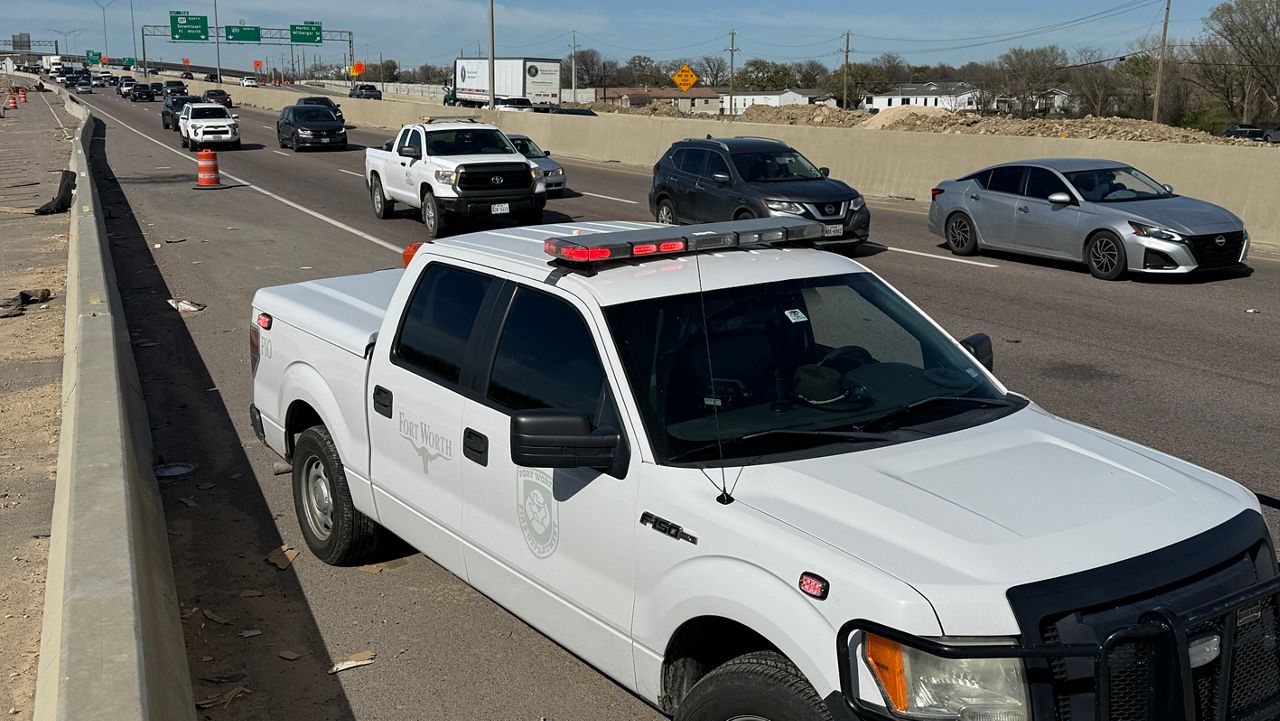
FORT WORTH, Texas — We’ve all been there: suddenly stopped on the highway, stuck in standstill traffic because of a wreck ahead.
It’s frustrating for drivers, but for first responders, it can mean the difference between life and death.
Spectrum News 1 is digging into the challenges causing traffic back-ups from San Antonio to Houston. And in Dallas-Fort Worth, Spectrum News got a front-row seat with first responders — seeing firsthand the traffic hurdles they face while responding to emergencies.
A crash happens in seconds, causing gridlock on Interstate 35 that can stretch for miles. For first responders, every minute stuck navigating blocked lanes puts lives at risk.
EMS Supervisor Cody Riley has to maneuver through lanes with nowhere to go, in a race to help before it’s too late.
“Sometimes you’ll have people do the right thing and you know move over to the right side of the road and sometimes it just gets a little chaotic and people may not know what to do,” said Riley.
As Texas grows, so does the pressure on roads.
When Craig Trojacek joined the Fort Worth Fire Department about 20 years ago, the city was a lot smaller.
“We’re well over a million people now. The 11th largest city in the nation. With that comes a lot of challenges and stuff with the growth, roadways and safety of people on the roads,” Trojacek said.
The growth means more people, more cars and more moments where help can’t get there fast enough. And it’s not just happening in Tarrant County.
To give you some perspective, Spectrum News 1 monitored a crash-prone stretch of Interstate 30 that crosses both Dallas and Rockwall counties.
For 120 hours, every weekday rush hour, morning and night, Spectrum News tracked what drivers and first responders face in real time between Bass Pro Drive and Horizon Road, where the crash rate is above the regional average.
Texas Department of Transportation (TxDOT) records show that in the 30 days Spectrum News 1 monitored this stretch of road, there were 26 crashes; three occurred when construction workers were present, and none of the crashes were fatal.
Spectrum News 1 also captured what first responders tackle before they even arrive, and sometimes it’s not just the driver who needs help.
“There’s been some tragic cases here in Fort Worth very recently that some of the first responders have lost their lives responding to emergencies while they’re out there on the freeway,” said Trojacek.
So, the city is trying something new. Spectrum News 1 got a first look at Fort Worth’s new Blocker Trucks, equipped with a device called the Scorpion.
“Things are almost like a big cushion,” said Trojacek.
They are designed to absorb impact, creating a protective barrier between traffic and first responders.
“It’s designed not only with our protection and stuff in mind, but they’re also engineered to make sure they’re trying to do a crumple zone. So, whoever’s hitting them, we’re thinking of them too. So, it’s supposed to be a softer impact. Then hitting one of our fire trucks. That may weigh 40-80,000 pounds, and it’s that abrupt halt,” said Trojacek.
Fort Worth plans to roll out two more of these trucks in April. That’s encouraging to first responders like Trojacek.
“We’ve had many injuries on this job with people coming through our scenes, hitting our trucks since I’ve been on the job. I think with the growth and some of the construction and stuff that’s kind of more recent here in Fort Worth. There’s been somewhat of an uptick,” said Trojacek.
While it may feel like crashes are happening more often, new data tells a different story. The latest crash report from the North Central Texas Council of Governments reveals a shift. In the Dallas-Fort Worth area, fatal crashes peaked in 2021. Since then, fatal crashes trended down each year. The biggest decrease happened in 2025.
Spectrum News 1 compared this to statewide numbers and discovered the same trend: fatal crashes peaked in 2021 across Texas and reached a five-year low in 2025.
“It does seem like we’re doing something to improve it,” said Natalie Bettger, senior program manager of congestion management and system operation at the North Central Texas Council of Governments.
The challenge now is to understand what’s working.
“We just need to figure out what exactly it is. We take a whole host of programs to try to fight against crashes on our roadways,” said Bettger.
Those programs are things like “Drive Aware North Texas,” which teaches about what causes crashes, and “Look Out Texans,” which is a bike and pedestrian campaign.
“We have we still have programs to implement. And so hopefully we continue to see this reduction,” said Bettger.
The goal of these programs is to keep the roads moving when every second counts as first responders find a way through, no matter the traffic.
“We’ve got moms and dads, brothers and sisters, wives, kids. And we want to get back home, too. And we want to do it safely. And the reason that we’re out there to begin with is because it may be your moms and dads and brothers and sisters that are needing our help out here on these freeways,” said Trojacek.