
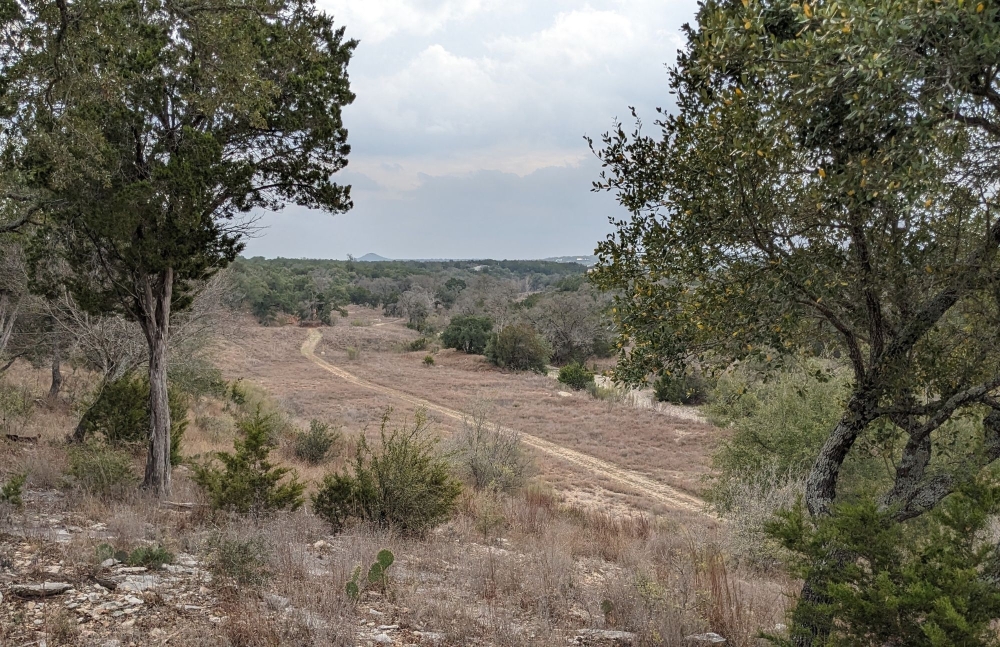
Hays County officials and parks department staff celebrated the opening of Karst Canyon Preserve on March 27. The 175-acre preserve features a stretch of Dry Cypress Creek, the Wimberley Bat Cave and a habitat for the endangered golden-cheeked warbler.
The big picture
Karst Canyon is the biggest addition to the Hays County park system in a decade, said Karl Flocke, Hays County director of parks and natural resources. The preserve is located in the Greater Jacob’s Well Natural Area. Hays County officials and parks department staff cut the ribbon to the Karst Canyon Preserve on March 27. (Michael Milliorn/Community Impact)The Watershed Association purchased the site in 2019, stopping the established plans for high-density development of more than 1,000 residential lots. Hays County purchased the land in 2025 with funding from the Parks and Open Spaces Bond.
The two entities, in partnership with Hays County Master Naturalist volunteers, prepared the land for public access following the purchase. The efforts included:
Trail cutting and clearingInstallation of maps, signage and wayfinding markersConstruction of benchesCompletion of biological and karst surveys“With this conservation, we’re able to protect the sacred springs of Jacob’s Well,” Flocke said. “We’re able to protect the recharge into the aquifer that not only feeds Jacob’s Well, but supports the lives of so many people in this area.”
The preserve’s first phase included 2 miles of trail that connect to the North 40 Trail at Jacob’s Well Natural Area. The second phase will add more than 2 additional miles of trail.
 Karl Flocke, Hays County director of parks and natural resources, led the ribbon-cutting for Karst Canyon Preserve on March 27. (Michael Milliorn/Community Impact)Diving deeper
The preserve features distinctive karst landscaping, shaped by soluble limestone that forms sinkholes, caves and springs. The terrain is essential for recharging the Trinity Aquifer and supporting regional water sustainability, according to Hays County.
“We’re also able to protect the aquifer for drinking water and for the storm flow,” said David Baker, executive director of the Watershed Association. “This area gets almost 30% recharge, where other areas only get maybe 3%, so it’s very significant.”
“>