
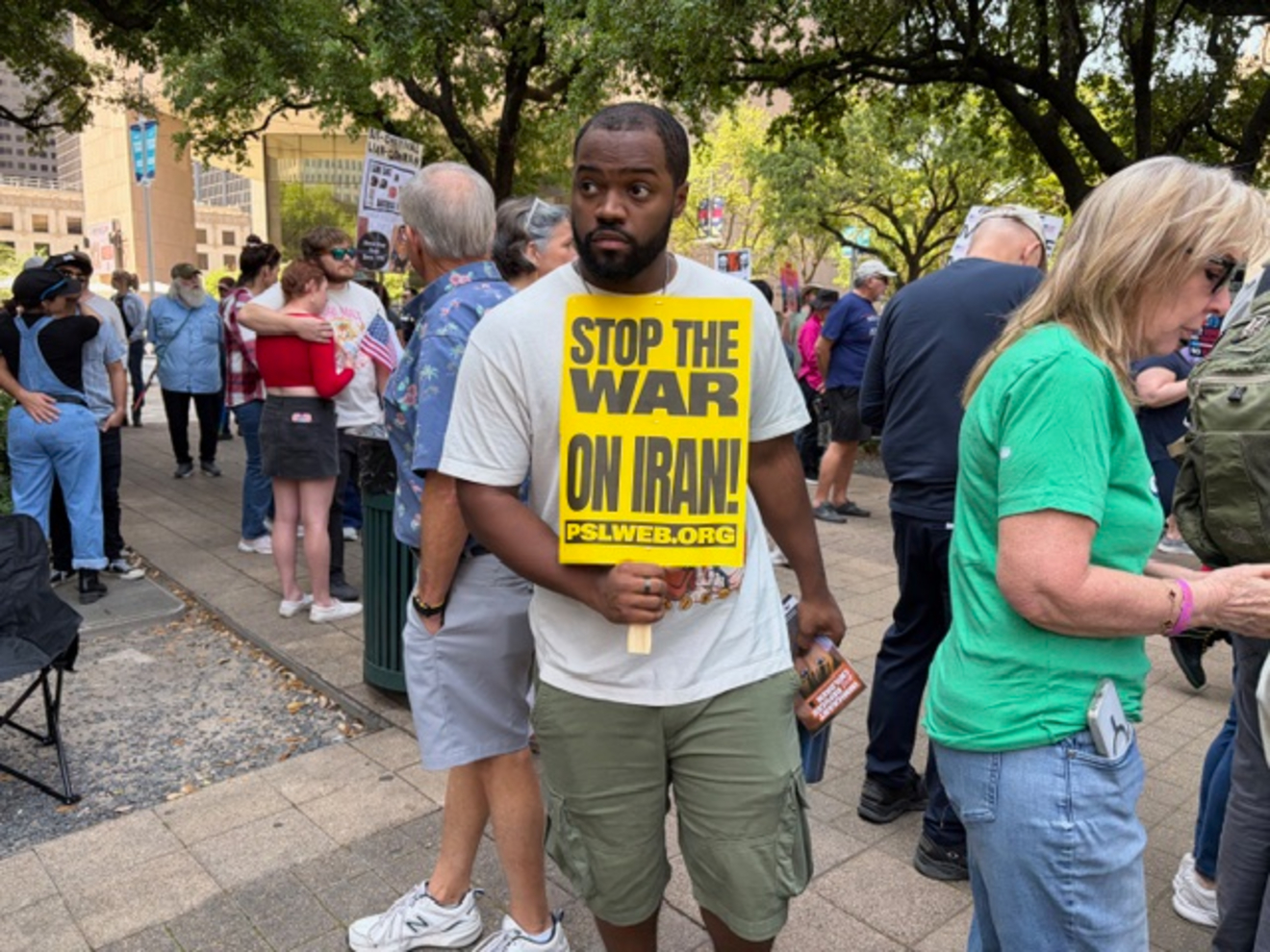
Emily Butler says she doesn’t like spending $50 on gas every few days just to make her morning commute to work, and she’d rather the President of the United States focus his energy on stabilizing the American economy than ordering the invasion of a foreign country.
Butler was among thousands of protesters at a No Kings event at Houston City Hall last week. Most of the attendees were there to show their disapproval of Donald Trump’s immigration policies, but, according to Butler, there are a plethora of things that warrant protesting.
The single mother of two drives 18 miles one way, Monday through Friday, to her job as a paraprofessional at a public school in a Houston suburb. She could find a job closer to home, but she likes the district where she’s employed. She even likes the morning drive, listening to the radio and having time to herself. She doesn’t like that the price of gas went from about $2.50 a gallon in February to $3.50 a gallon in March.
“I have to drive every day,” she said. “There’s no option of carpooling or taking the METRO. It’s only been a month and already I can’t afford it. Why are we spending billions of dollars on a war in Iran when people can’t afford health insurance and working moms have to go to the food bank to feed their kids?”
Fuel prices spiked shortly after President Donald Trump, without Congressional approval, decided to join Israel in launching air strikes into Iran late last month. In response, Iran cut off access to the Strait of Hormuz for its adversaries, limiting access to oil and liquefied natural gas.
Iran officials reportedly rejected a U.S. ceasefire proposal and said it would end the war when it decides to do so and its conditions are met. Those conditions, according to The Guardian, are promises that the fighting and assassination of high-ranking officials will end, a guarantee that no other war will be started against Iran, reparations for the current conflict, and Iranian control over the Strait of Hormuz.
Pakistan Foreign Minister Ishaq Dar said in a televised speech Sunday that his country would host peace talks between the United States and Iran. However, U.S. Marines are already stationed in the Middle East and Iran’s Parliament Speaker dismissed the negotiations as “cover for a ground invasion,” according to Time.
Iran still has missiles, drones, and regional allies so some experts think the war could drag on, possibly for years.
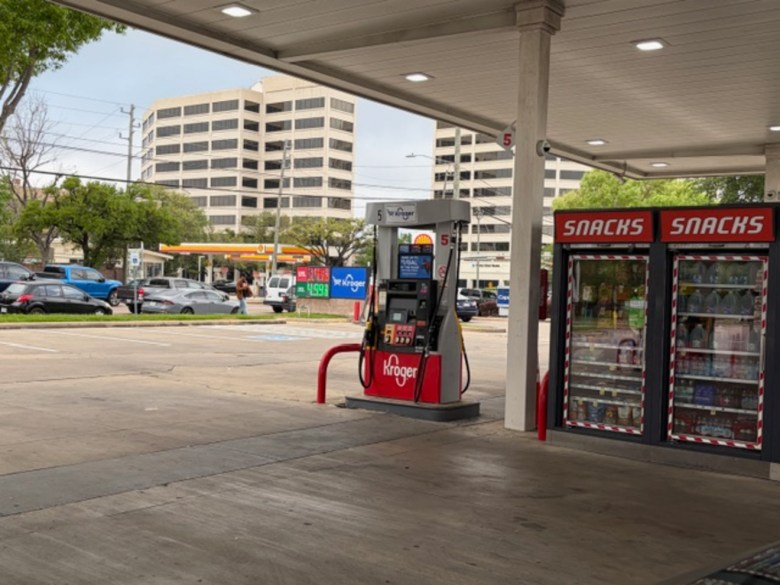 Rising gas prices are keeping some Houstonians off the roads. Credit: Photo by April Towery
In the short term, the limited access to the Strait of Hormuz is a good thing for the Lone Star State’s oil and gas industry. The price of oil has risen to more than $120 a barrel, providing a revenue boost for producers. But it’s not sustainable in the long term. War creates uncertainty, which can delay or complicate major investments. And when gas prices jump, people reduce their drive time, and the auto industry tanks, harming the economy.
Food prices rise because most products are delivered to grocery stores by diesel trucks, said Loren Steffy, an independent business and energy writer who recently appeared on the radio show Houston Matters.
About one-third of the world’s globally traded fertilizer goes through the Strait of Hormuz, so its limited access has hampered food production in an already stressed agricultural industry, according to the United Nations Trade and Development.
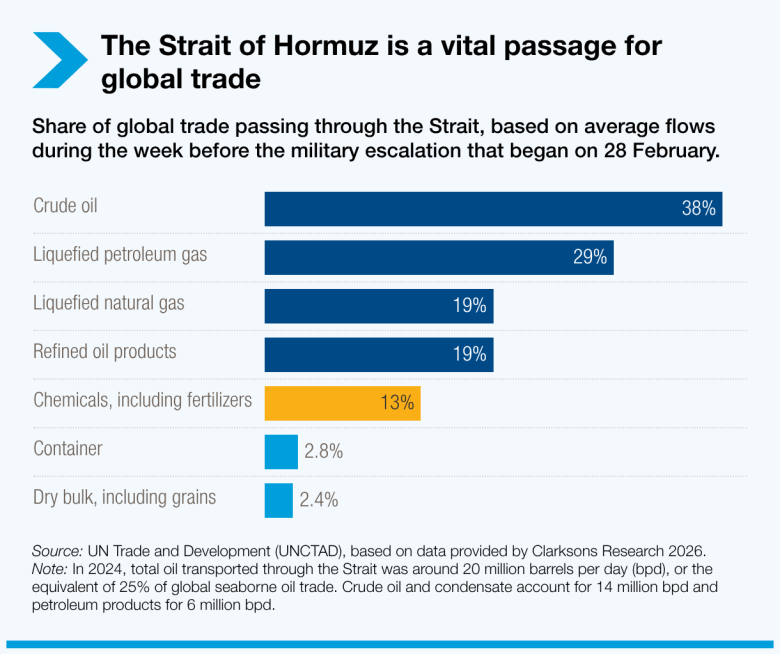 Credit: United Nations Trade and Development
One-fifth of the world’s oil comes through the Strait of Hormuz, and producers in the Middle East are curtailing their production, Steffy said, “because they don’t have any place to go with the oil.”
“In this case, I think the big question is, can we do anything to ease the bottleneck? At least in the short term, there doesn’t seem to be an obvious answer to that,” he said.
The core inflation rate is 2.5 percent as of February, above the Federal Reserve’s 2 percent target. The scenario of high inflation, a struggling economy and an oil crisis is familiar, said University of Houston political science professor Brandon Rottinghaus.
“This happened as the pandemic was starting and it happened after 9/11,” he said. “There have been strong political outcomes that were connected to the rising price of fuel. There are ways that presidents can manage this but the bottom line is that if gas is too expensive at the pump, it’s going to be a problem for the party in power.”
Rottinghaus notes that with some critical, competitive midterm elections coming up in November and affordability at the forefront of much of the political messaging, there’s no question that Republicans are going to have to answer for the choices of the President.
“There’s a strong connection between presidential approval and gas prices,” Rottinghaus said. “If gas prices continue to increase, and the presidential approval continues to decrease, that could be a problem in the midterms. There is a relationship between presidential approval and midterm success, so those things can definitely be connected. I don’t know that the presidential approval ratings can go down much further. They’re already pretty much at the floor.”
Reuters reported last week that Trump’s approval rating was at 36 percent “as fuel prices surge amid the Iran War.”
It’s going to be politically challenging for Republicans to convince people that they’re “doing what they can to fix it when the national narrative is run through Donald Trump, who hasn’t made the issue a priority,” Rottinghaus said.
“The White House wants to get Trump out to stump for affordability issues, and he does, but he also talks about a range of other things that may not be as politically palatable for voters,” he said. “The messaging matters. There’s not a lot of academic work on whether people are willing to suffer for a greater cause. There’s some anecdotal evidence, like the pandemic and 9/11, when prices rose as a result of these external forces which are not necessarily blamed on any one person or party. The Iran situation might be different. The problem the White House faces is that they haven’t explained well the reasons for intervention, and it comes at a moment when people are already sensitive to high prices.”
Trump has been criticized throughout his second term, which began in January 2025, for being out of touch with the working class. Rottinghaus said the factors needed to declare a recession — a slump in the stock market, a skidding of economic growth and cratering in terms of job creation — haven’t happened simultaneously yet.
“Economists would say there are hundreds of indicators that make up a recession, but politically, there doesn’t have to be a technical recession for it to have a major liability for Trump and the Republicans in the midterms,” he said. “Right now they can kind of coast on the successful stock market and reasonable job growth to say this is going fine but not great. There are a lot of people who are still struggling. People are making accommodations based on economic tightening. People are selling plasma to make ends meet. The economy is squeezing people. I suspect it’s more widespread than we think and it’s measured in ways we don’t always see.”
As for Butler, inflation and rising gas prices aren’t life-or-death matters for her and her daughters, but she says she doesn’t understand why the President would get involved in a war that directly harms the American economy.
“We’re not going to starve to death, but we’re buying groceries at Dollar Tree instead of Target,” she says. “We’re not getting new dresses for Easter Sunday. We’re not taking weekend road trips. [Trump] promised us that the economy would thrive under his leadership. He lied.”
Related