
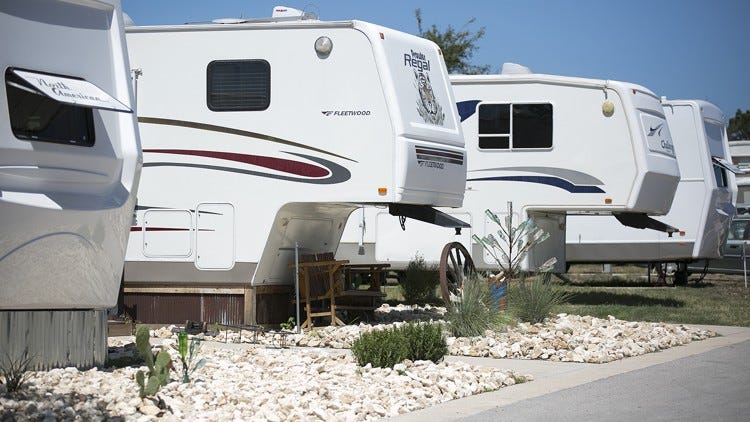
A line of RVs for residents at Community First! Village on Thursday, July 27, 2017. The Downtown Austin Alliance has announced a $2 million grant to Mobile Loaves and Fishes for the community which will be used for an expansion project. DEBORAH CANNON / AMERICAN-STATESMAN
Austin American-Statesman

The average rent in Texas is about $1,441 per month for an 892-square-foot apartment as of March 2026, according to RentCafe. Prices typically range from about $1,109 for a studio to $1,538 for a two-bedroom, though costs vary widely by city.
Article continues below this ad
As the cost of living rises, some Texans are looking for alternative housing options. One possibility: living in a recreational vehicle, or RV.
A January 2026 report from the Texas Real Estate Research Center at Texas A&M University found RV living is gaining traction in major metro areas, including Austin, Dallas, Houston and San Antonio, as housing affordability remains a concern.
The report found home prices statewide rose to about $360,000 in summer 2022, up roughly 34% from about $269,000 in 2020 during the pandemic housing surge.
Living in an RV is one option — but is it legal to live in one on your own property? Here’s what to know.
Article continues below this ad
Is it illegal to live in an RV in Texas?
There is no single statewide law that explicitly allows or bans full-time RV living on private property, according to the Texas Department of Public Safety. Instead, rules are largely set at the local level, meaning city and county ordinances determine what is allowed.
In general, property owners must comply with local zoning, permitting and health regulations, which can vary significantly depending on where they live.
For those traveling full time, Texas has many long-term RV parks and campgrounds with modern amenities. Some state parks allow stays of up to 180 days, while others limit visits to 14 days, so it’s important to check rules before planning a stay.
Article continues below this ad
If an RV — or RV with a trailer — weighs less than 26,000 pounds, it can be driven with a standard Class C driver’s license in Texas. Heavier vehicles require a noncommercial Class A or B license through the Texas Department of Public Safety.
Is it legal to live in an RV on private property in Austin?
In Austin, city code and zoning regulations — not a statewide rule — govern where RVs can be parked or used as a residence.
In many cases, long-term RV living on private property may be restricted or require permits, particularly within city limits. Residents should check with Austin Development Services for current requirements.
Article continues below this ad
Parking rules differ from residency rules. According to RVshare, RVs can generally be parked where not prohibited by signage, and some destinations offer designated RV parking with shuttle access.
What does an RV cost?
The cost of an RV varies widely depending on type, size and whether it’s new or used.
Estimates from industry sources show prices can range from $10,000 to $300,000, depending on the size and amenities.
Article continues below this ad
Typical price ranges include:
Travel trailers (towable, basic): $10,000 – $60,000
Fifth wheels (larger towable): $30,000 – $100,000
Class B camper vans: $80,000 – $150,000
Class C motorhomes: $70,000 – $140,000
Class A motorhomes (luxury): $100,000 – $300,000