
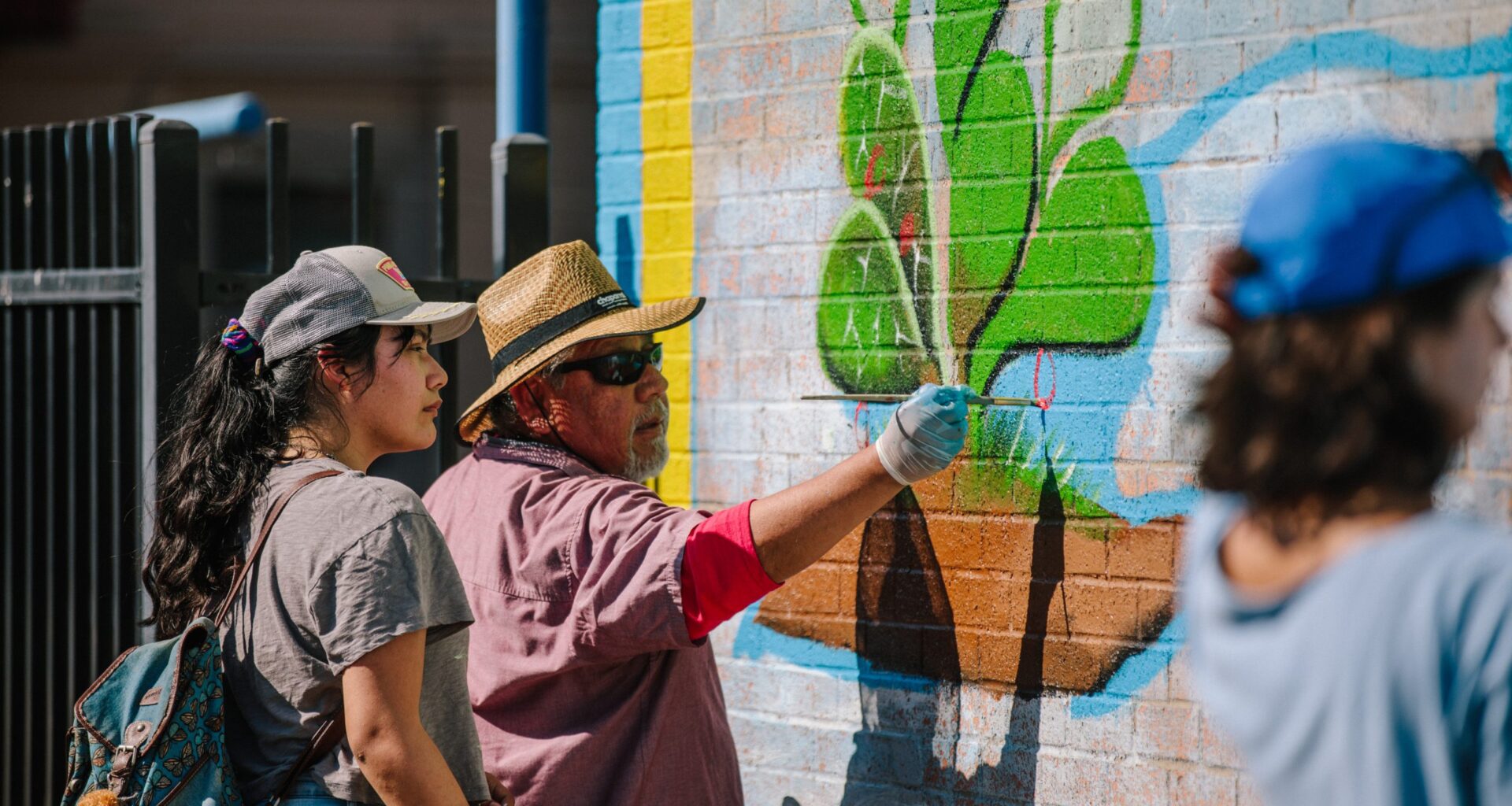
Dominique Zapata arrived early to the Cassiano Homes on the West Side of San Antonio. She pulled her long brown hair into a cap, grabbed a paint brush and got to work.
Following the faded pattern of a nearly 50-year-old mural, she helped paint different shades of blue into water; bright green nopales decorated with star-like thorns and red circles with diffused yellow highlights as its tunas.
The 26-year-old joined a handful of her Our Lady of the Lake University classmates, staff members and faculty on a recent Saturday morning tasked with restoring the Treaty of Guadalupe Hidalgo mural, a treaty signed in 1848 to end the U.S.-Mexico War which ceded Mexican territory, including Texas, to the U.S.
Across Texas, universities are responding to state legislation by reshaping or doing away with cultural studies and diversity initiatives.
“I’m getting to give back to the community that my family is a part of,” Zapata said. “A lot of us students, we live on campus … we’re so focused in our little bubble. So having these opportunities where we can do a community event allows us to kind of reach out and look around us. Pick our heads up a bit.”
Zapata is majoring in art education, and her degree plan requires basic art courses such as Art Appreciation, as well as Mexican American Visual Arts and Global Perspectives in Art History.
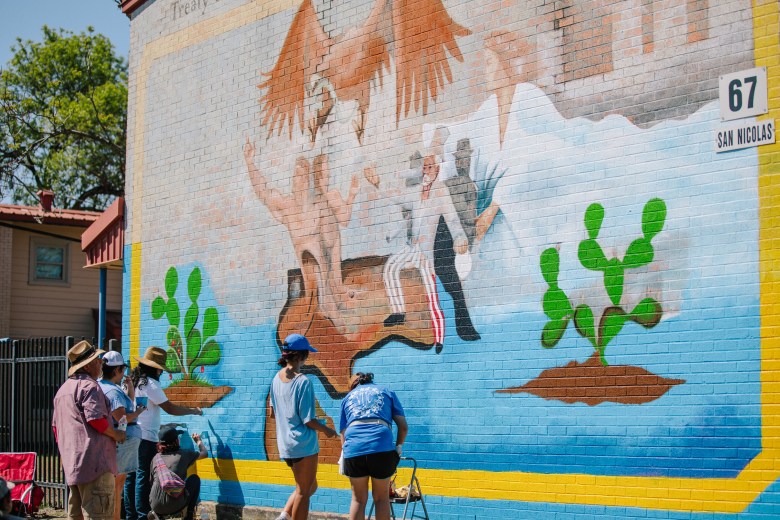 Students and volunteers restore a mural during Community Mural Day held by OLLU’s Arte del Barrio class at the Cassiano Homes, and were joined by the mural’s original artists. Credit: Vincent Reyna for the San Antonio Report
Under Senate Bill 37, which was signed in 2025 but went into effect this year, the governing boards of public colleges and universities were tasked with curriculum oversight. Although the bill’s final version did not include language that limits teachings on race, sex, ethnicity or religious belief, advocates said the added oversight could lead to self-censorship of these topics.
Private, nonprofit universities, such as Our Lady of the Lake University are among the higher education institutions in Texas that have more flexibility to keep cultural education in its curricula.
“At OLLU, we have a really special Visual Arts Program. We center classes like these,” said Suzy Gonzalez, OLLU visiting assistant professor and visual arts program head. “We also have classes like African Art in México, looking at the Afro-Latino perspectives, we have Ancient Art of Mesoamerica.”
Gonzalez teaches the Barrio Arts and Popular Culture class as part of the OLLU’s Visual and New Media Arts Program. She also teaches Mexican-American Visual Arts, all of which are not treated as elective classes for students in visual arts majors, she explained.
“We see lots of street art, muralism, and public artwork inspired by the culture,” Gonzalez said. “We’re kind of focusing on visual art here, but we talk a little bit too about other elements of culture, music, movies, literature, you know, TV, politics.”
Exploring culture
Zapata is now a junior and this semester she is among part of a mostly-female Barrio Art and Popular Culture, a class she landed in by chance, but that has fostered in her a better understanding of the community, she said.
The volunteers were joined and guided by Juan Hernandez, Anastacio “Tache” Torres, Esteban Adame and Alex Rubio, some of the original muralists who painted hundreds of murals on San Antonio’s West Side and the Cassiano Homes back in the late 70s and early 80s.
“It was really fun,” Zapata said. “Juan was very proactive and talked to everybody and just his guidance was very amazing … He was very adaptable, so I was learning [a lot] from him.”
The mural restoration was born out of the university’s commemoration of El Segundo de Febrero, a conference that focuses on the day that the Treaty of Guadalupe Hidalgo was signed in 1848, ending a two-year war between U.S. and Mexico and resulted in Mexico ceding about 55% of its territory, which included Texas.
Our Lady of the Lake faculty, staff and community members formed a committee that began observing the date in 1977. This year they held a five-day conference free to the public where this history was explored.
Among the participants were the Barrio Arts students who took to paper to depict what resilience means to them. They tied El Segundo de Febrero, or Feb. 2, to another widely celebrated holiday in Mexico and Latin America called El Día de la Candelaria, which commemorates the day that the Virgin Mary presented baby Jesus to the church.
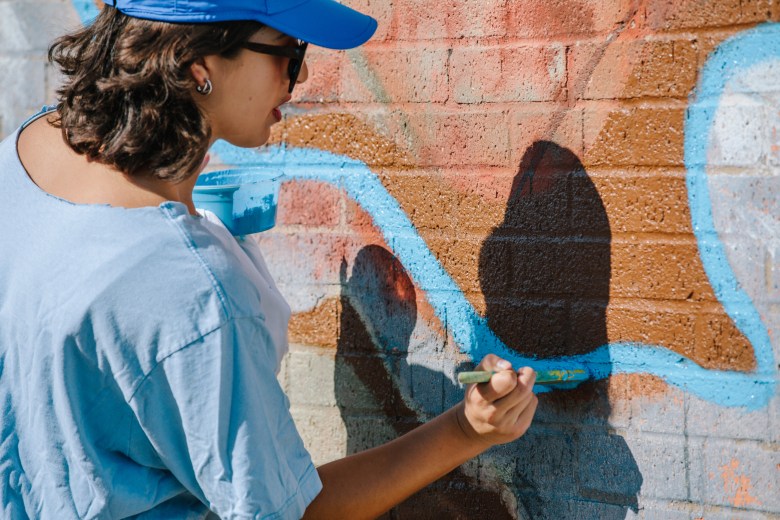 Biology major Bethany Garr outlines the water section of a mural during Community Mural Day, held by OLLU’s Arte del Barrio class, at the Cassiano Homes on March 21, 2026. Credit: Vincent Reyna for the San Antonio Report
“To find out that in Mexico, which is part of my culture, they have this whole other holiday that ends Christmastime later, was very interesting to me,” said Sophie Robles. “I wanted to depict Mary’s resilience by bringing baby Jesus to the temple, escaping the Romans who wanted to kill him.”
In her painting, Robles placed a statue of Mary holding baby Jesus at the end of a bright pink table where the traditional feast of tamales and Rosca de Reyes was served.
“I wanted to reference the ‘three sisters’ of indigenous culture, so I have corn on the cob, calabaza, or squash, refried beans and tamales and Rosca de Reyes,” she said. “It’s the resilience of Mary but also the resilience of Mexican culture.”
Robles is a visual arts major at OLLU and was also among the students who volunteered to help restore the mural, even though she is not an outdoorsy person.
“It’s really important that we help restore historic pieces, especially pieces of art and especially nowadays with AI taking over,” Robles said.
The value of public art
As volunteers revived one of the hundreds of murals painted by Hernandez and his crew back in the late 1970s and early 1980s at the Cassiano Homes, curious community members also began stopping by.
“I remember them painting [the murals],” said Ruben Chavez, a former resident of Cassiano Homes, who said he must have been 10 years old when the murals were painted.
“We were just having fun looking at art, but back then they didn’t really educate you much on this kind of art,” he said. “But like we were around it. We knew the people that helped out and volunteered.”
As they began painting these murals, the artists encouraged volunteerism of young community members, regardless of their experience painting, as a means to take ownership of the art and to keep them away from gang activity and illegal tagging, Hernandez said.
“Our plans were not to start a mural program or a mural movement,” Hernandez told the Barrio Arts class during a recent visit. “Anastacio [Tache], at that time was working with young people that were involved with inhalants. He was trying to get them involved in something positive. So he said, ‘You know what? A mural would be a nice activity for these kids to do together.’”
Torres and Hernandez soon joined forces to paint murals around the neighborhood mainly in locations that had been heavily tagged to cover the graffiti and beautify the community.
Through their first city grant issued in 1979, they began their work at the Cassiano Homes where they took community requests on what they’d like to see on the outside walls of their complex.
Eventually they would lobby for additional funding to keep adding murals that depicted veterans, La Virgen de Guadalupe, Aztec warriors, and more.
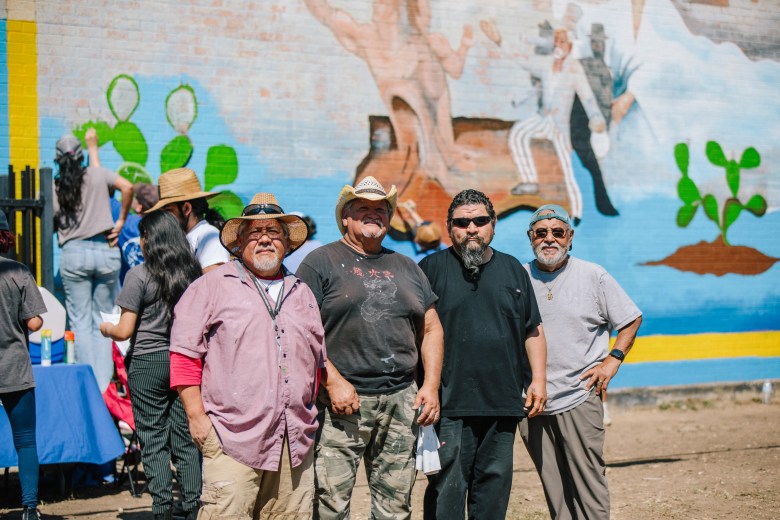 Artists Juan Hernandez, Esteban Adame, Rubio and Tache Torres at a recent mural restoration. They are among a group of artists who painted the mural depicting the Treaty of Guadalupe Hidalgo, as well as others in the late 70s to early 80s on the West Side. Credit: Vincent Reyna for the San Antonio Report
“Once we started receiving funding from the city, part of the responsibility was to make sure that that City Hall knew we were doing things in the community,” Hernandez said. “We would lobby the City Council to make sure that they remember we’re here, ‘This is the youth of Cassiano Homes, this is the youth of Lincoln Courts.’”
The last mural painted at Cassiano Homes went up in 1993 and it depicted a young man that was killed during a drive-by shooting, Hernandez said. The community requested this mural and the team saw it as a good opportunity to remind the youth of the risks and impact of gang activity in their own neighborhood.
Our Lady of the Lake University sits a few miles away from the housing authority managed apartments, and on Saturday the university’s Center for Service Learning and Volunteerism partnered with the visual arts department, Opportunity Home, and City Council District 5 to hold an unveiling ceremony of the restored Treaty mural.
One by one, community members approached the mural, dipped their hands into a bowl of holy water and sprinkled it on the freshly painted wall as a way of blessing it.
“They are getting to be a part of this history,” Gonzalez said. “Public art should be community art… and I hope that my students are witnessing that and understanding, you know, the value of that. The community is a part [of this art], it’s not separate from it.”
The San Antonio Report partners with Open Campus on higher education coverage.