
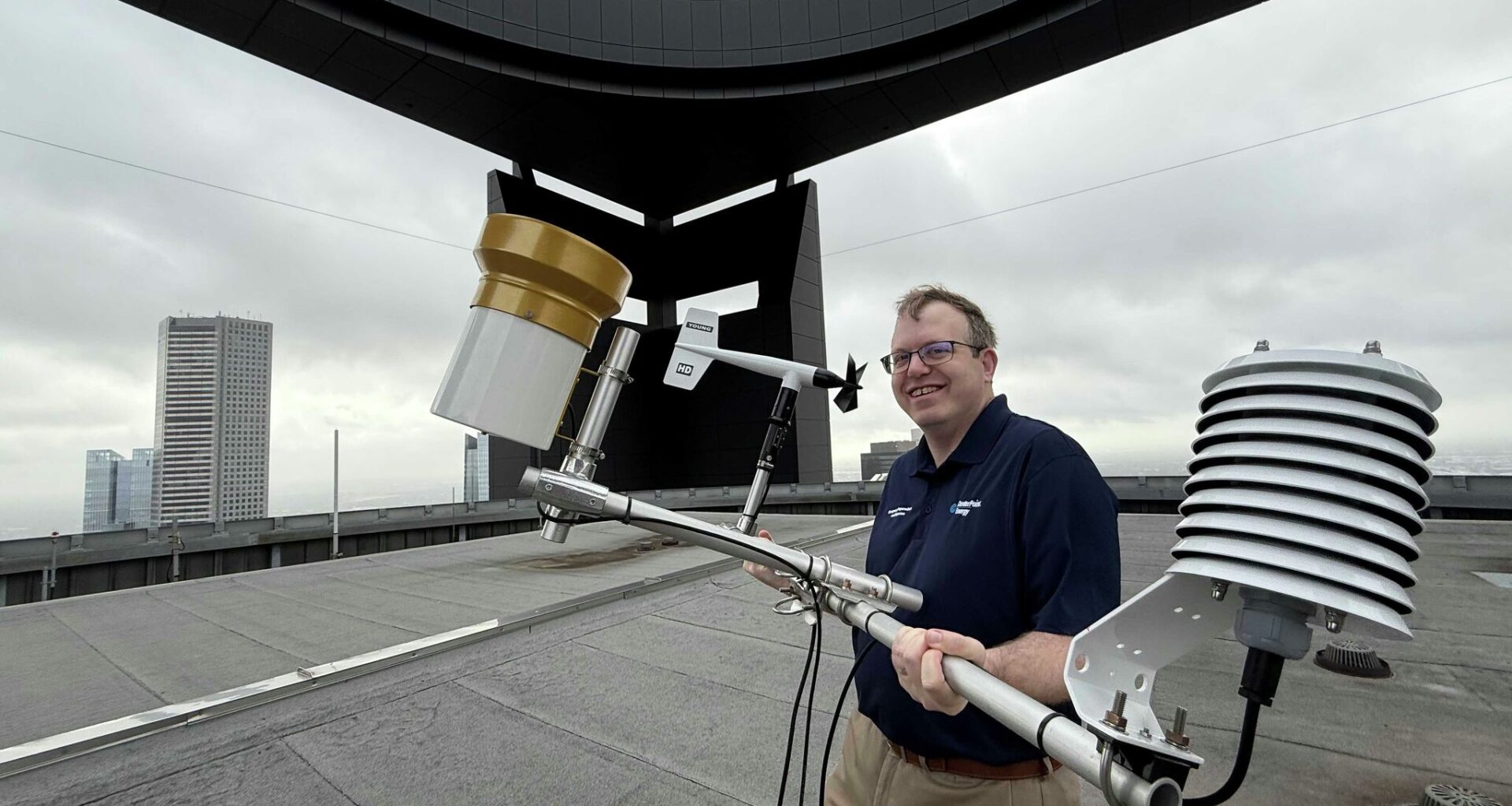
Matt Lanza, seen here holding weather equipment, is leaving Houston after 15 years of weathering storms and informing communities.
Courtesy photo, provided by Matt Lanza
Matt Lanza has spent more than a decade helping Houstonians make sense of storms, floods and extreme heat. Now, as he prepares to leave Texas for Connecticut, the Space City Weather managing editor is reflecting on how the city’s weather — and the role of meteorologists — are changing.
Lanza will continue in his role at Space City Weather and said his move is primarily driven by family. But his time in Houston — from Hurricane Harvey to increasingly intense heat — has shaped how he views the city’s future.
HURRICANE NAMES: These are the hurricane names for the 2026 season and why ‘Melissa’ is retired from it
Article continues below this ad
In a conversation with the Houston Chronicle, Lanza discussed how forecasting has changed, why trust matters now more than ever and what gives him hope for Houston’s climate resilience. This interview has been edited for length and clarity.
Q: After more than a decade in Houston, why make the move now?
A: It’s mostly family. My parents are back east, and it’s gotten harder to see them — some of that is travel challenges, some of that is just where they are physically in life. When you have kids, that weighs on you a little more.
But I’d be lying if I said Houston weather hasn’t factored into it at all. The first five or six years we were here, we were generally fine. We had the Memorial Day flood, the Tax Day flood — and then Harvey happened and it was like, OK, this is different.
Article continues below this ad
Then there are summers like 2023. That was just miserable. I think those kinds of summers are going to become more common, and personally, that’s tough to deal with.
Q: How did Hurricane Harvey change how you view your role as a meteorologist?
A: It really made me realize that this job is bigger than forecasting.
It’s beyond just a weather forecasting job. It’s really about comforting people and shepherding them through an event that, for some, is going to change their lives.
During Harvey, you’re watching it unfold, and then you start hearing from people: “I’m on my roof,” or from people you know whose homes flooded. That sticks with you. You feel a responsibility to help however you can.
Article continues below this ad
Q: Has forecasting become more difficult in the current media environment?
A: Everything is a threat now. Every little seedling becomes the biggest thing in the world, and you just constantly have to calm people down.
HOUSTON WEATHER: Sign up for texts to get forecasts and extreme weather alerts on your phone
There’s less downtime, especially during hurricane season. You’re not just dealing with real threats, you’re also managing expectations and trying to prevent panic over things that aren’t actually threats. That wears on you.
Q: Space City Weather has built a loyal following in Houston. Why does that approach work?
Article continues below this ad
A: Our philosophy has always been: let’s keep it boring until we have to make it not boring.
We don’t answer to anyone but ourselves, so we can take that approach. And I think people trust it.
During Harvey, some readers told us they could tell from the language we were using that this was different. They moved things upstairs, and it saved their belongings. That kind of feedback sticks with you.
Q: Many people only see meteorologists on TV. How is the role changing beyond traditional media?
A: It’s expanding a lot.
Article continues below this ad
In the utility industry, for example, companies want meteorologists in-house now. It’s not just about getting a forecast from a service, it’s about understanding risk specific to your operations.
You need to know not just what’s going to happen, but how bad it could realistically get, and how to prepare for that.
And it’s not just utilities. You’ve got companies like Walmart and Amazon hiring meteorologists. Hospitals and even retail brands are looking at climate risk.
There’s a lot more demand now because the stakes are higher.
Q: What should Houston be doing differently to prepare for future weather risks?
A: We’ve made progress since Harvey, especially with flood control projects. But the big challenge going forward is regional coordination.
Houston isn’t just Houston. It’s Harris County, Fort Bend County, Montgomery County — all these areas that are connected. A development in Montgomery County can impact flooding in Harris County. Borders are lines on a map. They’re not physical barriers.
We all need to be working together on that.
Q: What about at the individual level — what should residents understand better?
A: I think we need to be more upfront about what living in Houston means.
You move here and you don’t get much information. We should have something like a welcome packet: here’s your watershed, here are the bayous to watch, here’s why streets flood — because they’re part of the drainage system.
People are surprised when they learn that, but once you see the rain here, it makes sense.
Houston floods. That’s reality. The goal is to help people understand it and live with it safely.
Q: What gives you hope about the future of forecasting and resilience?
A: The technology is getting better.
Our models are improving, and AI is starting to show real promise, especially in specific areas like hurricane forecasting. We’re going to see more niche tools to better predict localized flooding and severe weather.
At some point, we’re going to have models that can say, “This area is getting 10 inches of rain,” and be pretty accurate about it.
That kind of precision would make a huge difference in Houston.
Q: How will your role at Space City Weather change after the move?
A: It’ll be pretty similar. I’ll still be filling in and doing Friday forecasts.
Honestly, being an hour ahead might help during big events — you can get information out a little earlier and maybe let Eric get some sleep.
Q: On a lighter note, you don’t hide your love for H-E-B — what will you miss most about them?
A: The cocoa granola. Not the triple chocolate — the cocoa granola. It’s so good.
A caricature of Matt Lanza on a box of H-E-B cocoa granola — one of the Houston meteorologist’s favorite staples.
Courtesy / Matt Lanza
I always joke that it’s part of my hurricane kit. You’ve got your essentials, and then you’ve got that.
Q: Finally, as a long-time resident of Houston, which Beyoncé album best represents this next chapter?
A: We’ll go with “Renaissance.”
I’m firmly a mid-career professional at this point. We’re going to a new place, and we’ll have our renaissance.
And there’s a song called “Energy,” which fits what I do — so it works perfectly.