
The Garvin Cemetery has been a state landmark since 1980, and a Dallas landmark since 2007.
Robert Wilonsky/Staff writer
Do not, under any circumstances, think that just because something has been designated as an official Dallas landmark that it means anything. Because it doesn’t. Not now. If it ever did.
To the too-long, sordidly shameful list of historic buildings, sites and districts this city has let languish, either willfully or because there’s nobody left at City Hall who knows anything about anything, an old favorite now rises to the top. Or it sinks to the bottom. I guess it all depends upon your perspective as you walk the shredded, toppled, nicked and pulverized remains of the 151-year-old Garvin Memorial Cemetery tucked away on Northwest Highway near Bachman Lake, between newly built townhouse “communities” and longstanding zero-lot-line neighborhoods.
Article continues below this ad
“It’s upsetting,” said Tim Thobe, who lives next door to the cemetery filled with early Dallas settlers and the Confederate dead. He and his husband, Wade Hyde, have served as the cemetery’s unofficial historians and caretakers in recent years, as developers keep buying and selling a burial ground upon which they’ve always hoped to build because, apparently, they think Poltergeist is a feel-good movie.
Early the morning of March 21, Thobe and his husband woke to the sound of a Bobcat chewing up everything in its path, trees and headstones alike. Another owner, another developer — the latest, native Southern Californians who hired someone to clear-cut the land for townhomes.
“It’s disrespectful,” Thobe said. He’s angry. But he’s also being kind.
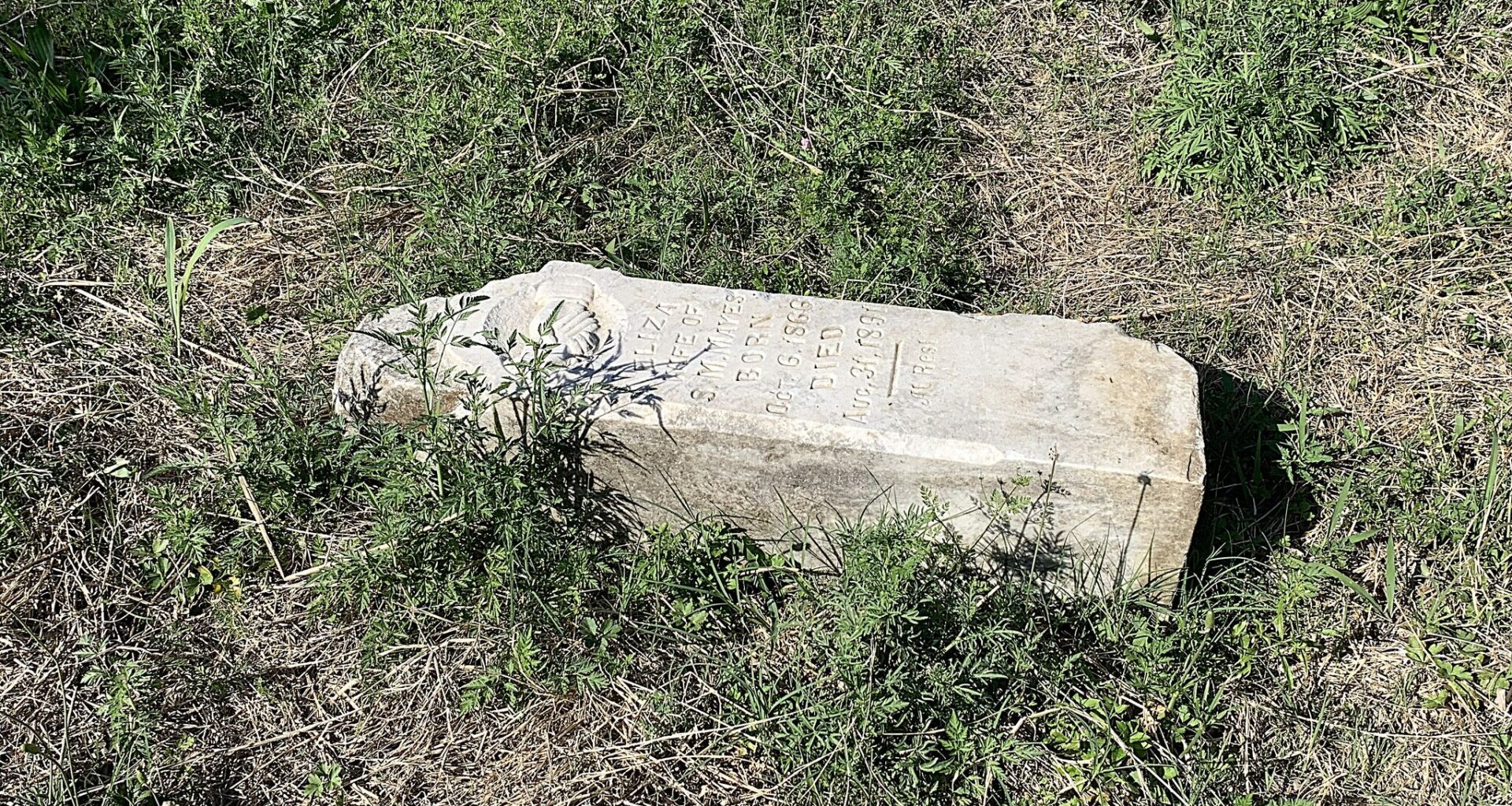
Preservationists believe this tombstone was among the pieces of the Garvin Cemetery demolished by the clear-cutting that took place early the morning of March 21.
Robert Wilonsky/Staff writer
I walked through the cemetery Sunday afternoon, my first visit in nearly a decade. In recent years it was a well-tended necropolis, its caretakers Boy Scouts and kids from the Texas Youth Commission who saw that these graves were kept clean. Now, save for a small square of 1870s graves overgrown with weeds — referred to as Tract A — it’s a wasteland adorned with toppled tombstones and countless others buried beneath recently shredded trees. Other headstones have had their dates shorn off by reckless blades; one now lies in small pieces, torn apart from a base planted shortly after the end of the Civil War.
Article continues below this ad
James Garvin, the Confederate States of America veteran and Dallas grocer who bought this land for $75, buried his first wife, Catherine, here in 1875. He wrote in the deed that the cemetery shall serve as a “resting place for the dead.” He said, too, that it should remain “a place of sepulture for the people … forever.” And yet, time and again, developers keep coming to disturb the dead and lay waste to their resting place.
Make Dallas News a preferred source so your search results prioritize writing by actual people, not AI.
Add Preferred Source
Now, in addition to a historical marker, there’s a rezoning sign that never should have been allowed and an orange code violation placard that doesn’t address the Bobcat and the damage done.
Article continues below this ad
Here, too, it would seem, is where the city comes to bury its head.
“It’s absolutely stunning to have a developer purchase a cemetery for redevelopment,” said Sarah Crane, executive director of Preservation Dallas, who visited the cemetery last week. “But what really ticks me off is the damage that has been done, which is absolutely disrespectful to Dallas history and the people interred there. I was shocked to see that disregard.”
The Garvin Memorial Cemetery, between Marsh Lane and Midway Road, rests upon a small plot that’s easy to spot: A giant “FOR SALE” billboard has been planted here for years — nearly two decades — close to the brown sign with the white arrow indicating there’s a historical marker planted here. Last I wrote about it was in October 2017, when a Houston developer bought the land and tried to do what home-builder Andrew Strange is hoping to do today.
To the numerous signs clogging up the entrance to the Garvin Cemetery, add these additional ones courtesy of Dallas City Hall.
Robert Wilonsky/Staff writer
In 1980, the Texas Historical Commission planted a marker here, which reads, in part: “This burial ground served the pioneer families who settled in the area. Graves here date from the 1870s.” Twenty-seven years later, the Dallas City Council added it to the list of official Dallas landmarks.
Article continues below this ad
Which has meant little to the litany of developers who keep trying to build townhomes atop the long-dead, which include Garvin along with three of his wives and their children; Pleasant Green Swor, a captain in the Confederate States’ 5th Tennessee Infantry Regiment, and his kinfolk; and a 5-year-old boy named Clint Sparkman, who died on Jan. 1, 1890, when he fell into an iron kettle filled with boiling water near a hog slaughtering pen.
It’s long been unclear how many people are buried here: Find a Grave lists 91 memorials, but numerous graves long ago had their headstones destroyed or stolen. A 2007 archeological dig located a dozen previously unidentified corpses, but city restrictions forced researchers to limit the scope of their excavations.
Most of this long-ago farmland was once owned by John Cochran — a Civil War veteran who became a Dallas County tax assessor, speaker of the Texas House and historian. It hasn’t only been a place to bury the Confederate dead but also the formerly enslaved. Only God knows how many are buried beneath this land.
In her invaluable book Dallas County History From the Ground Up, the late Frances James chronicled numerous desecrations and court battles involving the Garvin Memorial Cemetery. She wrote that “developers have even tried to take over the site and get their plans approved by the City of Dallas for a gated community.”
Article continues below this ad
There used to be a sign along Northwest Highway indicating the location of the Garvin Memorial Cemetery. That sign was long ago replaced by the “FOR SALE” billboard marking the gravesite.
Dallas Central Appraisal District records show the land has been owned since 2024 by ST Association, its address a San Clemente, Calif., strip mall anchored by a Ralph’s grocery store. According to Dallas County deed records, Strange bought the land two years ago for some $700,000, far less than the $1.2 million Harvard Companies Inc. began asking for it in 2016.
At some point Strange asked the city for a zoning change, which resulted in the proposed rezoning sign along Northwest Highway. Strange hasn’t returned messages, but Thobe said he saw him the morning of March 21 and that the developer told him he initially hoped to build four single-family homes before settling on townhomes.
I still can’t figure out how Strange got the city to consider a zoning case, given that the small wedge is covered by a historic overlay.
Article continues below this ad
“We actually spent a lot of time putting those protections in place,” said Victoria Clow, who helped Frances James prepare the designation documents. “Only to have them unilaterally decimated by a developer.”
Rhonda Dunn, who heads the city’s Office of Historic Preservation, told Thobe and others via email the night of March 22 that she didn’t know about any of this until Thobe reached out. Dunn, who said she can’t talk to me because it’s against the city’s policy, wrote in that email that she “explained to the developers and their representatives that Landmark Commission approval and a Certificate of Appropriateness is required prior to any ground disturbance.”
It’s not clear when she reached out or to whom. Which, considering the way this city operates, makes sense.
A toppled headstone at the Garvin Cemetery, better than a missing or destroyed headstone
Robert Wilonsky/Staff writer
Dunn also wrote that “by state law an 18 ft. access easement is required extending from W NW Hwy to Tract A of the cemetery which must be recorded on a plat filed with the Dallas County Clerk’s Office.” There used to be a pathway from the street to the cemetery, which has been all but erased.
Article continues below this ad
By signing up, you agree to our Terms Of Use and acknowledge that your information will be used as described in our Privacy Policy.
Since she won’t talk on the phone, on Monday I emailed Dunn to see how this happened — and to find out what happens next, as the ordinance designating this land as historic allows for fines of up to $2,000 for violations. I’ve also asked the city attorney and a city spokesperson. So far, nothing.
Maybe everyone’s already moved out of City Hall and just didn’t tell us. That would track. Or maybe, like anyone who tries to destroy this city’s history, who tries to build atop a cemetery, we’re all just cursed.