
When Artemis II lifts off on Wednesday, humans will once again circle the moon, over 50 years after Apollo 17, the last crewed lunar mission. In North Texas, a different kind of space explorer has already made the journey — and taken root.
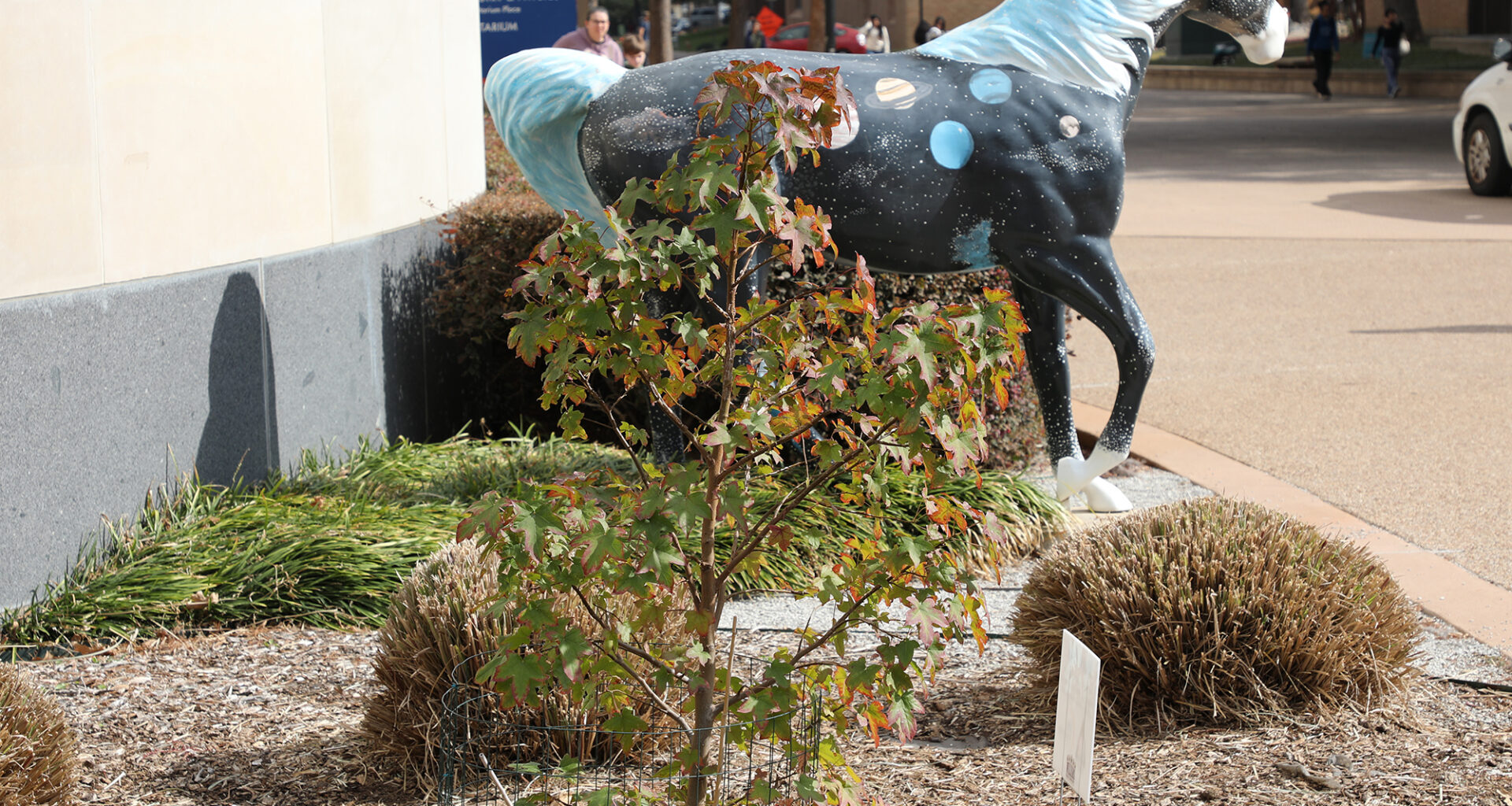
This explorer is a sweetgum tree, just over four feet tall, with bright green, star-shaped leaves. It began as a seed that traveled about 270,000 miles from Earth during the 2022 Artemis I mission aboard the Orion spacecraft. In 2024, when it was still a sapling, it was planted outside the planetarium at the University of Texas at Arlington.
The tree is part of the Artemis Moon Trees project, a collaboration between the National Aeronautics and Space Administration and the United States Forest Service to understand how plants fare under the stresses of deep space travel, said McKenna Dowd, UT Arlington’s planetarium coordinator.
The experiment builds on a legacy dating back to the 1971 Apollo 14 mission, when astronaut Stuart Roosa carried several hundred tree seeds in a metal canister about the size of a soda can aboard the spacecraft. The effort was partly a publicity stunt, but it also aimed at understanding how the seeds would grow after exposure to zero gravity and radiation in space.
In the years after Apollo 14’s return, the seeds were planted around the world, growing into “moon trees” of five different species: loblolly pine, sycamore, sweetgum, redwood and Douglas fir.
The next generation of moon trees came from the Artemis I mission, an uncrewed mission in 2022 that tested NASA’s Space Launch System rocket and Orion spacecraft capsule, designed to carry astronauts. The seeds traveled much deeper into space than their predecessors and were from the same five species that Roosa brought along. They traveled thousands of miles beyond the moon and spent about four weeks in space before returning to Earth.
After the Orion splashed down, the United States Department of Agriculture took the seeds and germinated them, Dowd said. “The second I heard that they were attempting to do the same thing they did with the Apollo missions and grow the trees, I thought, I will have to do everything I can to make sure UTA gets one.”
In 2023, Dowd applied to NASA to receive a moon tree. A sapling just over a foot tall arrived April 8, 2024 — the day of the total solar eclipse — in a cardboard box. The university was one of 236 locations selected to receive a tree grown at the USDA’s Forest Service.
UTA’s sweetgum, a species native to Texas, has adapted well to its spot outside the planetarium, Dowd said. It has endured North Texas freezes and is given frequent care.
Dowd said preliminary findings from a yet-to-be-published study show little difference between seeds grown on Earth and those sent into space, with both germinating at similar rates. The results suggest space travel did not significantly affect the seeds’ ability to sprout.
Beyond the science, Dowd said what stands out most is how the tree serves as a tangible connection to space.
“It’s not just a tree,” Dowd said. “It’s a living artifact of space exploration. It’s a true testament to the resiliency of living things.”